Dutch Aquascape
The art of the Dutch aquascape: Mastering \"underwater flower gardens\" through plant diversity, \"streets\" for depth, and high-frequency trimming techniques.

The Dutch Aquascape Style
The Dutch Aquascape is the oldest of the popular aquascaping styles, dating back to the 1930s in the Netherlands. It is often described as a "flower garden underwater." Unlike Nature or Iwagumi styles, hardscape (rocks and wood) is often absent or completely hidden by plants.
History & Philosophy
The Dutch Society for Aquarists (NBAT) established strict guidelines for this style, which are still followed in competitions today. The focus is entirely on the cultivation and arrangement of aquatic plants.
The goal is to create a heavy covering of plants with diverse leaf shapes, sizes, and colors. The arrangement is not intended to look "natural" in a wild sense, but rather "cultivated" and aesthetically pleasing through contrast and depth.
Key Design Principles
1. The Rule of Thirds
The tank is typically divided into three sections. Focal points (usually a red plant or a large, unique species) are placed at the 1/3 and 2/3 marks.
2. Contrast and Texture
Plants are grouped by species. You should avoid placing two plants with similar leaf shapes or colors next to each other. The contrast between fine-leaved green plants and broad-leaved red plants creates visual separation.
3. Terracing and Streets
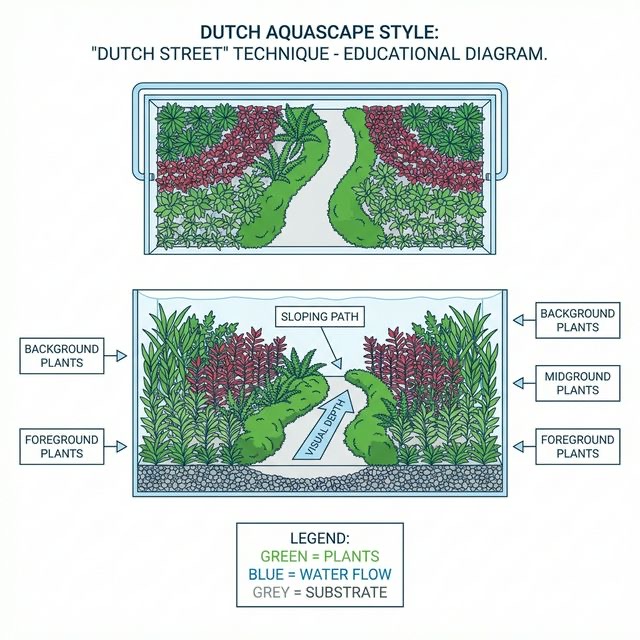
- Terracing: Creating height differences by planting taller species in the back and shorter ones in the front.
- Dutch Streets: A technique where a group of plants is planted at an angle, starting low in the front and rising towards the back. This creates a powerful sense of depth and perspective.
4. Limited Species per Tank width
A classic rule suggests using no more than one plant species for every 10cm of tank length to avoid a cluttered look.
Hardscape Materials
- None: Ideally, no rocks or wood should be visible. If used, they act solely as supports for mosses or ferns.
Typical Flora and Fauna
Fauna
Fish are secondary and chosen to complement the plants. Shoaling fish that swim in the upper and middle levels are preferred.
- Congo Tetras
- Emperor Tetras
- Angelfish (in larger tanks)
Flora
A wide variety of stem plants is essential.
- Lobelia cardinalis (for streets)
- Alternanthera reineckii (for red contrast)
- Limnophila aromatica
- Rotala species
- Bacopa caroliniana
Maintenance
The Dutch style is high-maintenance.
- Trimming: Frequent pruning is required to keep the "hedges" neat and defined.
- Nutrients: High demand for fertilizers and CO2 to maintain vibrant colors and dense growth.