Scarlet Hawkfish
The Scarlet Hawkfish (Neocirrhites armatus), or flame hawkfish, is a brilliant red Pacific reef fish — hardy and coral-perching, but a predator of small invertebrates.
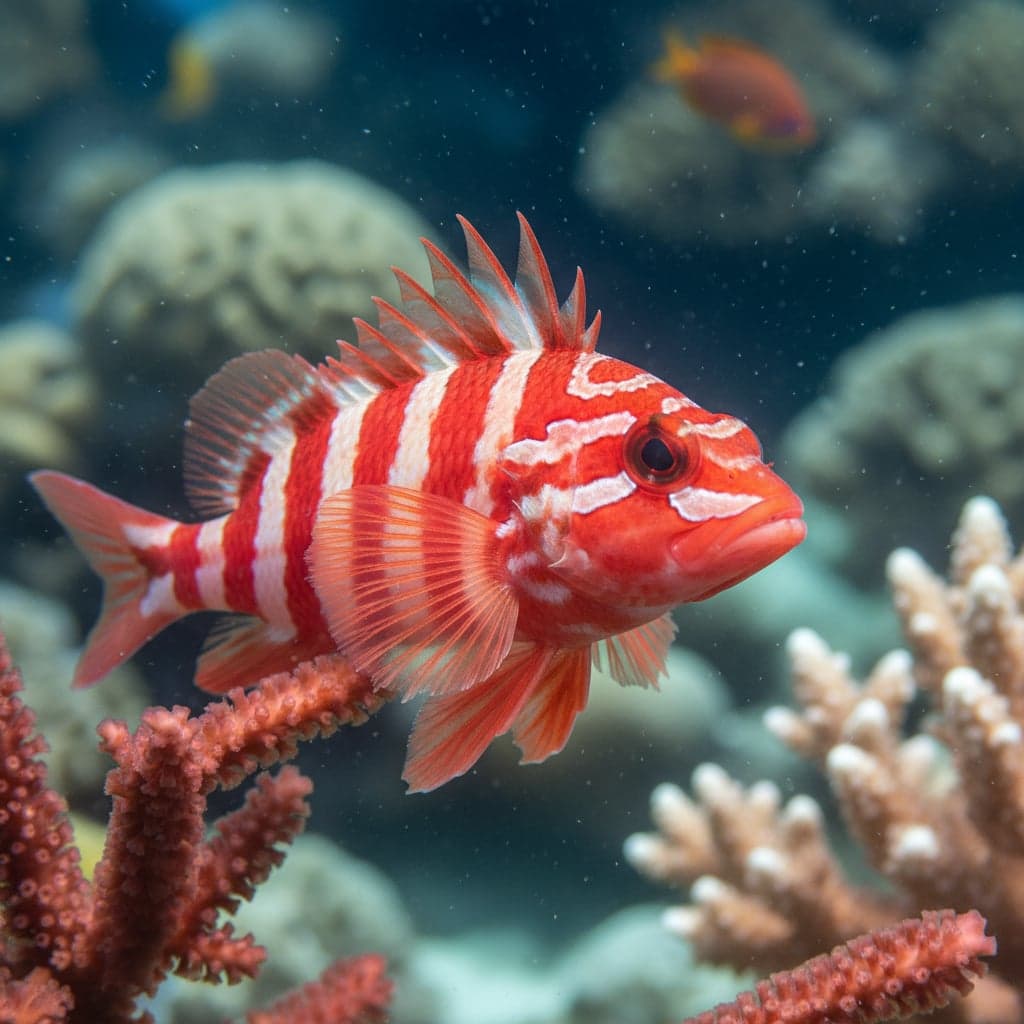
Scarlet Hawkfish
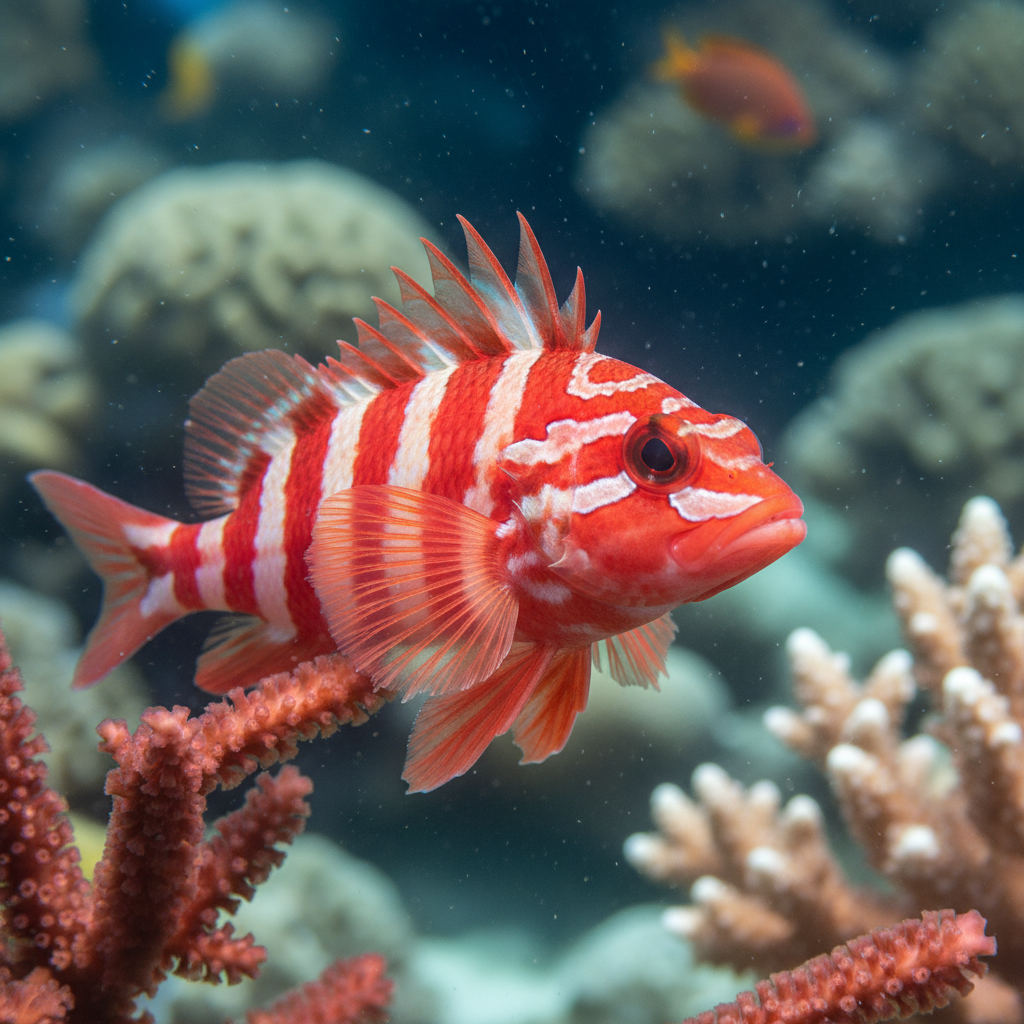
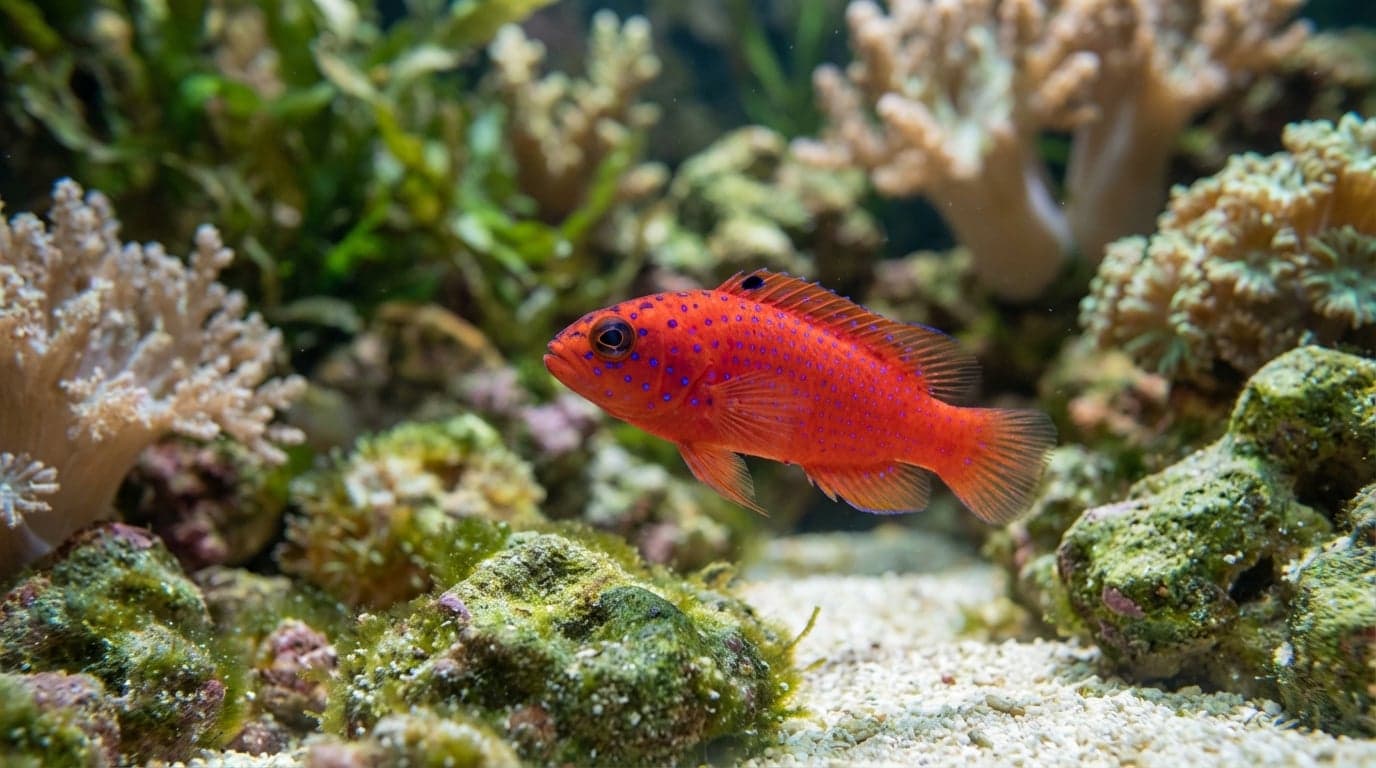
The Scarlet Hawkfish (Neocirrhites armatus), better known as the flame hawkfish, is an intense fiery-red Pacific reef fish with a black-bordered dorsal and a dark mask around the eyes. Like other hawkfish it has no swim bladder; thickened pectoral rays work as props, so it perches on coral and rock, eyes independent, waiting. Hardy, characterful and vividly coloured, it is an easy marine fish on chemistry and a dishonest one if you expected it to ignore shrimp.
The perching habit is the whole show. The appetite for small crustaceans is the whole constraint. Coral-safe is not invertebrate-safe — that distinction is the species in one line. A flame hawkfish on a Pocillopora head looks like reef jewellery until the cleaning crew vanishes one dart at a time.
Natural Habitat & Origin
Neocirrhites armatus lives across the tropical Pacific, perching among branching corals such as Pocillopora and Stylophora and darting out for small invertebrates and zooplankton. It stays close to a chosen lookout rather than roaming like a tang. That niche — ambush perch plus short strike — is what you must rebuild in glass.
In the aquarium provide live rock with ledges, branching coral or coral-like structure, and clear sightlines. A flat sand bed with one cave leaves a hawkfish without a proper perch: it either hides, jumps, or monopolises the only high point and harasses everything that passes. Branching heads are not decoration here; they are furniture the fish was built to use.
Care Requirements
Stable marine conditions: salinity around 1.024–1.026, pH 8.1–8.4, temperature about 24–26°C (75–79°F). Adults reach roughly 9 cm (about 3.5 inches). Around 75 litres (20 US gallons) works for a single fish with serious rock and perch structure; the need is footprint and lookouts more than pelagic swimming length. Larger is kinder once you add assertive tankmates. Shop fish are often sold small — plan for the adult, not the cup size.
A secure lid is not optional. Hawkfish jump when startled, when chasing prey near the surface, or at night. Mesh covers beat open-top “reef aesthetics” for this family. Leave no gap at overflows or cable cut-outs; a 9 cm fish only needs one mistake. Quarantine new arrivals anyway — hardy does not mean pathogen-free. Marine ich (Cryptocaryon irritans) and velvet (Amyloodinium ocellatum) ride in with wild Pacific fish as readily as with Caribbean stock. Treat in QT, not on the display; see medications.
Rock layout should give at least two or three elevated perches with different sightlines so the fish can rotate lookouts without owning the only high point in the tank. That small design detail cuts harassment of tankmates that share the same ledge. Because there is no swim bladder, the fish is a poor continuous swimmer — do not expect open-water schooling behaviour or judge health by “activity level” the way you would a wrasse. Perch-and-watch is normal; frantic glass swimming is not.
Track salinity and temperature in the Aquarium Tracker so small systems do not silently drift while the hawkfish still looks fine on its perch.
Diet & Feeding
Strict carnivore in practice. Wild diet is small crustaceans and other invertebrates taken in ambush. In captivity it usually converts fast: frozen mysis, enriched brine shrimp, finely chopped seafood and quality marine pellets or frozen preparations. Feed once or twice a day. Watch the perch-and-pounce — offering food into light current so it can dash out is both enrichment and a health check.
A hawkfish that ignores prepared food for days after import may still be locked onto live prey memory; keep offering frozen in QT until it eats before you declare it display-ready. Enrich frozen foods with a marine vitamin soak if the fish arrived thin. Do not “train” it on your expensive cleaner shrimp — once that association forms, the reef cleaning crew is finished. Body shape tells the truth: a sunken belly behind the pectorals is a feeding problem, not a lean perching look.
Between meals the fish will still hunt anything that fits in the mouth. That is why invertebrate compatibility fails even when prepared foods are accepted enthusiastically — hunger is only one driver; opportunity is the other.
Behavior & Temperament
Semi-aggressive in the hawkfish sense: generally peaceful toward similar-sized fish, bold toward anything that fits in the mouth or that crowds the favourite perch. Keep one per tank in normal home systems; two hawkfish mean a dominance fight over the best coral head. Added last among similarly sized fish often works better than first, so established residents already hold territories.
It spends the day perched, often among branching coral, then darting out to feed. Toward timid nano fish it can be a bully without ever “attacking” in the dramatic sense — repeated charges off the perch are enough. Toward large tangs and robust wrasses it is usually irrelevant background colour. The lack of a swim bladder shapes temperament: this is a sit-and-strike predator, not a chase-all-day trigger.
Tank Mates
Pair it with robust tankmates of similar size — hardy wrasses, tangs in large enough systems, clownfish, dottybacks that can hold their own, and similar — rather than tiny, timid fish it might intimidate or eat. Avoid packing ornamental shrimp, small crabs and micro-inverts into the same display if those animals are the point of the reef.
It is coral-safe because it does not graze polyps; the hunting style targets mobile prey, and the perch habit even benefits from healthy branching coral structure. It is not invertebrate-safe: ornamental shrimp, small crabs and other small mobile invertebrates are prey. Keep it in reefs without prized small inverts, or accept losses. A poor choice for a shrimp-focused nano or a carefully built cleaner-crew reef; an excellent choice for a fish-and-coral reef that wants a vivid red sentry on the Pocillopora.
Breeding
Neocirrhites armatus is a protogynous hermaphrodite and pelagic spawner. It has been bred by dedicated hobbyists, though rearing the larvae is demanding. Most trade specimens are wild-collected. Home spawning is not a realistic goal for typical community reefs — treat pairs as a specialist project, not a side-effect of buying two red fish.
Common Health Issues
Hardy once eating and perched, but still a wild marine import. Ich and velvet follow capture and shipping stress; quarantine every fish. Jump injuries are common when lids are decorative. Lateral scrapes happen when the only perch is a sharp, unstable rock the fish hammers during startle responses — give stable branching structure.
A flame hawkfish sold as “fully reef-safe” without the shrimp caveat is marketing. Prove feeding in QT, provide real perches, skip the ornamental shrimp, and this scarlet Neocirrhites is one of the most rewarding small additions to a coral reef. Stock it beside a cleaning crew you care about, and the colour was never worth the invoice.