Bandit Angelfish
The Bandit Angelfish (Apolemichthys arcuatus) is a striking, deep-reef marine angelfish endemic to Hawaii. A sponge-eating expert-only species prized for its bold black-and-white banding.

Bandit Angelfish
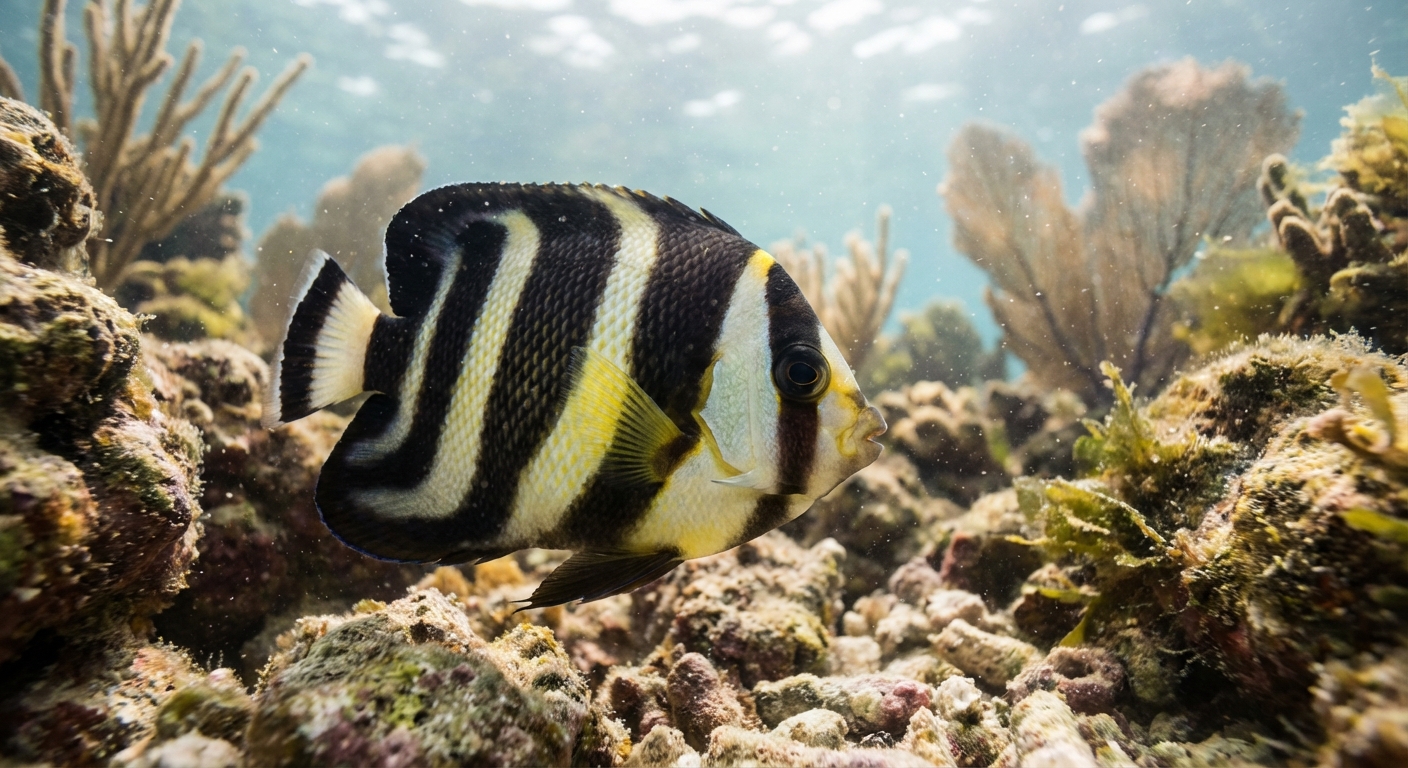
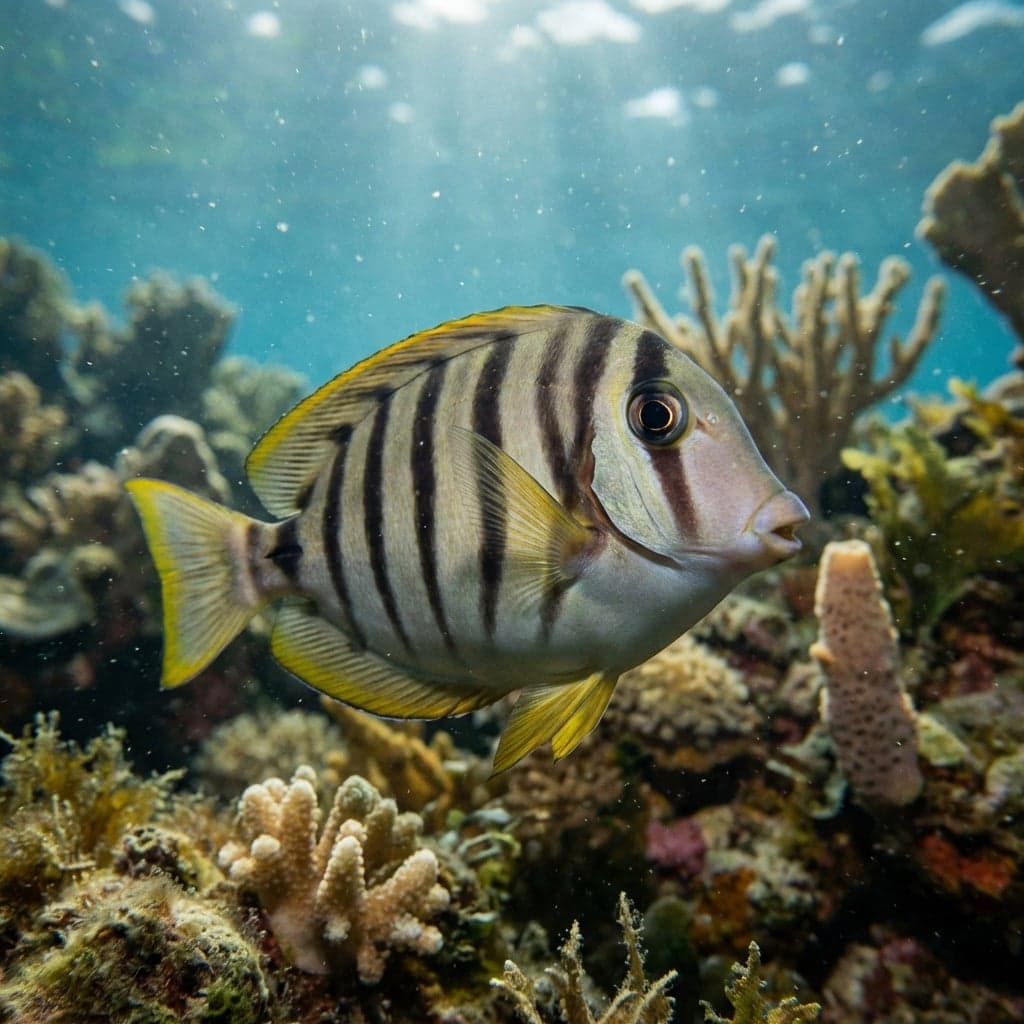
The Bandit Angelfish (Apolemichthys arcuatus) is one of the most distinctive marine angelfish in the hobby, instantly recognised by the bold black bands — each edged in white — that sweep across its pale, pearly body. Endemic to the Hawaiian Islands and nearby Johnston Atoll, it is a deep-reef specialist that is rarely collected and commands premium prices when it does appear. Its understated, graphic colour pattern has made it a holy-grail fish for dedicated keepers of Hawaiian and deep-water biotopes.
Beautiful as it is, the Bandit Angelfish is firmly an expert-only animal. It is a committed sponge-feeder from cooler, dimly lit reefs, and replicating that diet and environment in captivity is genuinely difficult. Longevity records in home aquaria are poor, and most losses come down to diet and stress rather than disease. This profile focuses on what it actually takes to keep one alive and thriving.
Natural Habitat & Origin
Apolemichthys arcuatus is endemic to Hawaii and Johnston Atoll, where it lives on rocky and coral reefs — typically under overhangs and inside caves rather than out in open water. It occupies a remarkably broad depth range, recorded from around 10 metres down to about 180 metres (roughly 33–600 feet), with juveniles tending to favour the deeper, darker end of that range.
These are not bright, shallow-lagoon fish. They come from structured, shaded habitat with steady, cool-to-moderate temperatures and excellent water quality. Understanding this matters for captive care: a Bandit Angelfish does best in a mature reef with abundant live rock, caves and overhangs to retreat into, and lighting that is not punishingly bright.
Care Requirements
This is a saltwater, reef-environment fish and should be kept in stable marine conditions: salinity around 1.024–1.026 specific gravity, pH of 8.1–8.4, and a temperature of roughly 24–26°C (75–79°F). Pristine water quality is non-negotiable — keep nitrate and phosphate low and maintain strong, stable parameters through generous filtration and regular water changes.
Provide a minimum tank of around 379 litres (100 US gallons), and more is better given the fish's adult size of up to about 18 cm (7 inches) and its need for territory and grazing surface. Aquascape with plenty of live rock arranged into caves and overhangs, keep lighting subdued during acclimation, and choose a low-traffic location so a newly imported, naturally shy fish can settle without constant disturbance.
Diet & Feeding
In the wild the Bandit Angelfish is a spongivore: its diet is dominated by sponges, supplemented with algae, hydroids and the eggs of other marine organisms. This dietary specialisation is the single biggest reason the species is hard to keep, because sponge matter is difficult to replace in captivity.
Success hinges on offering angelfish preparations that contain sponge, along with high-quality marine angel/algae foods, frozen mysis and enriched marine blends. A well-established tank with natural algae and microfauna for grazing between feedings is a major advantage. Feed small amounts several times a day and watch closely that the fish is genuinely eating — a Bandit Angelfish that refuses food rarely recovers without prompt intervention.
Behavior & Temperament
Bandit Angelfish are generally peaceful toward unrelated species but can be territorial, particularly with other angelfish or similarly shaped fish that occupy the same niche. As a rule, keep only one per tank unless the system is very large. In a well-structured aquarium they spend much of their time patrolling rockwork and grazing, retreating to caves when startled.
Because newly imported specimens are often nervous, a calm tank with non-aggressive tank mates and minimal disturbance gives them the best chance to acclimate. Boisterous or bullying tankmates will keep a Bandit Angelfish hidden and off its food — frequently a fatal combination for this species.
Tank Mates
Pair the Bandit Angelfish with peaceful to semi-aggressive marine community fish that won't outcompete it for food or harass it: many wrasses, smaller tangs, anthias, cardinalfish and gobies are reasonable companions in a large enough system. Avoid aggressive triggers, large aggressive angelfish, and any fish likely to monopolise feeding.
Reef compatibility should be approached with caution. As a sponge and invertebrate feeder, a Bandit Angelfish may nip at some sessile invertebrates; many keepers maintain it in fish-dominant systems or accept a degree of risk in a reef. Prized or delicate corals and clams are best kept elsewhere.
Breeding
The Bandit Angelfish is not bred in home aquaria. Like other marine angelfish it is a pelagic spawner producing planktonic larvae, and the combination of deep-water origin, specialised diet and demanding larval requirements puts captive breeding well beyond the reach of the hobby. Essentially all specimens in the trade are wild-collected, which — given the species' restricted Hawaiian range — is a further reason to keep only well-acclimated, feeding individuals.
Common Health Issues
Most Bandit Angelfish losses stem from failure to feed and from stress during and after importation rather than from a specific pathogen. A fish that stops eating will decline quickly, so early, varied, sponge-inclusive feeding is the priority. Like other marine fish, the species can also be affected by marine ich (Cryptocaryon irritans) and marine velvet (Amyloodinium ocellatum), especially when stressed.
Quarantine new arrivals, keep water quality high and stable, and minimise stress through subdued lighting and a calm tank. Given how challenging this species is, it should only be attempted by experienced marine aquarists able to provide a mature system and a suitable specialised diet.