Long-horn Cowfish: Lactoria cornuta
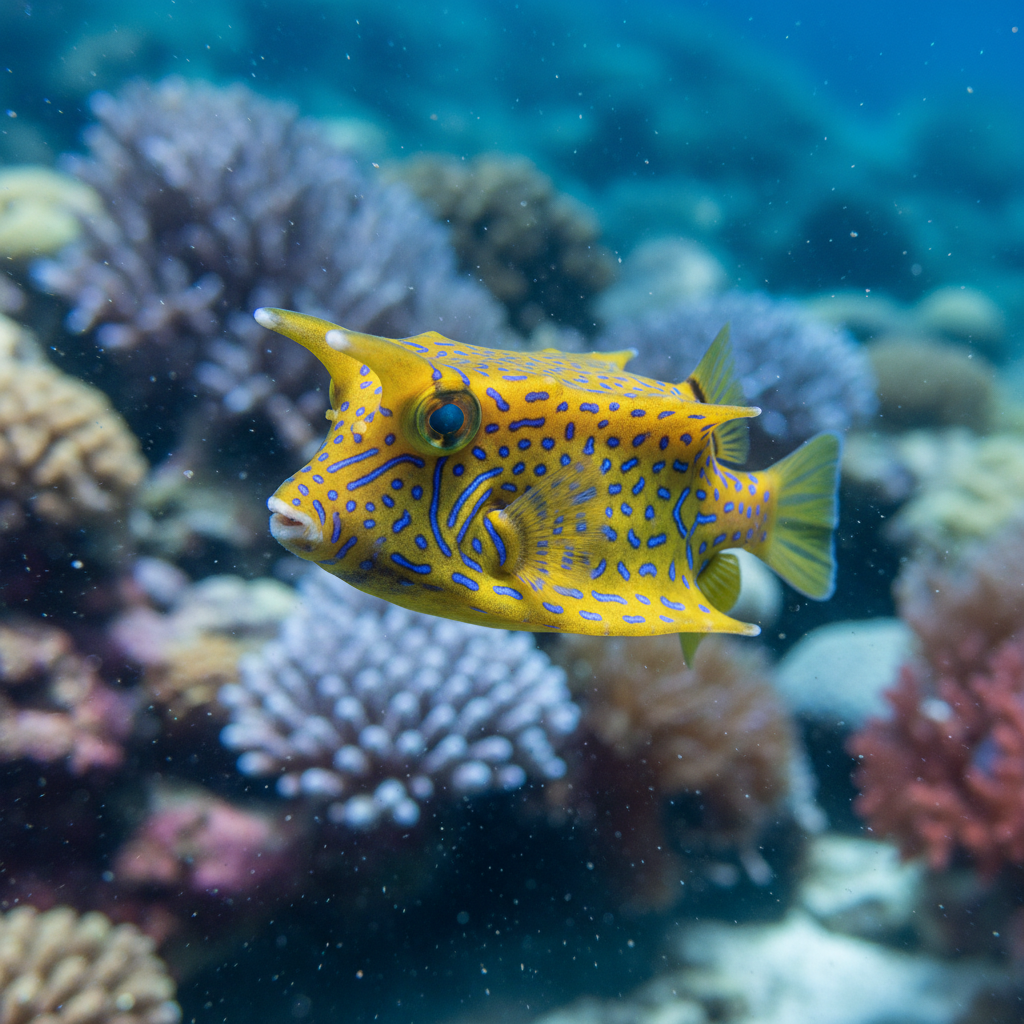
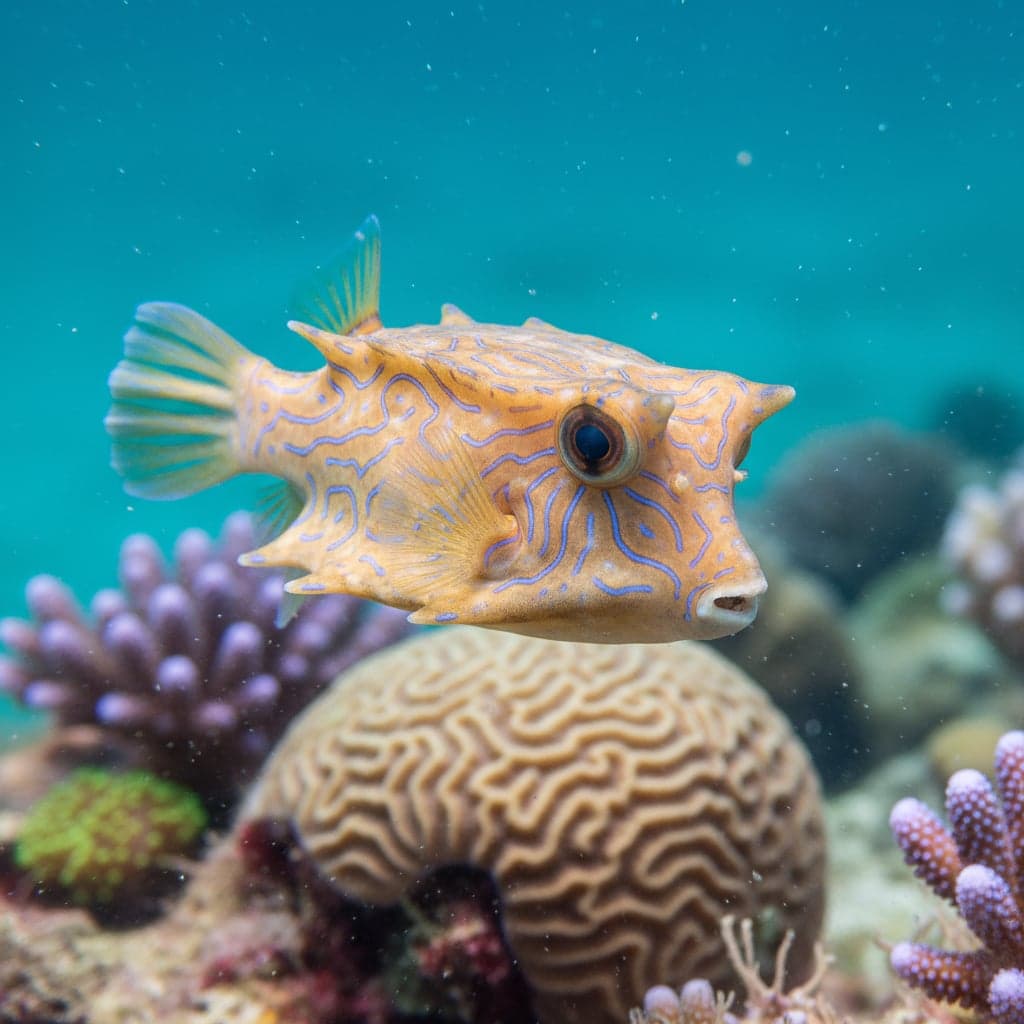
The Long-horn Cowfish (Lactoria cornuta) is an icon of the marine world, defined by its box-like armored body, its prominent paired 'horns', and its delightfully quirky, hovering swimming style.
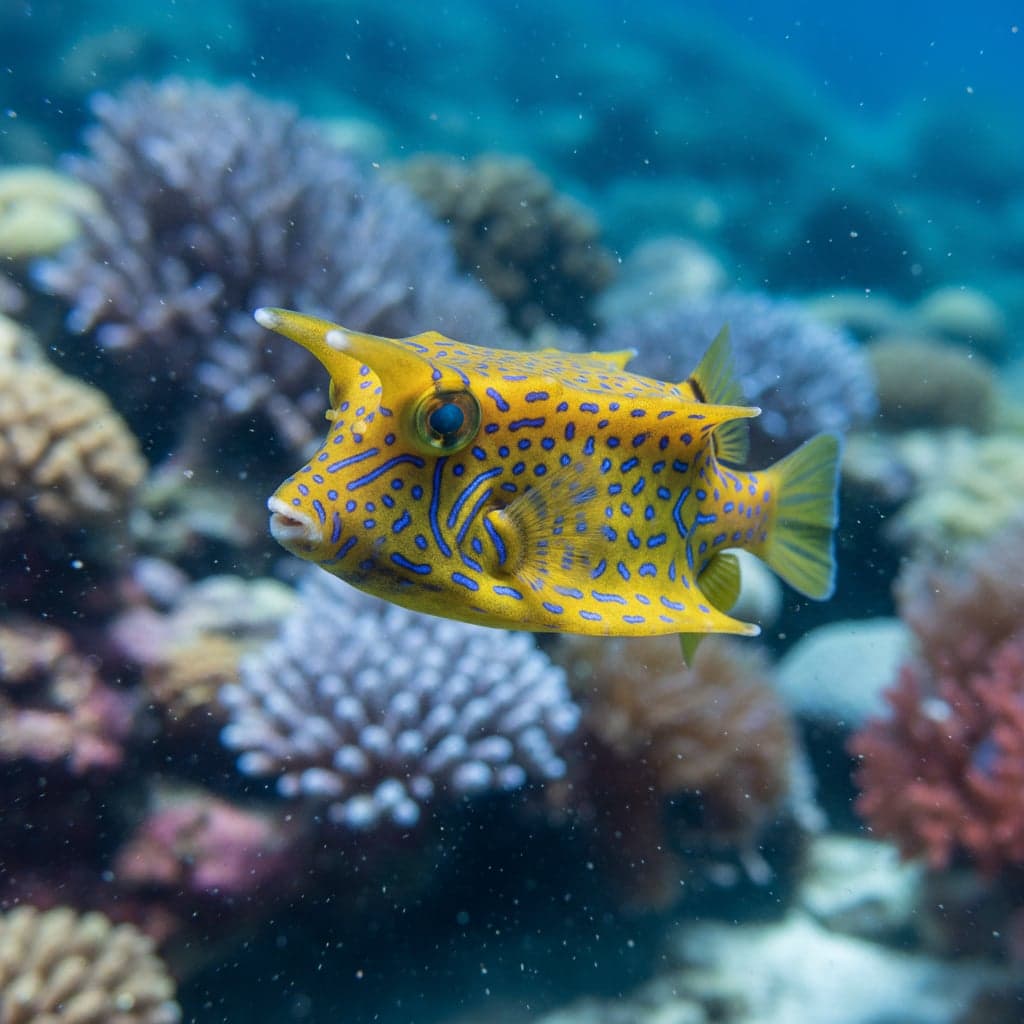
The Long-horn Cowfish (Lactoria cornuta) is a fish that defies conventional aquatic design. It is defined by its rigid, box-like carapace formed by fused hexagonal scales and two sets of prominent "horns"—one pair protruding forward from above the eyes and another pair pointing backward from the lower rear of the body. Its vibrant yellowish-tan body is often adorned with electric blue to white spots, creating a striking geometric pattern. It is an exceptionally peaceful and curious species, often seen "hovering" in place by using its small, transparent fins in a specialized, almost helicopter-like fashion. However, it is a high-responsibility resident; it possesses the ability to release ostraciitoxin, a powerful neurotoxin, if it becomes severely stressed or dies.
In the aquarium, they are the definition of "quirky charm." They are inquisitive fish that will often recognize their owners and approach the glass, using their specialized mouths to "blow" at the sand in search of food.
Natural Habitat & Origin
Lactoria cornuta is widely distributed across the Indo-Pacific, from the Red Sea and East Africa to the Marquesas and Tuamotu Islands. They inhabit shallow coastal reefs, lagoons, and sandy flats at depths of 1 to 50 meters. Juveniles are often found in the shelter of estuaries and harbor areas, while adults prefer the slightly deeper water of the outer reef slopes. They are solitary foragers, naturally spending their days hovering just above the substrate, blowing jets of water into the sand to uncover small crustaceans, worms, and mollusks.
Care Requirements
The Long-horn Cowfish is an Advanced-difficulty species due to its potentially large size, slow swimming speed, and its toxin-release reflex. A minimum tank size of 125 gallons (475L-500L) is required for an adult, as they can reach significant lengths in captivity.
Maintain stable marine parameters: a pH of 8.1 to 8.4 and a temperature of 75°F to 82°F (24°C to 28°C). CRITICAL CARE NOTE: Their slow swimming speed makes them highly vulnerable to being sucked into powerful wavemakers or overflows; all intakes MUST be shaded or screened. The aquarium should feature plenty of open swimming room complemented by stable rock structures that do not have sharp edges that could damage their rigid carapace. High-quality skimming is essential to manage organic waste and potentially neutralize low-level toxin releases. TIP: They are highly sensitive to stress; avoid any tank mates that are fast, boisterous, or aggressive.
Diet & Feeding
They are opportunistic omnivores, naturally feeding on a variety of benthic invertebrates and algae.
In captivity, they require a varied and consistent diet:
- High-quality marine pellets and flakes (herbivore-leaning) should be the staple.
- They MUST have frequent meaty foods: Mysis shrimp, Brine shrimp, chopped squid, and mussels.
- They are natural browsers; providing Nori (dried seaweed) on a clip will help satisfy their constant grazing instinct.
- Tip: They are slow feeders. In a community tank, you must ensure they are not outcompeted for food by faster species.
- Offering live blackworms in the sand is a great way to encourage their natural "sand-blowing" foraging behavior.
Behavior & Temperament
They are supremely peaceful and slow-moving. They show no interest in other fish and spend their time cautiously exploring the tank. However, their size and rigid body can make them clumsy. They are highly susceptible to "stress-induced toxin release" (Ostracitoxin). If a Cowfish is stressed by aggressive tank mates, it can release a toxin that may kill everything in the tank, including itself. For this reason, they are best kept with the most peaceful of companions.
Tank Mates
Suitable tank mates are other peaceful, slow-moving reef species:
- Anthias and Chromis
- Cardinalfish and Blennies
- Pipefish and Seahorses (in specialized setups)
- Larger, peaceful Tangs (like the Kole Tang)
- All corals (though they may occasionally nip at some polyps)
Avoid keeping them with aggressive Triggers, large Puffers, or boisterous Wrasses. Never keep them with other Boxfish or Cowfish, as territorial disputes are likely and can lead to toxin release.
Breeding
Breeding Long-horn Cowfish in captivity is not documented in a home aquarium. In the wild, they are pelagic spawners, usually breeding in pairs during the twilight hours. The eggs drift in the ocean currents and hatch into tiny, box-shaped larvae. Their slow growth and complex larval stages make them nearly impossible to rear in a closed system.
Common Health Issues
The primary concern is Capture/Acclimation Stress. They are also prone to Cryptocaryon (Marine Ich) and Marine Velvet. Because they are "scaleless" (having a carapace instead), they are extremely sensitive to many copper-based medications. Maintaining a high-volume, stable environment with zero nitrate/phosphate spikes and very peaceful tank mates is the best way to ensure the majestic Long-horn Cowfish lives for its potential 10-15 year lifespan.