Yellow Tilefish
The Yellow Tilefish (Hoplolatilus luteus) is a graceful, golden deep-reef burrowing fish — peaceful and reef-safe, but a determined jumper.
Yellow Tilefish
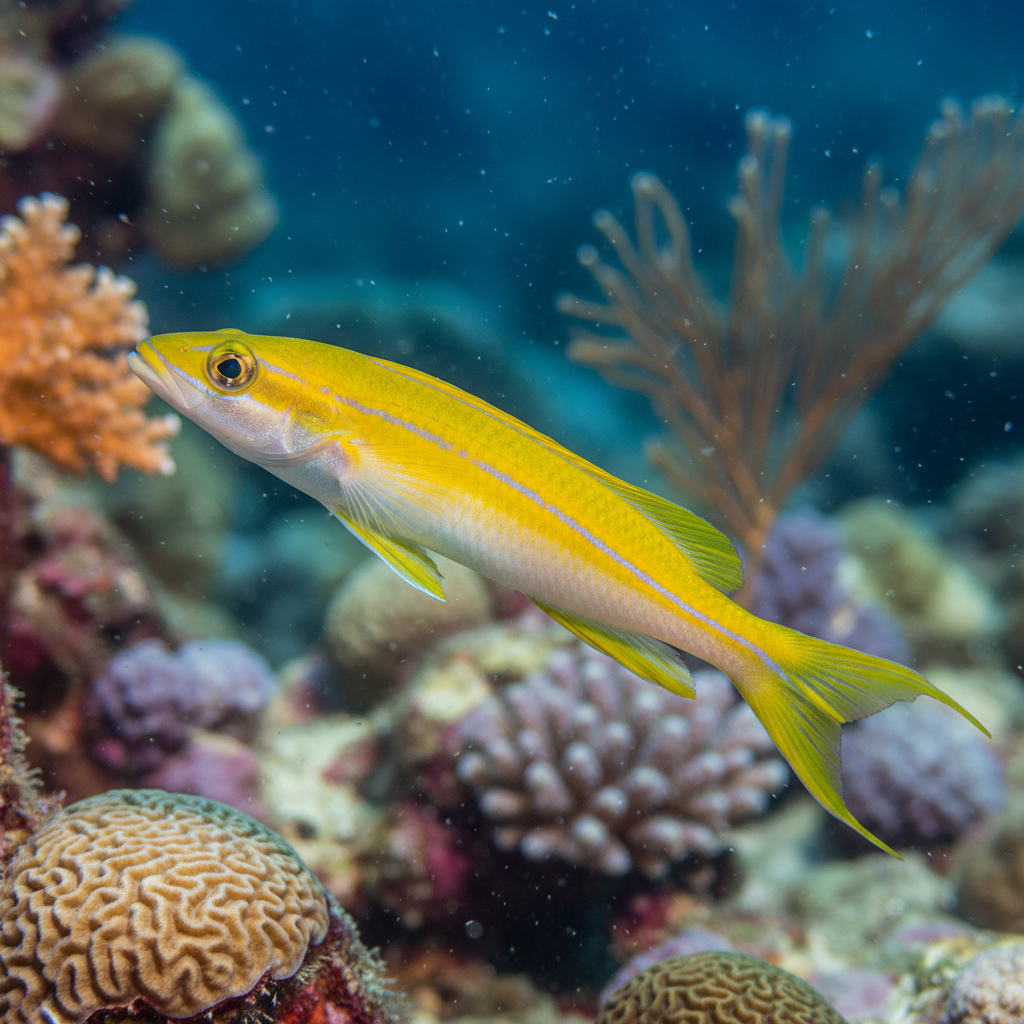
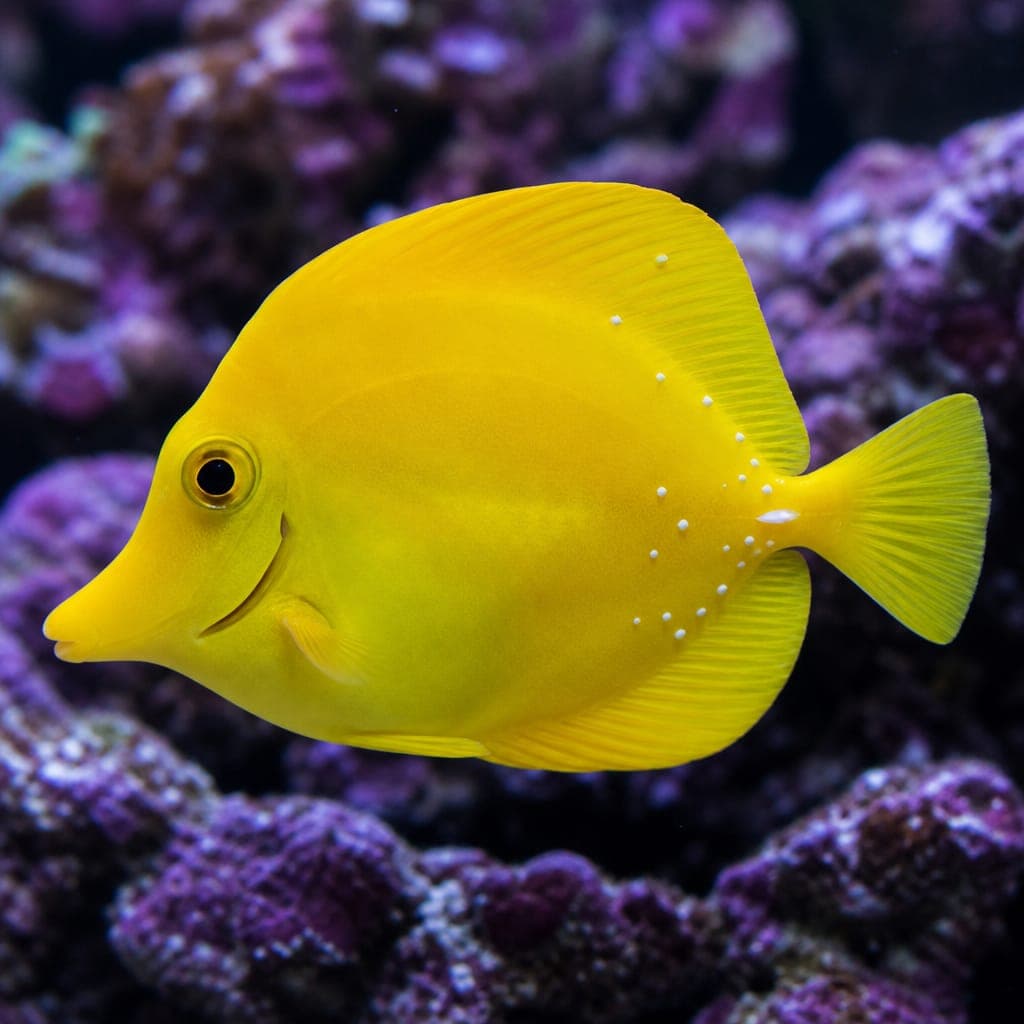
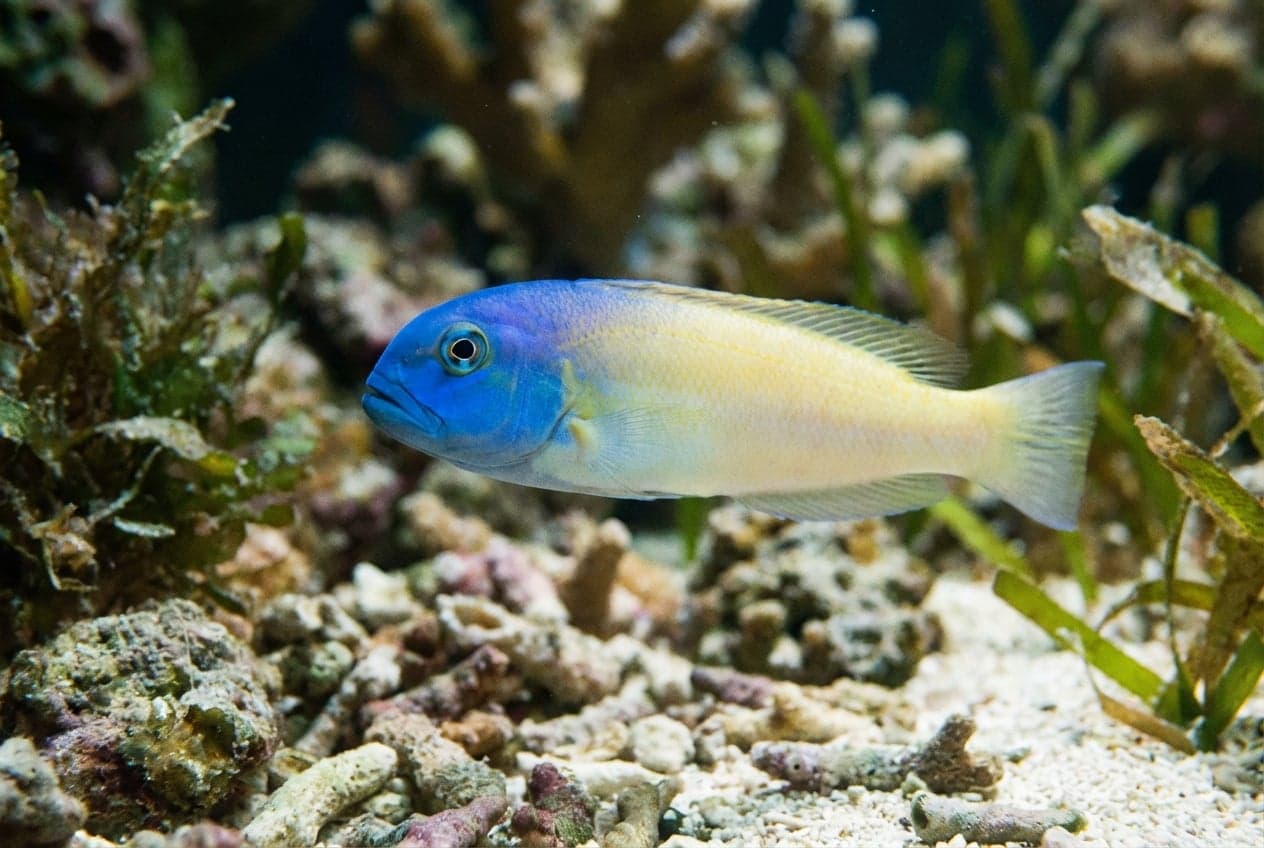
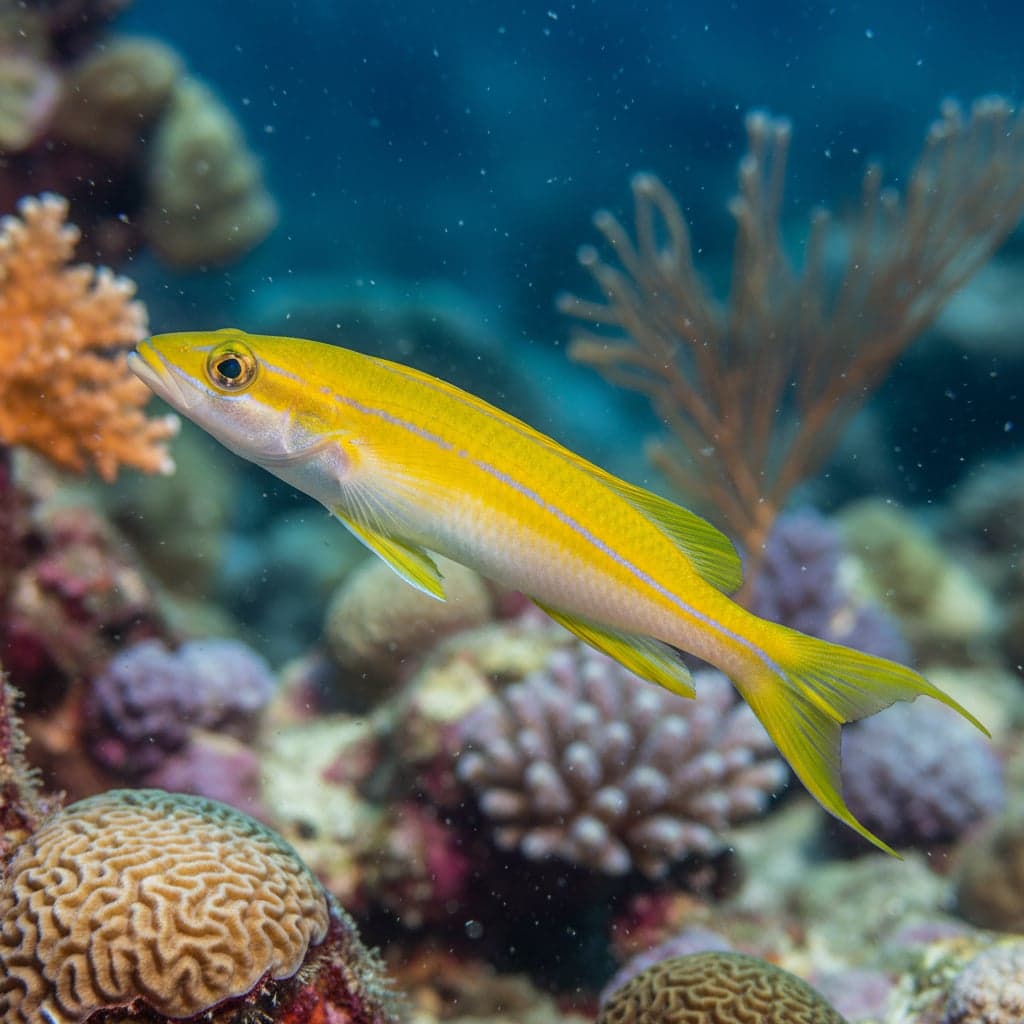
The Yellow Tilefish (Hoplolatilus luteus) is an elegant, torpedo-shaped fish washed in soft golden-yellow, sometimes with a bluish cast to the head. A deeper-water species that hovers above the substrate and builds rubble burrows, it brings constant, hovering movement to the lower water column of a reef aquarium and is fully reef-safe.
Its peaceful nature comes with one serious caveat: like other tilefish, it is among the most determined jumpers in the hobby, and an open-topped tank will almost certainly lose it. Buy the lid before you buy the fish.
Sand-and-rubble burrow space and open water above it are the first requirements. A gap-free lid is the second — and it is not optional. Frontmatter lists pair because wild fish often hover as pairs; in captivity a bonded pair is lovely in a large enough system, and a single specimen is fine if you cannot house two.
Natural Habitat & Origin
Hoplolatilus luteus lives on deeper reef slopes, typically near rubble and sand at the base of the reef, where it constructs and maintains a burrow from rubble and shelters in it when alarmed. Pairs are often seen hovering together above their burrow, dropping into it at the first sign of danger. That startle-and-dive response is exactly why lids matter: the “dive” in a closed aquarium sometimes goes up and out instead.
In the aquarium it wants a sand-and-rubble area to burrow in, some rockwork for shelter, and above all open swimming space above the substrate. Packing every inch with rock leaves nowhere to hover or dig.
Care Requirements
Stable marine conditions: salinity about 1.024–1.026, pH 8.1–8.4, temperature 24–26°C (75–79°F). Adults reach about 13 cm (5 inches). Plan on around 280 litres (about 75 US gallons) or more with open water and a substrate it can burrow into. A completely secure, gap-free lid is essential — jumping is the single biggest cause of loss for this species. Check overflows, probe holes, cable notches and filter lids: tilefish find the one gap you forgot. Subdued lighting during acclimation helps a deep-water fish settle; blasting full reef intensity on day one keeps it buried and stressed. Raise intensity over days, not hours, once the fish is hovering and eating.
Give it a genuine sand-and-rubble patch, not a thin decorative dusting over bare glass. Hoplolatilus builds and renovates rubble burrows; crushed coral or coarse sand with loose rubble pieces lets that behaviour happen. Bare rock walls with no diggable bed leave a stressed hoverer with nowhere to dive when startled — and startled tilefish jump.
Quarantine new arrivals. Tilefish can carry marine ich (Cryptocaryon irritans) and marine velvet (Amyloodinium ocellatum) like any marine import; stress from collection and shipping is real even when the species is not as notorious as tangs. Medications belong in hospital tanks off coral displays. Use the Aquarium Tracker to log salinity and temperature through acclimation — small drifts plus bright light make a shy burrower vanish for days.
Diet & Feeding
Carnivore feeding on zooplankton and small invertebrates in the water column and over the substrate. It usually accepts aquarium foods well once settled: frequent small meals of frozen mysis and enriched brine shrimp, finely chopped seafood and quality marine pellets. Feed several times a day to keep this active, hovering fish in good condition. Broadcast into gentle flow so particles drift past the hover zone rather than dumping one cube that hits the sand and dies there while the tilefish stays tucked.
If it stays buried and refuses food, dim lights, reduce traffic and offer food near the burrow entrance rather than only in open mid-water chaos. Hunger plus jumping risk is a bad combination — a thin, panicked tilefish is more likely to bolt. Prove feeding in QT with a lid on the hospital tank too. Once display life starts, watch body depth: a golden hoverer that looks pinched behind the head is underfed or outcompeted, not “still adjusting” indefinitely.
Behavior & Temperament
Peaceful and sociable; does well singly or as a pair and poses no threat to tankmates. Shy at first, especially in a bright or busy tank, then settles to hover confidently above its burrow once established. Calm tankmates and a secure environment bring out the hovering display that makes the species worth keeping.
Avoid boisterous fish that claim the sand bed or constantly chase mid-water space. A tilefish that never leaves its hole is telling you the community is wrong, not that it “likes privacy.”
Tank Mates
Pair with other peaceful reef fish — anthias, smaller wrasses, gobies, cardinalfish and similar — and avoid aggressive or boisterous species that will keep it hidden. It is fully reef-safe, leaving corals and ornamental invertebrates alone, which makes it an excellent choice for a peaceful reef with open water to patrol.
Do not house it with large sand-sifting predators or territorial jawfish that will contest every burrow site unless the footprint is truly large. Give pairs enough rubble real estate so they are not forced into one contested hole. A thin sand bed over bare glass is not a burrow — provide depth and loose rubble they can rearrange.
Breeding
Hoplolatilus luteus forms pairs and is a pelagic spawner; rearing the larvae is beyond the home aquarium, so trade specimens are wild-collected from deeper reefs. Enjoy the pair bond as behaviour, not as a breeding program. Spawning rushes may occur in mature pairs without producing keepable fry.
Common Health Issues
By far the greatest risk is jumping, so a secure, gap-free lid is non-negotiable — including overflow cutouts, filter lids and cable notches that look “too small to matter.” Beyond that the species is reasonably hardy, though it can take ich or velvet under stress and can be sensitive during acclimation. Quarantine new arrivals, acclimate gently with subdued lighting, keep water quality stable — and secure that lid.
Do those things and this graceful tilefish thrives in a peaceful reef. Skip the lid or drop it into a chaotic, over-lit community, and the golden hoverer becomes another “mysterious overnight loss” on the floor.