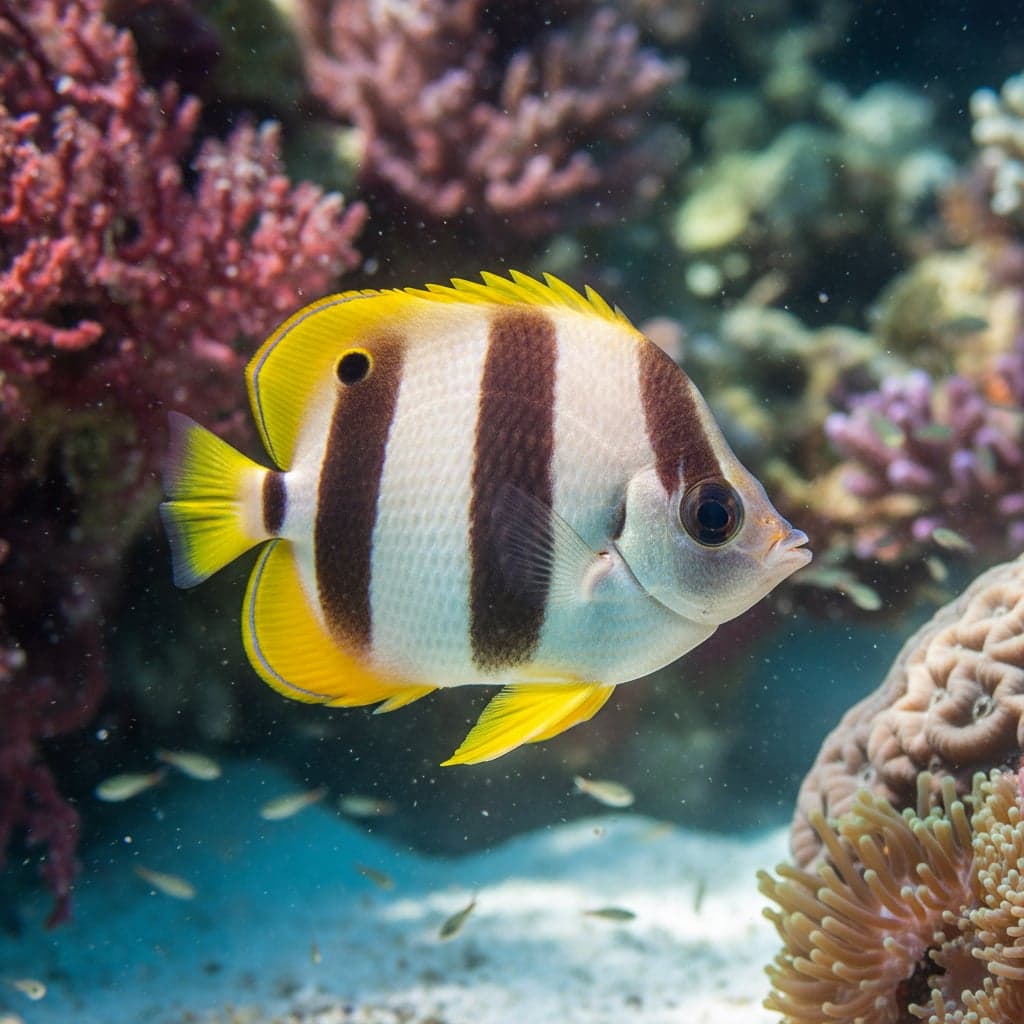
Masked Swallowtail Angelfish
The Masked Swallowtail Angelfish (Genicanthus semifasciatus) is a deep-water, planktivorous swallowtail angel — peaceful and genuinely reef-safe.
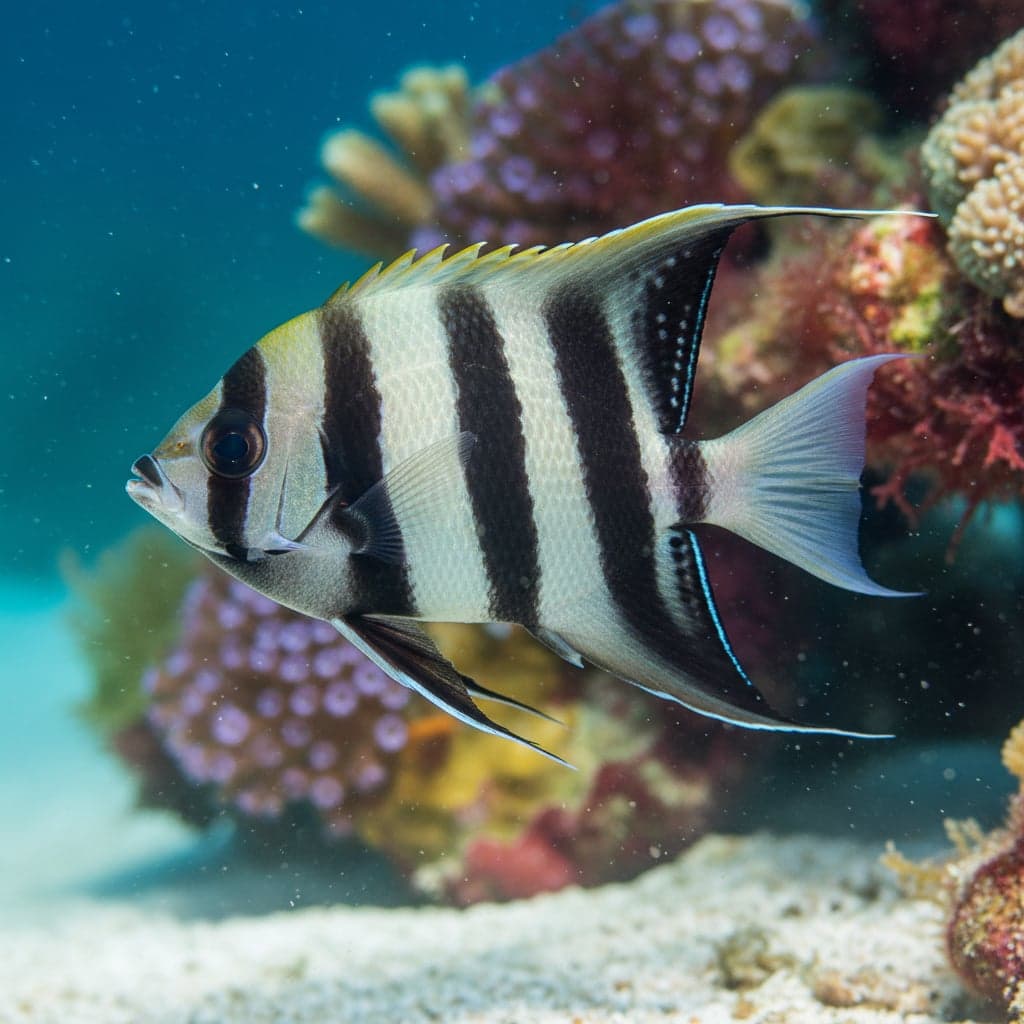
Masked Swallowtail Angelfish
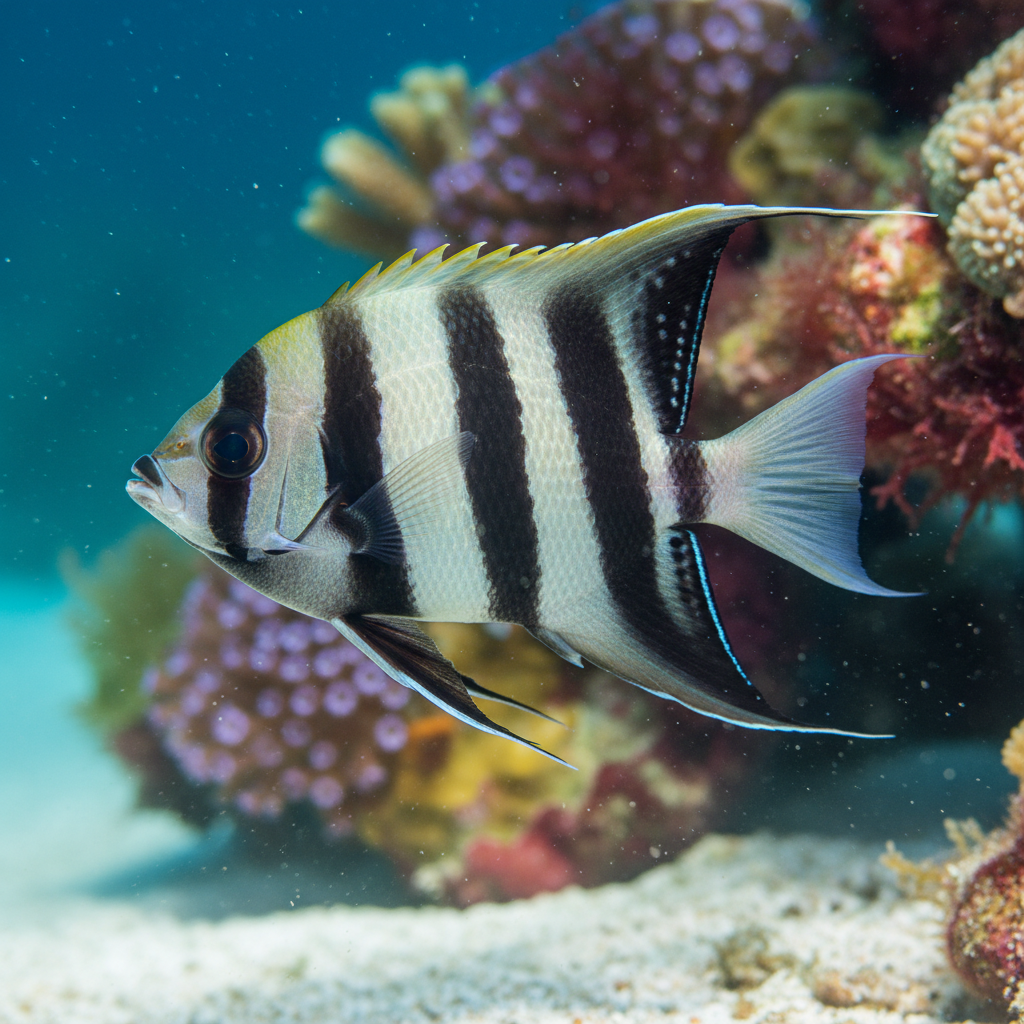
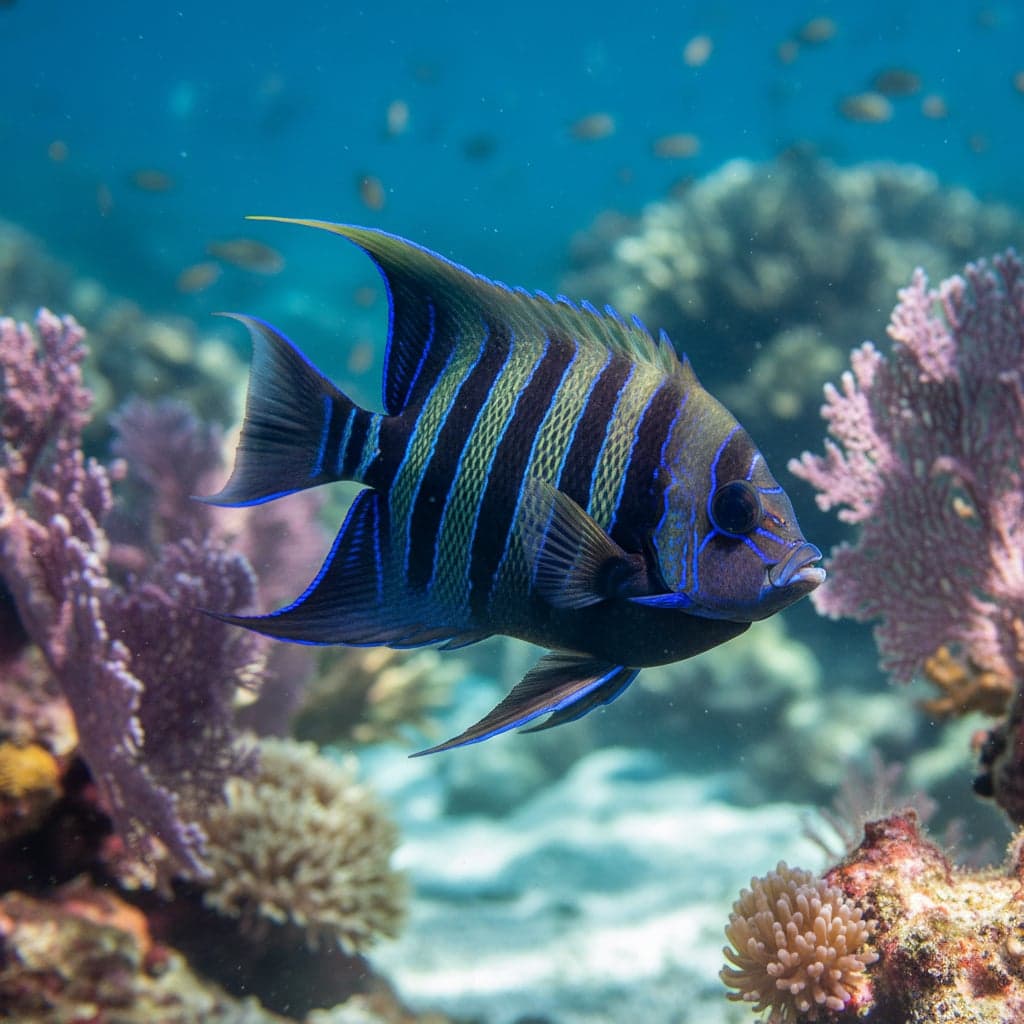
The Masked Swallowtail Angelfish (Genicanthus semifasciatus) is one of the few angelfish that earns a genuine reef-safe label. It is a graceful mid-water plankton feeder, not a coral-rasping Centropyge or large Pomacanthus. Males and females look different: females wear a dark “mask” over the head and dark upper body; males develop golden-yellow markings and fine striping. Adults reach about 21 cm (8 inches). As a swallowtail (Genicanthus), it is peaceful, elegant and trusted in full reefs when diet and volume are honest.
Deeper, slightly cooler water shapes husbandry. Treat it like a current-swept slope fish, not a shallow lagoon angel under blasting light from day one.
Natural Habitat & Origin
Genicanthus semifasciatus occurs in the western Pacific around southern Japan, Taiwan and the Philippines on deeper, current-swept reefs. Wild fish form mid-water schools and harems — typically a male with several females — feeding on plankton drifting past in the current. Depth and flow are the ecological keys, not shallow coral gardening.
In the aquarium that means open swimming space, steady flow and rock for shelter, plus temperatures toward the cooler end of tropical reef ranges. A tight, heavily lit SPS cube with no mid-water lane fights the fish’s natural posture.
Care Requirements
Stable marine water with a cooler bias: salinity about 1.024–1.026, pH 8.1–8.4, temperature about 23–26°C (73–79°F). Plan on around 340 litres (about 90 US gallons) or more with clear open water — length matters for a continuous cruiser. Subdued lighting during acclimation helps a deeper-water fish settle; raise intensity gradually once it is eating and swimming confidently.
Water quality should be excellent. Keep nitrogen compounds low — ammonia, nitrite and nitrate — and avoid sudden salinity swings. Deep-collection stress makes quarantine especially important: these fish often arrive after longer, harder transport than shallow reef angels. Observe and treat in QT; medications stay off the reef display.
Use the Aquarium Tracker to log salinity and temperature. A slow warm drift or chronic nitrate rise shows up as dull colour and hiding before appetite fails.
Healthy, well-acclimated specimens are hardy. Rush acclimation under bright lights into a chaotic community is how “delicate deep-water angel” stories get written. Prefer a mature system with established flow patterns so the fish can lock onto a mid-water patrol route instead of searching a sterile box for food.
Diet & Feeding
Essentially planktivorous in the wild; frontmatter omnivore reflects captive menus that include marine angel preparations and some algal content alongside meaty plankton substitutes. Offer frequent small meals of frozen mysis and enriched brine shrimp, marine angel foods and foods with marine algae content. Mid-water broadcast feeding suits the natural grazing rhythm better than one evening dump on the sand.
Confirm feeding in QT before display. A swallowtail that ignores frozen foods is not ready for a competitive reef. Once eating, it is usually an easy feeder — keep meal frequency high enough that anthias and wrasses do not monopolise every particle. Marine diets and feeding schedules cover routine structure for plankton-biased fish.
Body shape tells the truth: a hollow belly on a newly imported deep-water angel is an emergency feeding problem, not a growth phase.
Behavior & Temperament
Peaceful and sociable by angelfish standards. Keep singly, as a pair, or as a male with several females in a large tank. It is not the territorial bully many dwarf and large angels are. Frontmatter pair behaviour matches common captive stocking; harems need real volume and open water, not three angels stuffed into the minimum.
It cruises mid-water rather than picking constantly at rock and coral. Mild sparring between males is possible if two males share a too-small system — one male per tank is the safe default unless the system is truly large.
Tank Mates
Good companions are other peaceful reef fish: tangs, anthias, wrasses, gobies, cardinalfish and similar. It generally coexists with other peaceful angels when space and mid-water room are honest. Avoid aggressive triggers, large territorial angels and anything that will pin a plankton feeder away from food.
Crucially, G. semifasciatus is reef-safe: as a planktivore it leaves corals and ornamental invertebrates alone. That is the practical difference from most angelfish charts. Do not assume every “angel” listing shares this diet — many do not.
Breeding
Genicanthus semifasciatus is a protogynous hermaphrodite that forms harems; a dominant female can change sex to male when the male is lost. It is a pelagic spawner. Rearing larvae is beyond the home aquarium, so trade specimens are wild-collected from deeper reefs. Sex-change biology is why buying a “pair” of unknown fish can eventually yield two males if both are female and one switches — watch behaviour and colour as they mature.
Common Health Issues
Reasonably hardy after good acclimation, still susceptible to marine ich (Cryptocaryon irritans) and marine velvet (Amyloodinium ocellatum), especially after deep-water collection and transport. Quarantine every arrival. Acclimate gently with subdued lighting. Keep water stable and meals frequent.
A well-chosen specimen rewards the effort as a peaceful, reef-safe angelfish of real elegance. Skip QT, blast it with light on day one, or starve it in a competitive mid-water free-for-all, and a masked swallowtail becomes another expensive deep-water loss rather than the reef centrepiece it should be. When buying, favour fish already taking frozen foods and showing full mid-water swimming — colour and sex markings matter less than proven appetite after collection.