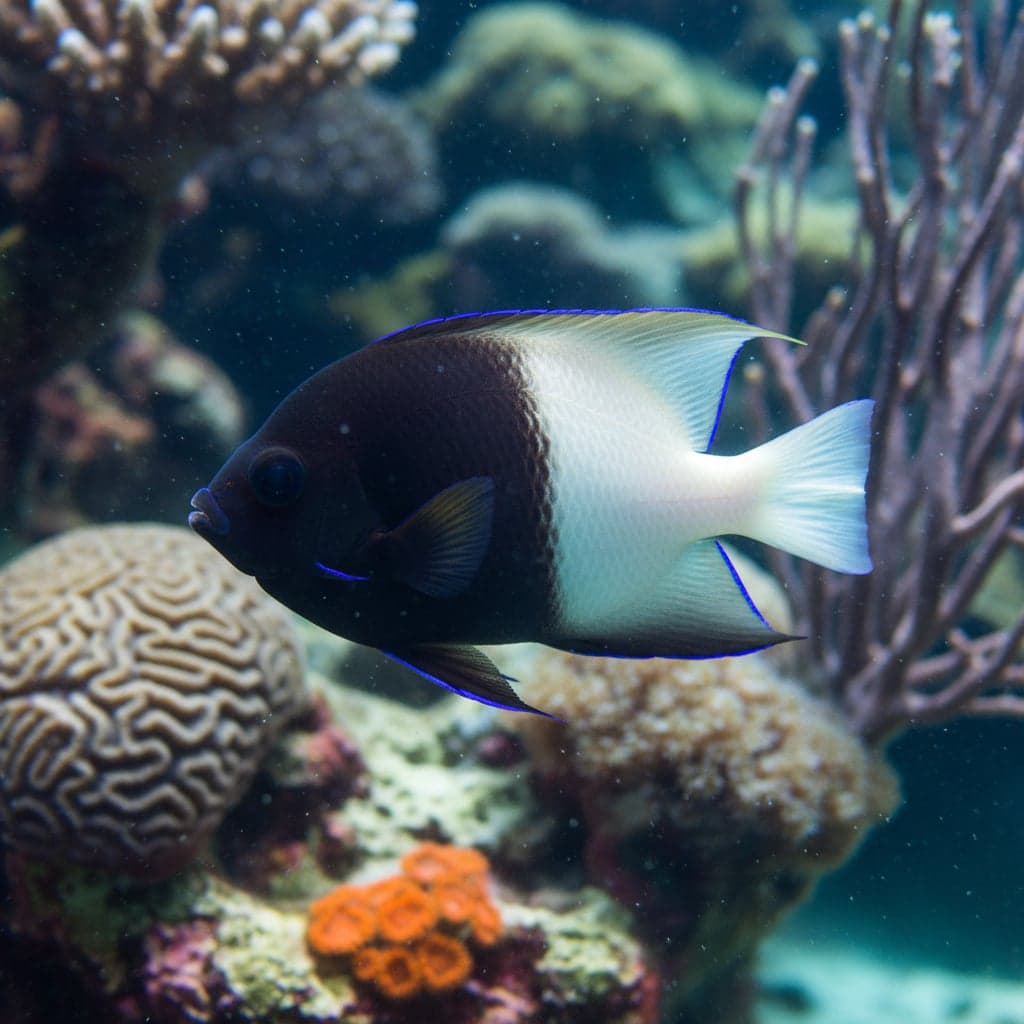
Midnight Angelfish
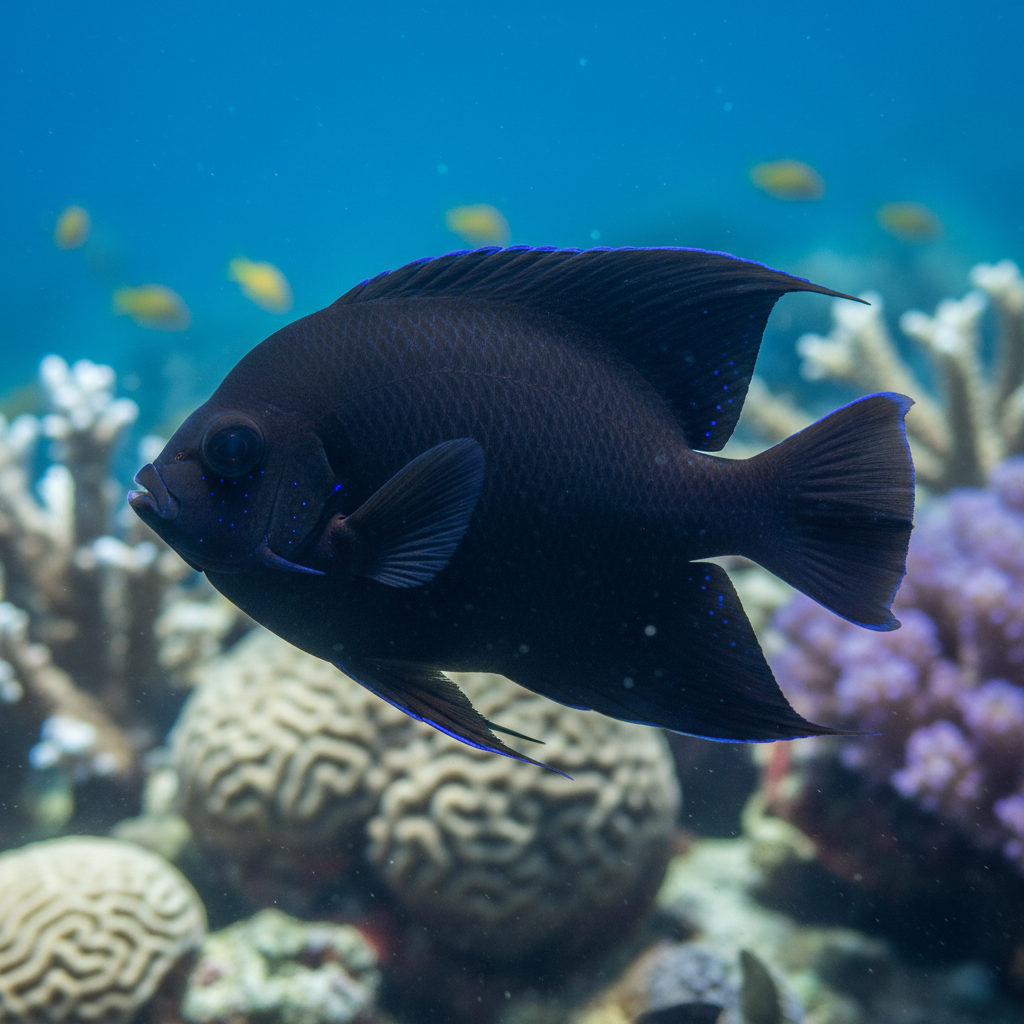
The Midnight Angelfish (Centropyge nox) is a jet-black dwarf marine angelfish from the Western Pacific — a hardy, algae-grazing reef fish best kept with caution around corals.
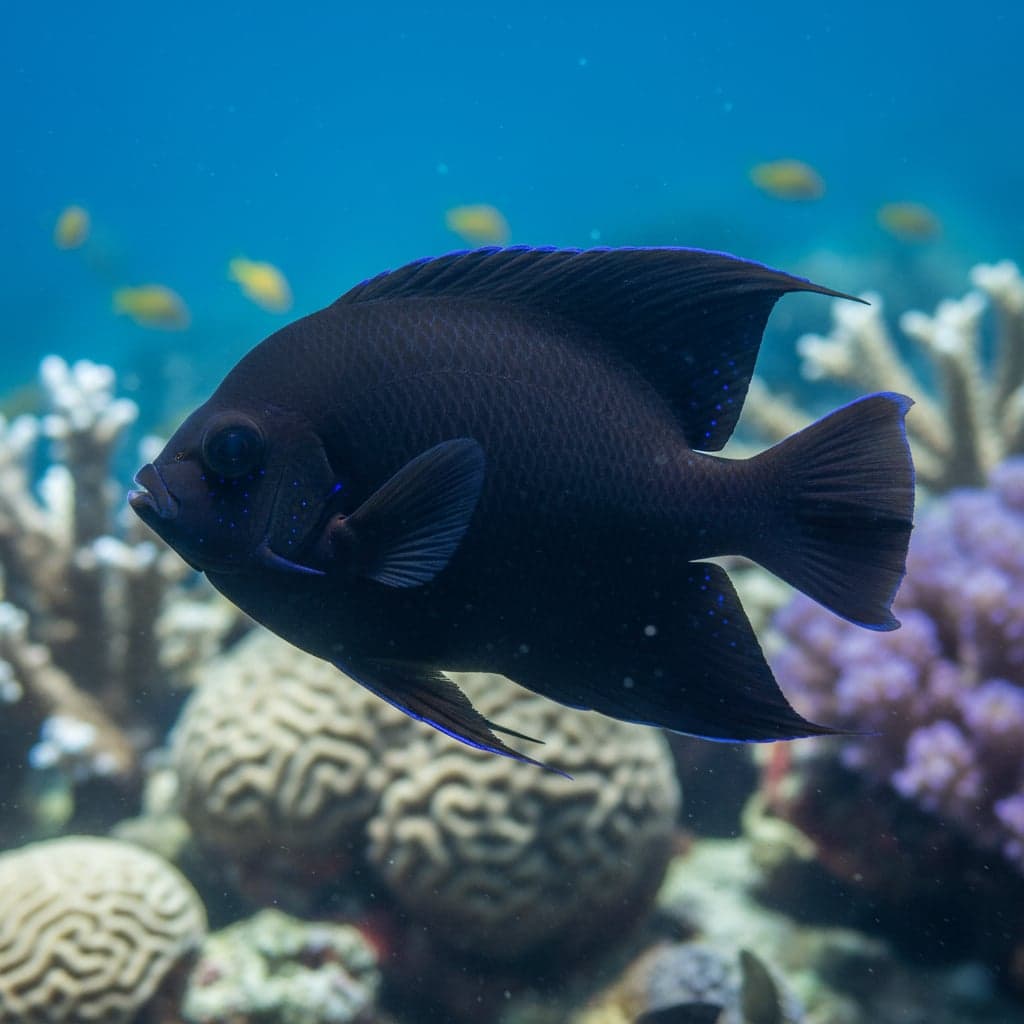
Midnight Angelfish
The Midnight Angelfish (Centropyge nox) is a dwarf marine angelfish defined by its complete simplicity: a uniform, velvety jet-black body with no markings at all. Where most dwarf angels rely on bright colour, C. nox stands out by contrast — a clean silhouette that reads beautifully against live rock and coral. It is a Western Pacific reef fish that has long been a favourite for keepers who want an understated, hardy centrepiece for a fish-only or carefully managed reef system.
Despite its dramatic looks, the Midnight Angelfish is one of the more approachable members of the genus once it is settled and feeding. It needs the same things every dwarf angel does — mature rockwork, grazing surfaces and a peaceful enough tank to claim a territory — but it is not the delicate specialist that some of its relatives are.
Natural Habitat & Origin
Centropyge nox is found across the Western Pacific, from the Ryukyu Islands south to New Caledonia and the Great Barrier Reef, and west into Indonesia. It favours coral-dense outer reef slopes and occasionally lagoons, recorded at depths of roughly 10 to 70 metres (33–230 feet). In the wild it is usually seen alone or in pairs, and like other Centropyge it can form small harems.
These origins point to the captive setup it appreciates: plenty of live rock with caves and crevices to retreat into, stable tropical reef temperatures, and surfaces with established algae and microfauna to pick at throughout the day.
Care Requirements
Keep the Midnight Angelfish in stable marine conditions — salinity around 1.024–1.026, pH 8.1–8.4, and a temperature of about 24–26°C (75–79°F) — with low nitrate and phosphate maintained through good filtration and regular water changes. A minimum tank of around 113 litres (30 US gallons) suits its modest adult size of roughly 10 cm (4 inches), though more swimming and grazing room is always welcome.
The single most important feature is mature live rock. A well-established system gives the fish both security and a natural food source, and greatly improves the odds of a smooth transition into captivity.
Diet & Feeding
The Midnight Angelfish is primarily herbivorous, grazing on algae in the wild along with associated detritus and microfauna. In the aquarium, base its diet on quality marine angelfish and herbivore preparations — including foods containing spirulina and marine algae — supplemented with frozen mysis and enriched blends. Offer small amounts several times a day, and rely on natural grazing across live rock between feedings.
A tank with healthy algal growth is a real advantage; a sterile, freshly set-up system makes it much harder for any dwarf angel to thrive.
Behavior & Temperament
Centropyge nox is semi-aggressive and territorial, particularly toward other dwarf angels and similarly shaped fish competing for the same niche. As a rule, keep only one dwarf angel per tank unless the system is large and the rockwork is broken into distinct territories. Toward unrelated species it is generally well behaved, spending its time patrolling the rocks and ducking into cover when startled.
Introducing it after less aggressive fish are established, and providing abundant hiding places, helps keep tank dynamics calm.
Tank Mates
Good companions include peaceful to semi-aggressive reef fish that occupy different niches: many wrasses, gobies, blennies, cardinalfish, anthias and tangs. Avoid housing it with other dwarf angels in smaller tanks, and steer clear of overly aggressive or boisterous fish that will bully it off its feeding.
In a reef, treat it with caution. Like most dwarf angels, C. nox may nip at coral polyps, clam mantles or zoanthids — many specimens are well behaved, but the risk is real and varies by individual.
Breeding
The Midnight Angelfish is a protogynous hermaphrodite — fish mature as females, and a dominant individual will become male — and pairs are pelagic spawners that release planktonic eggs. While related dwarf angels have occasionally been raised in dedicated breeding setups, captive breeding is not practical in the home aquarium, and trade specimens are wild-collected.
Common Health Issues
The Midnight Angelfish is reasonably hardy but, like all marine fish, is susceptible to marine ich (Cryptocaryon irritans) and marine velvet (Amyloodinium ocellatum), particularly when stressed or newly imported. The most common practical problem is a specimen that refuses to feed, which is best avoided by buying a fish you have seen eating and offering it a mature, food-rich tank.
Quarantine new arrivals, keep water quality high and stable, and minimise stress with plenty of cover to give this striking dwarf angel a long, healthy life.