Diorama Style
Forced perspective and hyper-realism: Mastering the diorama aquascape style. Learn techniques to create massive, deep landscapes in miniature form.

The Diorama Style
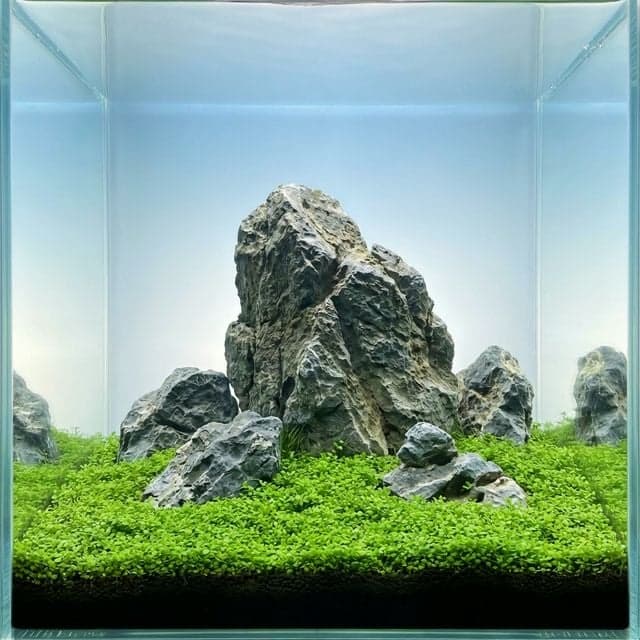
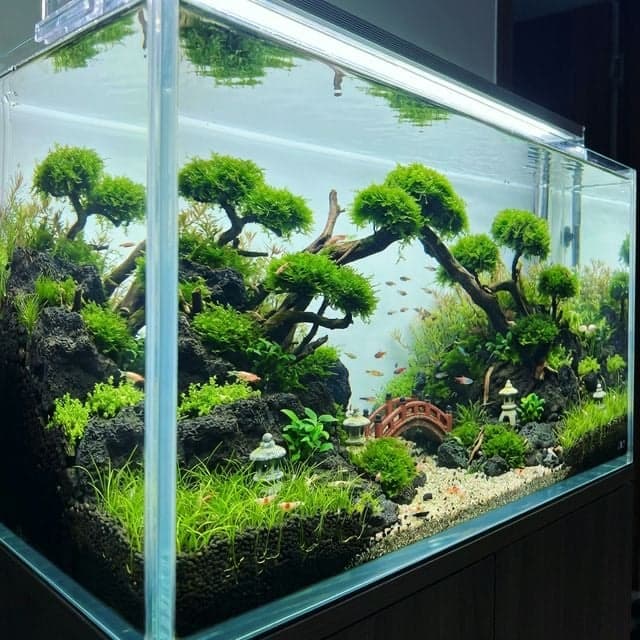
The Diorama Style is a modern evolution of the Nature Aquarium, but with a hyper-realistic focus on scale and depth. It aims to recreate a massive landscape (like a mountain range, a canyon, or a forest path) in miniature form, often looking more like a terrestrial painting than an aquarium.
History & Philosophy
Popularized in recent years by contest aquascapers, the Diorama style pushes the boundaries of perspective. The goal is to trick the eye into thinking the tank is much deeper and larger than it actually is.
Key Design Principles
1. Forced Perspective
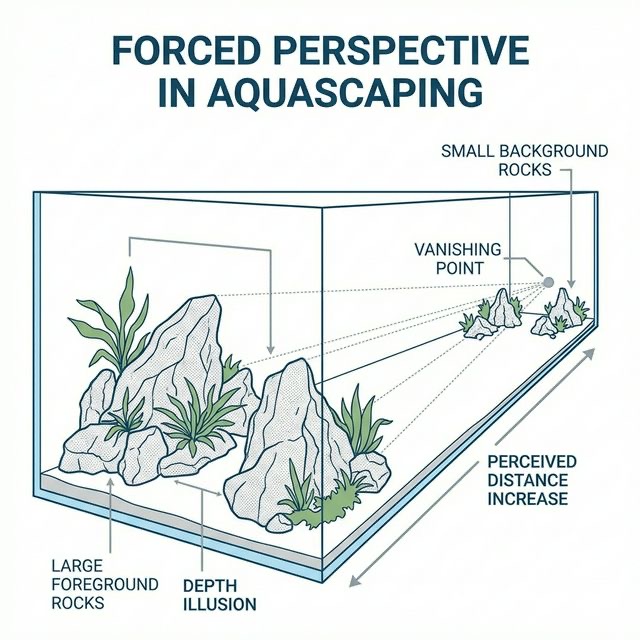 This is the defining technique of the style.
- Scale of Materials: Use large rocks/wood in the front and gradually smaller pieces towards the back.
- Sloping Substrate: The substrate is banked steeply towards the back wall, sometimes nearly to the top, to create a canvas for depth.
- Vanishing Point: Creating a path (using sand) that narrows as it recedes to a specific point, guiding the eye to "infinity."
2. Intricate Detail
Every centimeter is planned. Tiny stones (nano rocks) and fragments of wood are glued together to create complex structures that look like weathered cliffs or ancient trees.
Hardscape Materials
- Stones: Highly textured stones like Dragon Stone (Ohko) or Seiryu Stone are preferred because they can be broken down to look like miniature mountains.
- Wood: Spider wood or straight pieces are used to mimic tree trunks.
- Glue: Superglue and cigarette filters (or cotton) are used extensively to bond hardscape elements instantly.
Typical Flora and Fauna
Fauna
Fish must be "nano" sized to maintain the illusion of a massive landscape.
- Chili Rasboras
- Ember Tetras
- Celestial Pearl Danios
- Neocaridina Shrimp
Flora
Plants are used sparingly compared to Dutch or Jungle styles. They are often mosses or very small leaved plants.
- Mosses: Weeping Moss, Christmas Moss (to create tree canopies).
- Bucephalandra: Small varieties rooted in rock crevices.
- Hemianthus callitrichoides 'Cuba': For distant meadows.
Challenges
- Maintenance: Cleaning is difficult due to the intricate hardscape. Vacuuming the substrate without disturbing the "sand path" is an art.
- Flow: Dead spots can occur in the complex rockwork, leading to algae.