Blue Neon Goby
The Blue Neon Goby (Elacatinus oceanops) is a tiny, hardy Caribbean cleaner goby — peaceful, reef-safe, captive-bred and one of the best beginner marine fish.

Blue Neon Goby
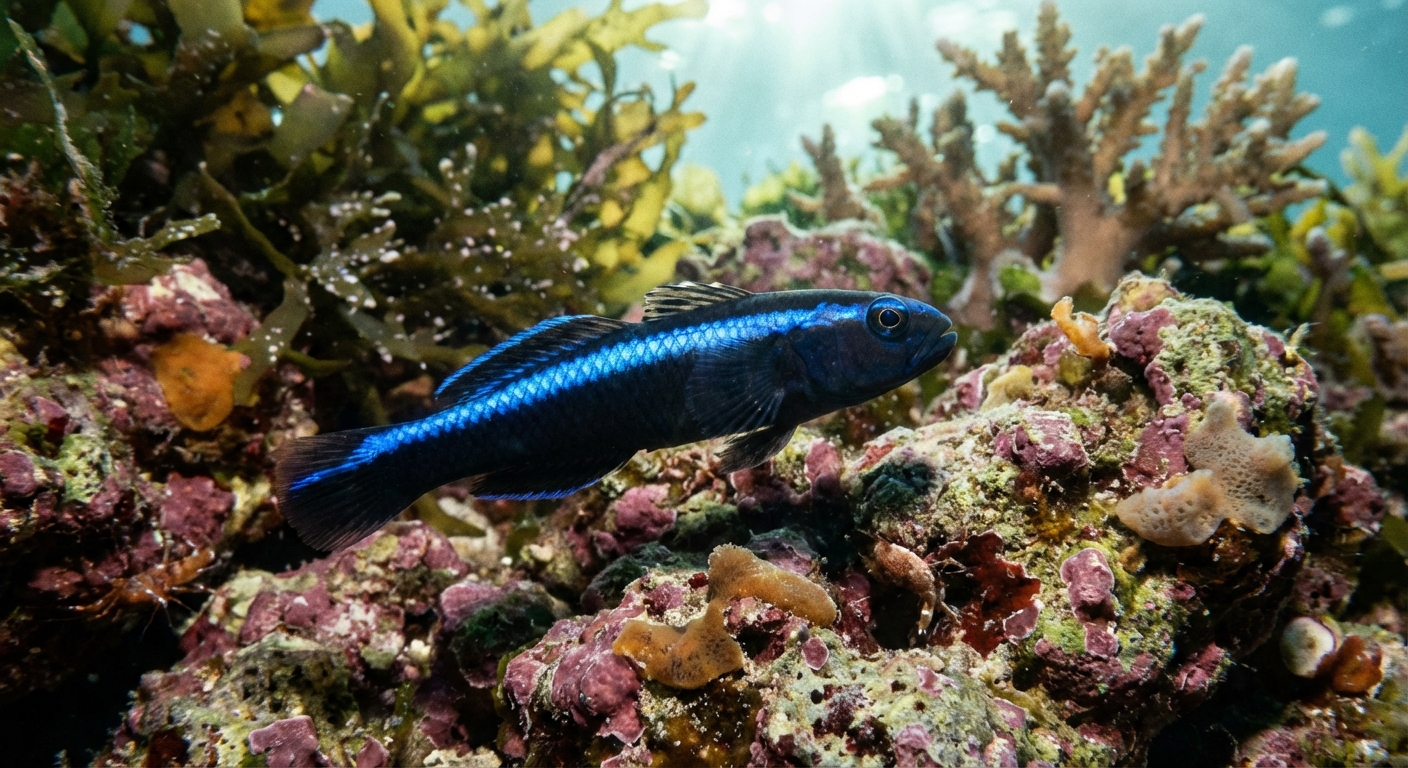
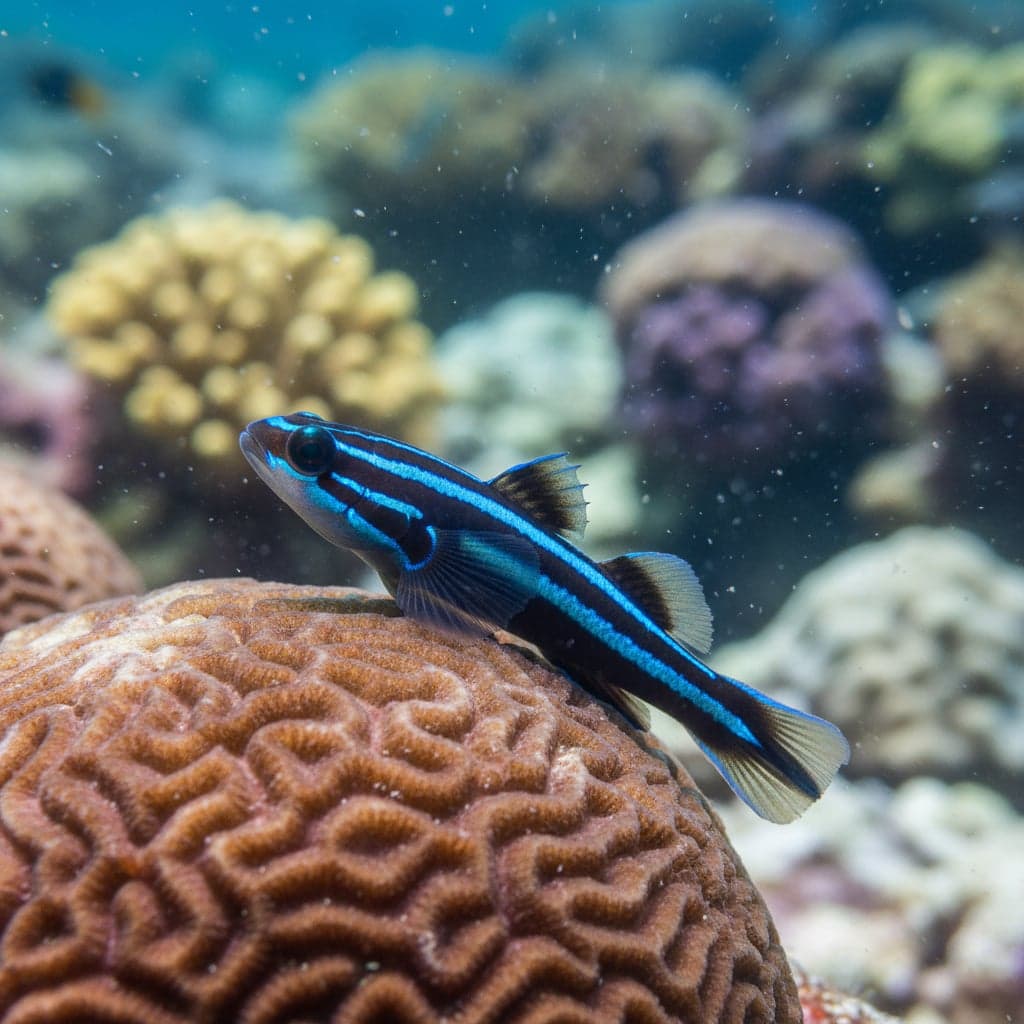
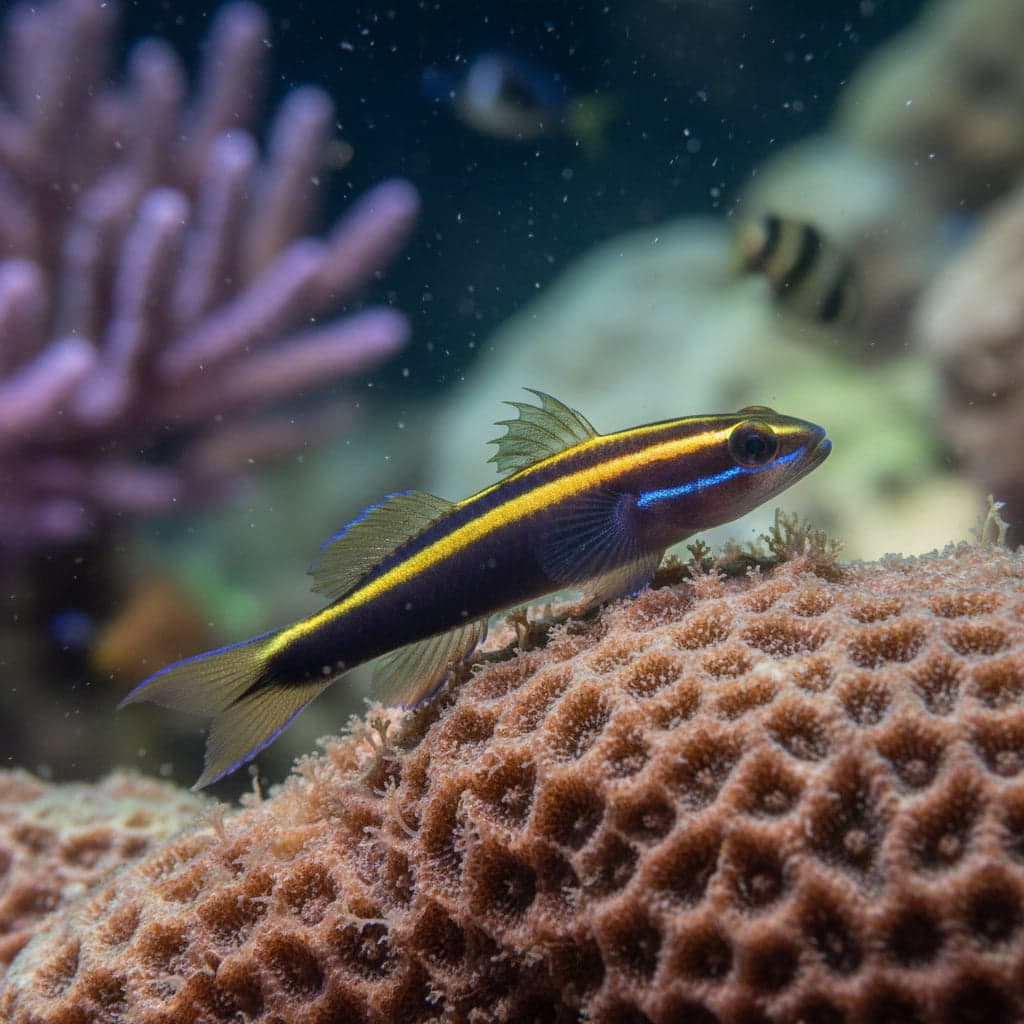
The Blue Neon Goby (Elacatinus oceanops) is one of the most useful and beginner-friendly fish in the marine hobby. Tiny and slim, it is jet-black with a brilliant electric-blue stripe running the length of each side — a living jewel that also earns its keep as a cleaner. In the wild and in the aquarium it sets up "cleaning stations," picking parasites and dead tissue from much larger fish that queue up for the service.
Hardy, peaceful and widely captive-bred, the Blue Neon Goby thrives where many marine fish struggle, making it an excellent first saltwater fish and a welcome addition to almost any reef community.
Natural Habitat & Origin
Elacatinus oceanops is native to the Western Atlantic and Caribbean, ranging from Florida down to Belize, where it lives on coral heads at depths from about 1 to 45 metres (3–148 feet). It perches conspicuously on coral and rock, advertising its cleaning services to passing fish.
In the aquarium it appreciates plenty of live rock with small perches and crevices, where a pair will often claim a particular spot as their station and base of operations.
Care Requirements
Keep it in stable marine conditions: salinity around 1.024–1.026, pH 8.1–8.4, and a temperature of about 24–26°C (75–79°F). Because it grows to only around 5 cm (2 inches), it can be kept in tanks as small as roughly 38 litres (10 US gallons), making it one of the few marine fish genuinely suited to nano reefs. A secure lid is wise, as small gobies can jump.
Its modest size and hardiness make it forgiving of beginner mistakes, provided water quality is kept stable.
Diet & Feeding
The Blue Neon Goby is a micro-carnivore. In the wild much of its food comes from cleaning — parasites, mucus and dead skin picked from other fish — supplemented by tiny crustaceans. In captivity it readily accepts a varied diet of small meaty foods: frozen mysis and brine shrimp, finely chopped seafood and quality small marine pellets. Feed small amounts a couple of times a day.
While it may clean tankmates, do not rely on cleaning alone to feed it; offer regular prepared foods to keep it in good condition.
Behavior & Temperament
This is a thoroughly peaceful fish that poses no threat to tankmates and is itself rarely bothered, since larger fish recognise it as a cleaner. It is happiest kept singly or as a bonded pair; two unpaired gobies may squabble in a small tank, but a male–female pair will often settle and even spawn.
It spends its time perched in the open or working its cleaning station, a confident little fish despite its size.
Tank Mates
The Blue Neon Goby is compatible with the vast majority of peaceful and even semi-aggressive reef fish, which generally tolerate or actively seek out its cleaning. Avoid only large predators or aggressive fish big enough to view it as a meal. It is fully reef-safe and will not harm corals or invertebrates.
Breeding
Elacatinus oceanops is one of the easiest marine fish to breed and is bred commercially in large numbers — many trade specimens are captive-bred. Pairs lay eggs in a sheltered cavity, such as a shell or piece of PVC, and the male guards them until they hatch. Raising the fry requires suitable small live foods but is achievable for a dedicated hobbyist, making this an excellent species for a first marine breeding project.
Common Health Issues
The Blue Neon Goby is hardy, but as a small fish it is sensitive to poor or unstable water quality. Like all marine fish it can contract marine ich (Cryptocaryon irritans) or marine velvet (Amyloodinium ocellatum), particularly under stress. Quarantine new arrivals, keep parameters stable, secure the lid against jumping, and feed regularly — do this and the Blue Neon Goby is a rewarding, long-lived addition to a peaceful reef.