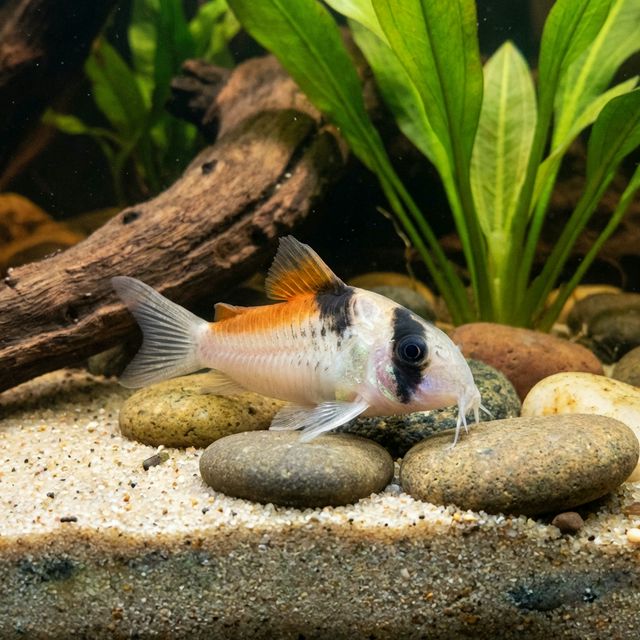
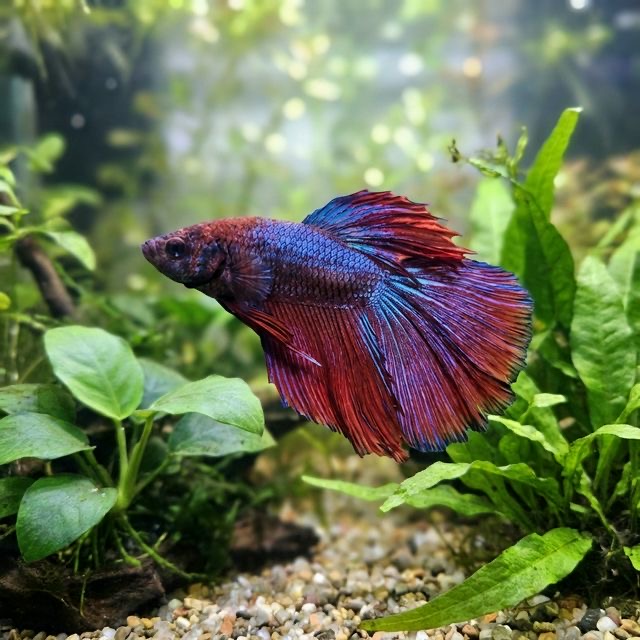
Betta and Angelfish: Why They Usually Clash
Vertical territory overlap, mass difference, and why angelfish and bettas are a poor default pairing.
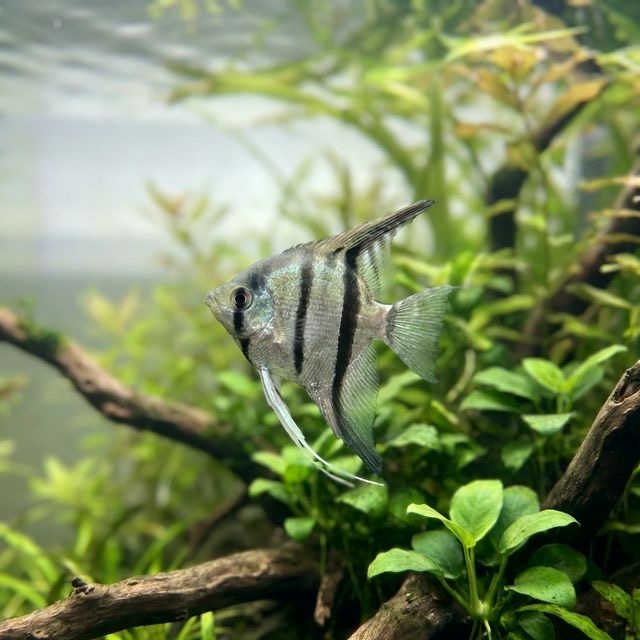
Bettas and angelfish both claim mid-water and vertical territory. Angelfish outmass bettas and can ram long fins; bettas retaliate and lose. Avoid this pairing by default in standard community tanks. Choose tank mates that occupy a different water column instead.
Scientific names: Betta (Betta splendens) · Angelfish (Pterophyllum scalare)
Compatibility summary
| | Betta | Angelfish | | --- | --- | --- | | Typical verdict | Usually avoid | Usually avoid | | Primary zone | Mid vertical cone | Tall mid sheet | | Main lever | No safe lane split | Spawning worse |
| Factor | Issue | | --- | --- | | Mass | Angelfish larger | | Finnage | Both extended | | Breeding | Extreme chase |
Behaviour analysis
Both species defend space they see through—not just floor area. Angelfish are tall cichlids; bettas hold vertical cones from favourite plants. They meet in the same slice of water. Angelfish ram; bettas tear fins and lose condition. Spawning angelfish multiply aggression toward anything that moves.
Why this pairing can work
This only works in rare, atypical tanks because the “problem” is built into the species behaviour. Angelfish and bettas both defend vertical space they can see, and in a small community footprint their zones overlap too often.
The few layouts that succeed do it by engineering escape and sight breaks: huge volume, heavy structure, and enough footprint that each fish can disengage without repeated contact. Even then, you must treat it as time-limited and keep separation equipment ready because juvenile angelfish often behave well until adulthood.
Why this pairing often fails
In normal community dimensions, angelfish outmatch bettas for vertical presence, and the betta cannot maintain a safe refuge. The result is repeated ramming, torn fins, and spawning-season escalation.
Beginners get misled by the “juvenile grace period.” Adults decide the outcome. Once the angels grow, their vertical territory expands and behaviour often escalates quickly, turning a “pretty young pair” into a chase tank overnight.
Environmental comparison
Angelfish want height; bettas want length and cover. Combined demand exceeds most “community” footprints.
| Parameter | Betta | Angelfish | Compromise | | --- | --- | --- | --- | | Temperature | 24–28 °C | 24–30 °C | Heat increases conflict pace | | pH / hardness | Wide | Soft–neutral | Not the limiting factor | | Flow | Gentle | Moderate OK | Separation beats tweaking flow |
Tank setup guidance
This is not a “tweak the decor and hope” pairing—the core problem is overlapping vertical territory. If you insist on attempting it, the tank must provide multiple vertical sight breaks and enough footprint that each fish can own a zone without constant pass-by contact.
Stocking order: if attempted at all, use a tank sized for adult angelfish first and treat the betta as the “last addition” under low light with a divider plan ready. If you do not have a divider/backup tank, don’t attempt it.
Minimum viable setup: very large footprint + vertical structure + a funded exit plan. Otherwise: choose one centerpiece species and build around it.
Risks
- Ramming and fin loss: trigger is adults in typical community dimensions. Signs: torn betta fins, angels cornering fish. Mitigation: separate quickly; do not wait for “settling.”
- Spawn aggression: trigger is angel pairing and egg guarding. Signs: sudden tank-wide chasing. Mitigation: divider, remove pair, or rehome—spawn season doesn’t negotiate.
- False juvenile safety: trigger is assuming young angels predict adult behaviour. Signs: “it was fine for months” then rapid escalation. Mitigation: plan separation before adult growth closes the window.
Tips
- Start here: betta tank mates · angelfish tank mates.
- Safer alternatives in this test: betta + Adolfos cory and Adolfos cory + angelfish.
- If you want angelfish with smaller mid-water fish, read first: neon tetra + angelfish.
- If you keep both, watch fins weekly and separate at the first repeat damage.
- Care sheets: Betta · Angelfish
FAQ
Are juvenile angelfish okay with a betta? Sometimes—briefly. Juveniles are not the adult behaviour you’re planning for.
Does a taller tank solve it? Height helps angelfish, but it doesn’t remove the visual overlap that triggers aggression. Footprint and sight breaks matter more.
Is a female betta safer? Sometimes less “banner” finnage helps, but the overlap in zone use remains.
Is a divider “cheating”? No—it’s the honest tool that prevents injuries when behaviour escalates.
Why do some people succeed online? Outlier individuals and very large, highly structured tanks. Match the volume and structure before copying the result.
Watching the first month
Juvenile angelfish in month one can look timid; month three they may own half the tank. Log body depth and height weekly—a sudden growth spurt is your cue to re-evaluate. Bettas that tolerated angels at 5 cm may not tolerate them at 10 cm. Vertical plants break sight lines better than one open rock pile.
If angels pair off, aggression toward the betta can spike overnight; have a divider plan or second tank funded before “maybe.” Feeding: angels compete mid-water; bettas at surface—spread food in time and space so neither starves. Tall tanks beat short cubes for this duo.
Watch betta operculum colour and breathing rate when angels fan fins—stress often precedes torn fins. For lower-risk alternatives, neon tetra and angelfish or guppy and angelfish spread risk across more, smaller fish. The angelfish tank mates hub ranks other combinations.
Chemistry, feeding rhythm, and when to split the tank
Large water changes in tall tanks can stratify temperature—mix before adding and match to within half a degree. Angels eat aggressively; bettas may hang back—offer betta-first surface food in one zone while angels feed mid-water in another. Long-term nitrate creep stresses both; tall tanks dilute visually but chemistry still needs discipline.
Split immediately if angels lip-lock with the betta, if the betta’s dorsal is torn repeatedly, or if angels begin circling the betta at glass. Adult angel pairs rarely “calm down” toward a betta. Pivot to neon tetra and angelfish or guppy and angelfish for angel-forward communities; betta and neon tetra keeps a smaller top-water footprint.
Glass surfing at identical times daily often tracks feeding expectation—vary schedule slightly to reduce obsessive pacing. If angels fan at the betta only after water changes, suspect temperature or pH swing, not sudden hatred.
Long-term management (weeks 5–12)
Juvenile angels that seemed polite often harden into territory holders by week eight. Height of the tank becomes survival space for the betta—without vertical breaks, angels corner from above. If you delay splitting until fins are ribbons, bacterial infection follows; act on posture changes before blood appears. Long-term success here is statistically rare in small tanks; document your volume honestly against adult angel size.
Breeding behaviour in angels can empty a betta’s safe zone for days; temporary divider or betta relocation beats “waiting out spawn.” For sustainable angel communities, neon tetra and angelfish and guppy and angelfish distribute predation risk; betta and neon tetra keeps the footprint smaller. Angelfish tank mates hub ranks the full compatibility grid.
Pre-purchase and add-order checklist
Do not impulse-buy juvenile angels for a betta tank without a tall, wide footprint and a second system. Quarantine both lines; parasites on either species stress the other faster in warm water. Add order: establish angels first only if the tank is large enough that the betta is not an afterthought—many keepers add betta last in a divided acclimation. Compare risk in guppy and angelfish and betta and neon tetra before spending.
Hardware: second cycled filter sponge or small tank ready within 48 hours; tall plants or vertical mesh to break sight lines before fish ship. Paper plan: write maximum adult angel height vs tank height—if two adult bodies stacked vertically exceed two thirds of water column height, the betta has no refuge. Medication: have a betta-safe ich plan and an angel-safe plan; they are not always the same formulation. Exit: agree in advance whether the betta or the angels leave if lip-locking starts—hesitation loses fish. Neon tetra and angelfish and Adolfos cory and angelfish show how angels behave with other guilds.
One-minute recap
Betta with angelfish is a tall-tank, small-sample gamble: juveniles lie, adults enforce height-based territory. Plants, feed angels well, betta last, and fund an angel exit before fins become data. Guppy and angelfish and neon tetra and angelfish are the usual angel communities; betta and neon tetra keeps risk smaller.
Document tank height in cm and compare to adult angel height at shops—if the math is tight, do not buy. Lip-locking between betta and angel is not “playing”; separate same day. Adolfos cory and angelfish shows how angels treat substrate fish when spawning.
Vertical driftwood gives angels display space without forcing the betta into a corner; horizontal wood alone often channels conflict. Night observation with a phone light reveals who sleeps where—stressed bettas camp surface corners every night.
Final verdict
Do not combine in standard setups. Use betta + Adolfos cory or Adolfos cory + angelfish instead.
If you already have both, separate the party that shows injury first—usually the betta once angels grow. This article exists so you can read the failure modes before buying; “it worked on YouTube” is not a volume calculation. Tall tanks without footprint still fail; footprint without height fails the betta. Document your actual cm of swimming length before checkout.
Also in this guide: betta adolfos cory · adolfos cory angelfish. Species: Betta · Angelfish. Hubs: Betta · Angelfish.