Ammonia in Aquariums: Testing, Toxicity, and Emergency Fixes
What aquarium ammonia is, why NH3 vs NH4+ matters with pH and temperature, how to test accurately, and step-by-step emergency response when levels spike.
Ammonia ($NH_3$ / $NH_4^+$)
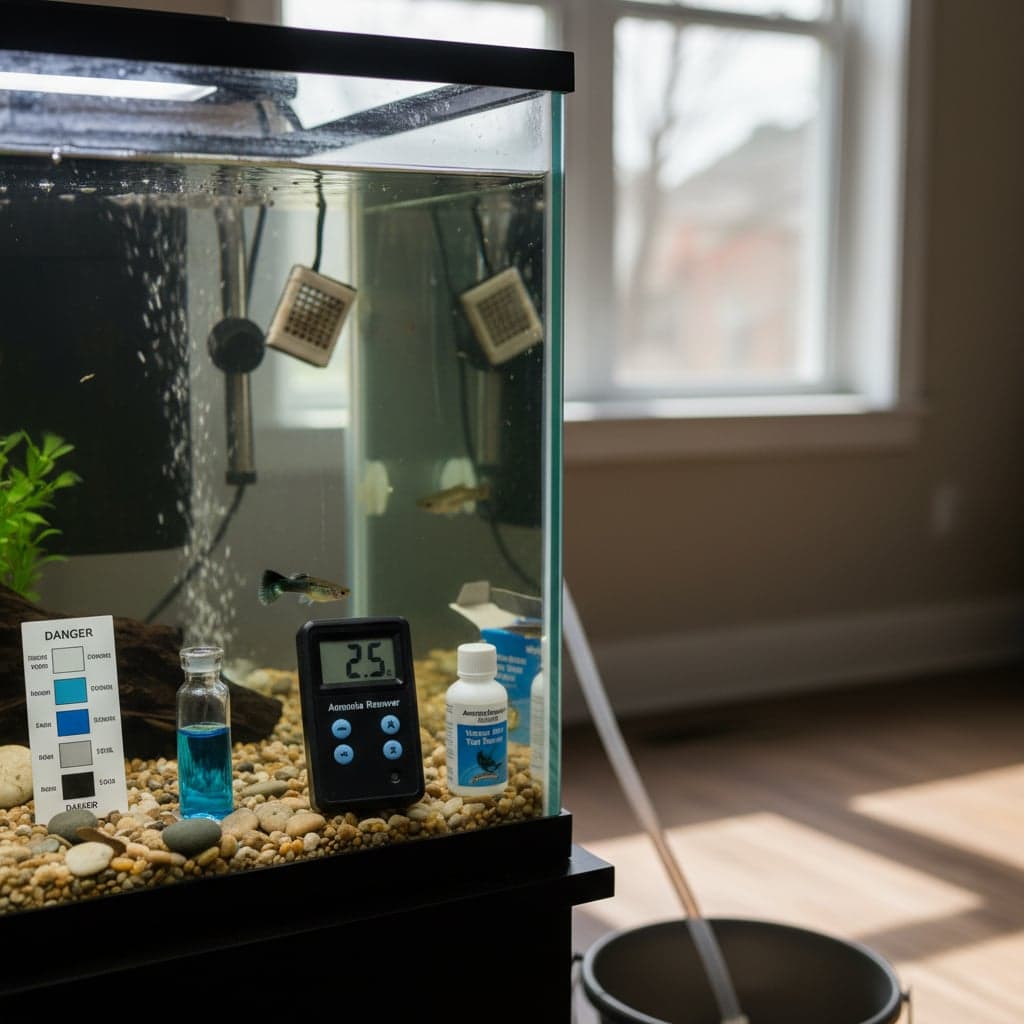
Ammonia is the first compound most aquarists learn to fear—and for good reason. In an uncycled or overloaded tank it rises fast, burns gills, and stresses fish long before you notice a problem. This guide explains what ammonia actually is, how free ammonia (NH₃) differs from ammonium (NH₄⁺), and what to do the moment a test kit shows anything above zero.
If you are new to the hobby, pair this page with our overview of the nitrogen cycle and nitrite and nitrate so you see where ammonia sits in the full picture.
Quick answer: What should ammonia read?
In a mature, cycled aquarium, total ammonia nitrogen should read 0 ppm on a liquid test. Any persistent reading above 0.25 ppm total ammonia needs action: find the source, dilute with a water change, and confirm beneficial bacteria are established in your filter—not just floating in the water column.
Where ammonia comes from
- Fish waste and respiration — Ammonia exits the gills and accumulates from digestion.
- Uneaten food — Organic debris decays and releases ammonia before nitrifiers process it.
- Dead plants and livestock — A hidden corpse or melting plant can fuel a spike overnight.
- Tap water — Rare, but chloramine-treated water releases ammonia when dechlorinated; always use a conditioner that handles chloramine (see chlorine and chloramines).
Symptoms in fish
You cannot see dissolved ammonia, but you can see its effects:
- Surface gasping — Fish hang at the top; gill tissue may look swollen or “burned.”
- Lethargy and clamped fins — Stress before obvious physical damage.
- Red or inflamed gills — Often described as lilac or raw-looking tissue.
- Darting or flashing — Sometimes confused with parasites; test water first.
NH₃ vs NH₄⁺: Why the same test number can mean different danger
Total ammonia nitrogen (TAN) exists mainly as toxic free ammonia (NH₃) or less toxic ammonium (NH₄⁺) depending on pH and temperature:
- Higher pH and higher temperature shift the balance toward NH₃, which crosses gill membranes more easily.
- Lower pH increases the proportion of NH₄⁺, which is still not “good”—it signals organic loading—but is less acutely toxic at the same total reading.
Practical takeaway: Do not use low pH as an excuse to ignore ammonia. The target is always 0 ppm total ammonia in a stocked tank. Use the relationship to interpret why a fish looks worse at pH 8.0 than at 6.5 with the same test strip result.
Emergency response (test shows > 0.25 ppm)
- Large water change — Often 40–50% with temperature-matched, properly dechlorinated water. Repeat the next day if needed.
- Stop feeding — Pausing food reduces new ammonia while bacteria catch up.
- Detoxifiers — Products such as Seachem Prime bind ammonia into a non-toxic form for 24–48 hours, buying time for biofilter recovery. They do not remove ammonia from the system; dilution and bacteria do.
- Find the cause — Dead stock, clogged filter, or a crashed cycle—fix the root issue or the spike returns.
Common mistakes
- Trusting “stability” over test results — Brown water or “clear” water does not prove zero ammonia.
- Small water changes during a crisis — A 10% change barely moves a toxic reading.
- Cleaning the filter in tap water — Chlorine kills nitrifying bacteria; rinse media in old tank water only.
Prevention and routine care
- Cycle before heavy stocking — Follow a fishless cycle or use mature, seeded media.
- Stock gradually — Add fish in stages so ammonia production matches bacterial capacity.
- Test weekly during the first months, or after any filter mishap or medication.
Frequently asked questions
Is 0.25 ppm ammonia always an emergency?
Treat it as urgent. In soft, acidic water some of that may be ammonium, but you should still identify why ammonia is present and remove it. In alkaline, warm water, the same reading is more dangerous.
Will plants remove ammonia?
Fast-growing plants and beneficial bacteria both consume ammonia, but plants are not a substitute for a cycled filter in a typical community tank.
Can I use an air stone instead of a water change?
Aeration improves gas exchange but does not remove ammonia. Dilution and biological processing do.