Aquarium Nitrogen Cycle Explained: Fishless Cycling and New Tank Syndrome
How the aquarium nitrogen cycle works, why ammonia and nitrite spike during cycling, how to fishless cycle safely, and how to avoid new tank syndrome.

The Nitrogen Cycle
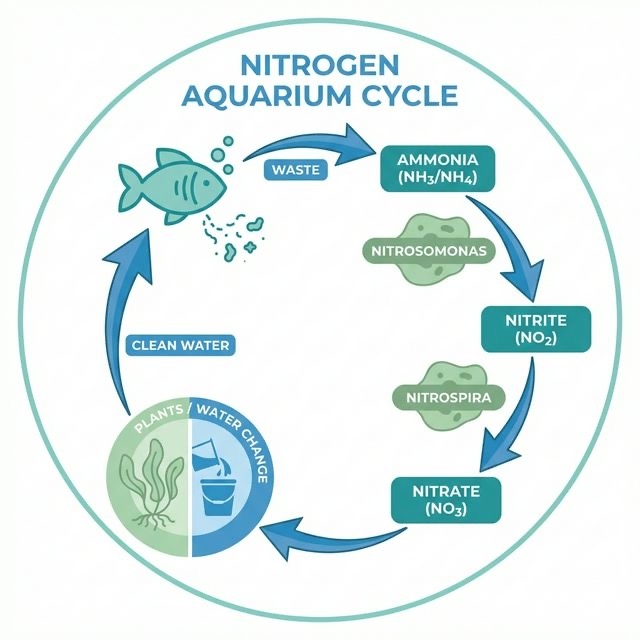
The nitrogen cycle is the biological process that converts fish waste from highly toxic ammonia into nitrite, then into nitrate, which you manage with water changes and plants. Without this bacterial pathway—hosted mainly in filter media, not in the water itself—most aquariums cannot safely hold fish for long.
If you understand one concept in fishkeeping, make it this one. It connects directly to ammonia chemistry, nitrite and nitrate management, and every decision about stocking and maintenance.
Quick answer: What does “cycled” mean?
A tank is cycled when beneficial bacteria can convert a measured dose of ammonia to nitrate within about 24 hours, with 0 ppm ammonia, 0 ppm nitrite, and only nitrate rising. Until then, adding fish is gambling with new tank syndrome—rapid ammonia buildup with no bacterial safety net.
The three stages (what your test kit tracks)
Stage 1: Ammonia ($NH_3$ / $NH_4^+$)
- Sources — Fish waste, uneaten food, decaying plant matter.
- Toxicity — Very high; see ammonia for NH₃ vs NH₄⁺.
- Bacteria — Nitrosomonas-type ammonia-oxidizing organisms convert ammonia to nitrite.
Stage 2: Nitrite ($NO_2^-$)
- Source — Oxidation of ammonia.
- Toxicity — High; interferes with oxygen transport in blood (see nitrite).
- Bacteria — Nitrite-oxidizing organisms (often Nitrospira in modern aquaria) convert nitrite to nitrate.
Stage 3: Nitrate ($NO_3^-$)
- Source — End product of aerobic nitrification in most home aquariums.
- Toxicity — Lower acutely than ammonia or nitrite, but chronic highs stress fish and fuel algae if light and nutrients align.
- Removal — You export nitrate with water changes; plants and anaerobic zones play secondary roles depending on setup.
How to cycle a tank (fishless method)
Fishless cycling means growing bacteria before fish load the system with waste.
- Run the full system — Filter, heater (if needed), dechlorinated water, and flow through mature-style media if possible.
- Add an ammonia source — Pure ammonia dosing to 2–4 ppm, or decaying fish food (messier, harder to control).
- Test often — Expect ammonia → nitrite → nitrate in that rough order; timelines vary (often 4–8+ weeks).
- Confirm the finish line — Dose ammonia to ~2 ppm; within 24 hours you should read 0 ammonia, 0 nitrite, with nitrate present. Then do a large water change and add fish gradually.
Seeding with mature filter media from a healthy tank can shorten the timeline dramatically—always confirm with tests, not calendar days.
New tank syndrome
New tank syndrome is what happens when fish go into a tank whose biofilter cannot process their waste yet: ammonia climbs, fish gasp or die within days, and beginners assume “fish are fragile.” Usually the biology was not ready. This is avoided by cycling first, stocking lightly, and testing water parameters during the first weeks.
Common mistakes
- Adding fish “to help cycle” — Fish suffer ammonia and nitrite exposure; use fishless methods when possible.
- Rinsing new media in tap water — Chlorine kills bacteria; use old tank water.
- Ignoring nitrite after ammonia drops — The cycle is not done until both read zero.
Maintenance mindset
Once cycled, the cycle still depends on stable flow, regular maintenance, and avoiding biocide exposure (some medications, untreated tap water). Think of the cycle as a living engine, not a one-time checkbox.
Frequently asked questions
How long does cycling take?
Typically several weeks without seeding; sometimes faster with mature media or bottled bacteria (quality varies—tests matter more than brand claims).
Can I use water from an old tank to cycle a new one?
Old water carries almost no nitrifying bacteria compared to filter media or surfaces. Move sponge or ceramic media, not just water.
Do plants replace cycling?
Plants absorb some ammonia and nitrate, but they do not replace a robust biofilter in most stocked aquaria.