Aquarium Water Changes: How Much, How Often, and Why
Why dilution beats polishing for nitrate and organics, schedules by bioload, temperature-matched changes, and mistakes that crash cycles or trigger shock.
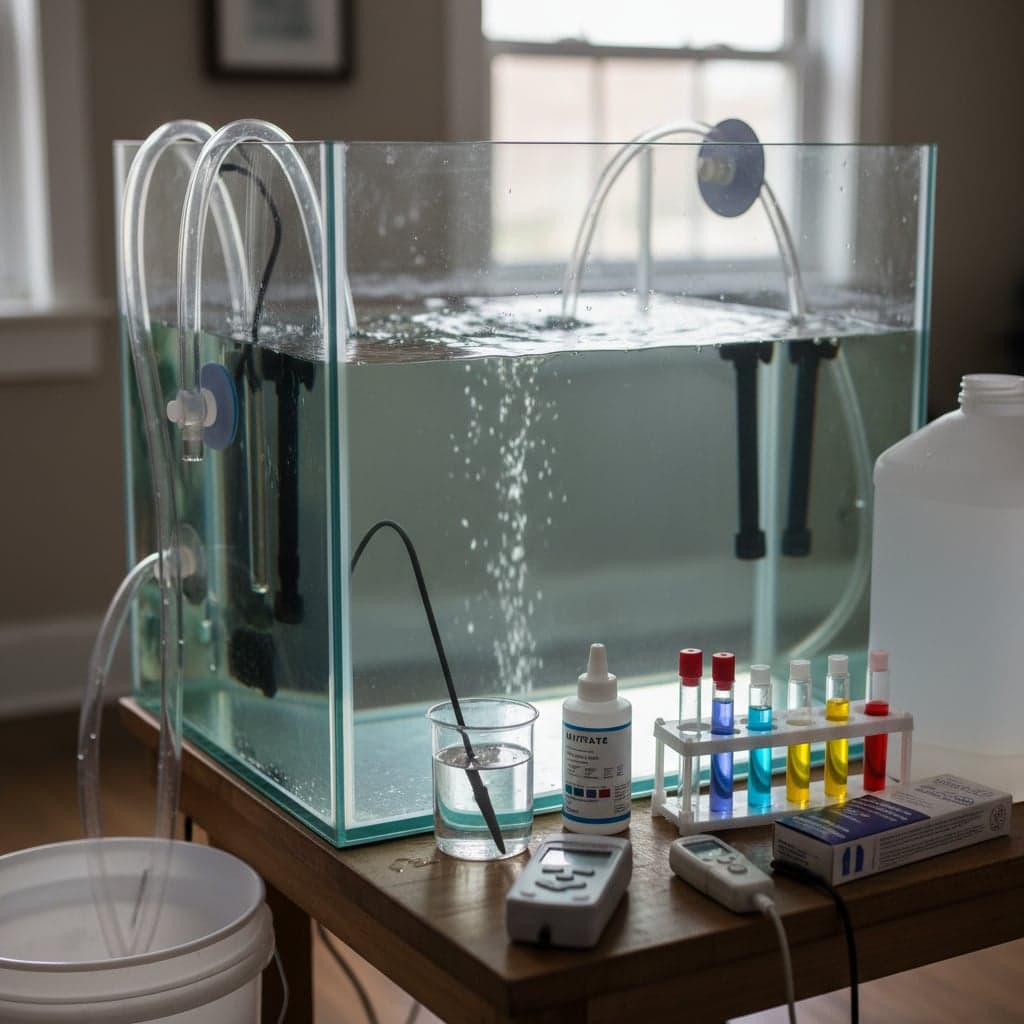
Water Changes: The Science of Dilution
Water changes are the most reliable export tool in freshwater fishkeeping. They remove a portion of nitrate, dissolved organics (often reflected in rising TDS), growth-inhibiting compounds released in crowded systems, and mulm—then replace volume with dechlorinated, temperature-matched water on a schedule you can sustain.
Quick answer: How much should I change?
For average community tanks, 25–30% weekly is a solid baseline. High-bioload setups—large goldfish, big cichlids—often need more. Sensitive shrimp setups often do better with smaller, more frequent changes than rare massive ones, to avoid TDS and osmotic swings.
Why changes work (and what they do not fix)
Closed aquaria accumulate waste unless you export it. Changes:
- Dilute nitrate and many dissolved organics
- Replenish KH and trace minerals from most tap sources, supporting pH stability
- Reduce dissolved stressors that build when stocking is heavy
They do not replace filter maintenance or fix ammonia if the cycle is broken—pair changes with diagnosis.
Schedules by context (starting points)
- Community tropical — 25–30% weekly
- Heavy feeders / large fish — 40–50% weekly, sometimes split across two sessions
- High-tech planted — Larger changes while dialing in fertilization and CO₂; settle toward ~30% once stable
- Caridina shrimp — 10–15% two or three times weekly often beats one huge monthly swing
Dilution math (why one change rarely “zeros” nitrates)
Each change removes a percentage of what is in the tank:
- 40 ppm nitrate → 25% change leaves ~30 ppm
- Another 25% leaves ~22.5 ppm
Very high legacy nitrate may require multiple sessions. Avoid panic-changing 90% in a long-neglected tank without checking GH, KH, and TDS—large osmotic shifts can shock fish.
Aging / pre-mixing water (optional)
Some aquarists pre-aerate buckets for 24 hours to stabilize temperature and degas excess CO₂—useful for sensitive stock or precision shrimp work, not mandatory for every aquarium.
Common mistakes
- First maintenance in months — One enormous change without testing can shock livestock; stage large corrections.
- Deep filter clean + huge water change same day — Split tasks to protect biofilter biomass.
- Cold tap slugs — Match temperature within a few degrees to reduce stress and ich triggers.
Frequently asked questions
Are water changes bad for planted tanks?
No—done correctly they reset errors, export organics, and stabilize nutrient drift. Plants still need consistent light and CO₂ strategy.
Should I vacuum substrate every change?
Light surface passes are common; deep gravel mining depends on goals—Walstad-style tanks may disturb less than high-turnover bare-bottom quarantine systems.
Do RO users change less often?
RO removes contaminants but also minerals—you remineralize on purpose. Change volume depends on TDS targets, not “less is always better.”