Nitrite and Nitrate in the Aquarium: Targets, Testing, and Export
Understand nitrite toxicity and brown blood risk, safe nitrate ranges for fish and plants, and practical ways to lower nitrate without crashing the tank.
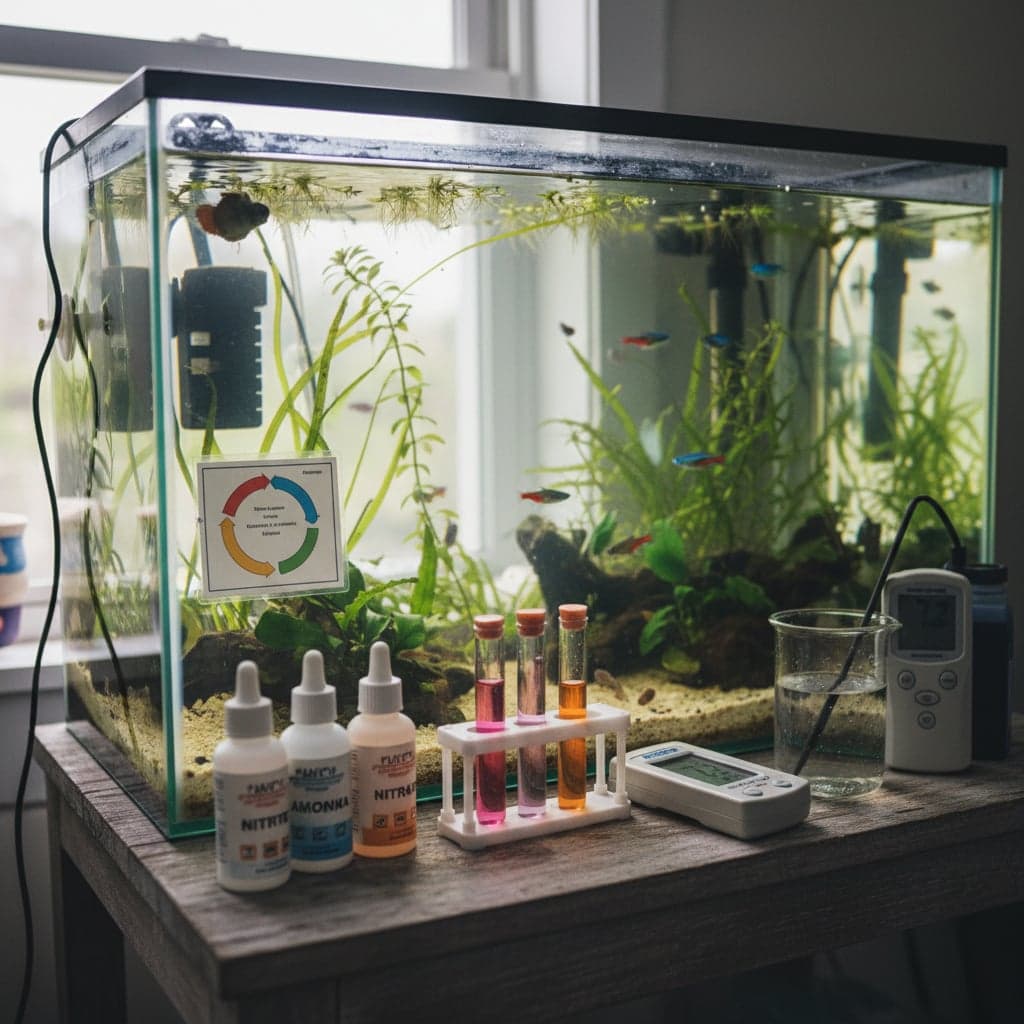
Nitrite ($NO_2^-$) and Nitrate ($NO_3^-$)
After ammonia is oxidized in the nitrogen cycle, the story is not over. Nitrite is the next gatekeeper: it is dangerously toxic at low levels. Nitrate is the usual end product in aerobic filters—less acutely toxic, but the compound you manage long term with water changes, plants, and feeding discipline.
This page separates emergency nitrite response from routine nitrate management so you know which test result means “drop everything” versus “adjust maintenance.”
Quick answer: Target numbers
| Parameter | Target (general community) | If high |
|---|---|---|
| Nitrite | 0 ppm — always | Water change immediately; find cycle disruption |
| Nitrate | ~5–20 ppm for many setups; <40 ppm often cited as upper “routine” | Increase change schedule; reduce feeding; add plants export as appropriate |
Sensitive species (some shrimp, wild discus, sensitive fry) often do better at the lower end of nitrate ranges—always research the species.
Part 1: Nitrite — the second spike
Nitrite appears when ammonia-oxidizing bacteria are working but nitrite-oxidizing populations are still catching up—common mid-cycle—or after a filter crash.
Why nitrite harms fish
Nitrite can convert hemoglobin to methemoglobin, which does not carry oxygen efficiently—sometimes called brown blood disease. Fish may gasp despite dissolved oxygen looking fine on paper.
Signs
- Brown-tinged gills, lethargy, piping at the surface
- Rapid gill movement without obvious parasites
What to do
- Water changes — The fastest way to dilute nitrite.
- Stop feeding until the source is controlled and tests improve.
- Salt (chloride) — In freshwater only, modest aquarium salt can reduce nitrite uptake through competitive inhibition; never assume salt is safe for all tanks—many plants, Corydoras, and scaleless fish need limits or zero salt. When in doubt, prioritize dilution.
Part 2: Nitrate — the long game
Nitrate accumulates because standard aerobic biofilters do not fully remove it; anaerobic denitrification is possible in specialized setups but is not the default for beginners.
Managing nitrate
- Water changes — Predictable, measurable export.
- Live plants — Fast growers and floating plants pull nitrate as nitrogen; high-tech CO₂ tanks may consume nitrate aggressively.
- Feeding and stocking — Less input means slower rise.
- Tap water check — Some regions have nitrates in source water; test fresh and tank water.
Nitrate and algae
High nitrate alone does not “cause” algae—imbalance of light, CO₂, and other nutrients does. Still, letting nitrate climb for months often tracks with organic buildup and maintenance drift.
Common mistakes
- Ignoring nitrite because “the tank was cycled last year” — Medications, deep cleaning, or new filter setup can disrupt bacteria.
- Chasing 0 nitrate in every tank — Planted tanks often run low; heavily fed fish-only tanks may sit higher with good maintenance—consistency and species needs matter more than a single universal number.
Frequently asked questions
My nitrite is 0 but nitrate is always high—why?
Usually infrequent water changes, heavy feeding, high stocking, or nitrate in tap water. Confirm with tests on tap vs tank.
Are nitrate “removal” filter media essential?
They can help in specific cases but are not a substitute for good maintenance. Water changes remain the reliable baseline.
Does nitrate affect pH?
Not as directly as KH and CO₂, but organic acids and overall husbandry tie into long-term stability—test GH/KH when troubleshooting swings.