TDS in Aquariums: What It Measures and How to Use It Safely
Total dissolved solids (TDS) explained for aquarists: conductivity vs ions, shrimp ranges, why TDS is a trend tool not a full diagnosis, and how to lower TDS with RO and changes.

TDS (Total Dissolved Solids)
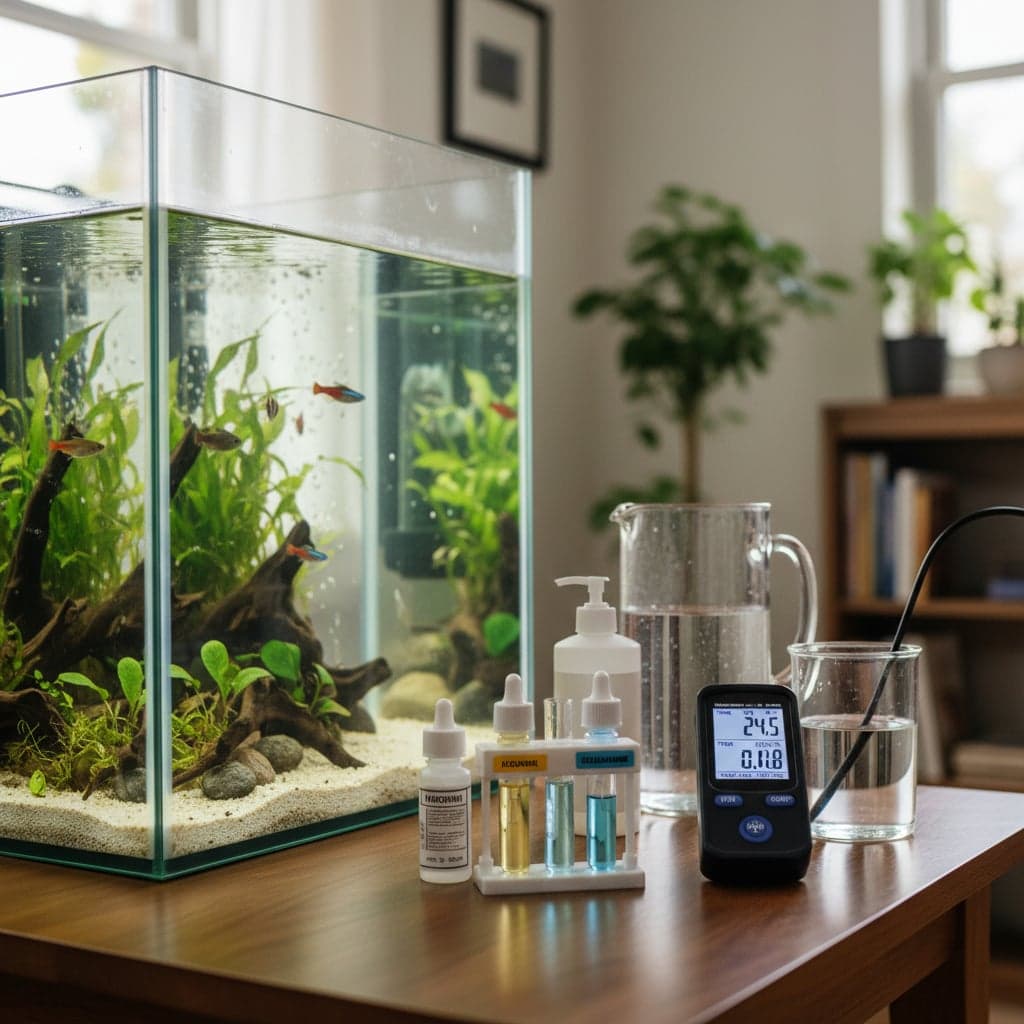
TDS estimates everything dissolved in water—minerals, salts, some organics, and waste products—usually inferred from electrical conductivity and displayed as ppm on a TDS meter. It is incredibly useful for shrimp keeping and RO remineralization but misleading if treated like a full water chemistry panel.
Quick answer: What is TDS good for?
Use TDS to track trends (is the tank creeping up between water changes?) and to hit a remineralization target after RO/DI. Do not infer ammonia, nitrite, or nitrate concentrations from TDS alone—use proper test kits.
What a TDS meter actually measures
Meters infer TDS from conductivity: pure water conducts poorly; ions (Ca²⁺, Mg²⁺, Na⁺, NO₃⁻, etc.) increase conductivity. Different brands use different conversion factors—compare consistency on your meter more than someone else’s absolute ppm online.
What contributes to TDS
- Calcium and magnesium (GH)
- Carbonates (KH)
- Nitrates, phosphates (nutrients)
- Sodium, chloride (tap variation, salt)
- Organics (tannins, waste, humics—see tannins)
Why TDS matters by tank type
Shrimp (Caridina vs Neocaridina)
Many keepers run Caridina in narrow TDS windows (often ~100–180 ppm depending on recipe) and Neocaridina more forgiving (~150–300 ppm commonly cited). Always pair TDS targets with GH/KH and species—TDS alone does not prove correct ion ratios.
Planted tanks
Rising TDS between water changes often tracks fertilizer buildup, evaporation (minerals concentrate), and organic load. If TDS climbs fast, revisit feeding and export.
General fishkeeping
Many fish tolerate wide TDS if acclimated—sudden large shifts (e.g., raw tap to pure RO) cause osmotic stress more than the endpoint number itself.
Limitations (read this twice)
The same TDS can mean different things:
- 250 ppm could be healthy remineralized RO or 250 ppm of nitrate-heavy waste water—TDS cannot distinguish.
You still need specific tests for ammonia, nitrite/nitrate, pH/KH, and conductivity sanity when troubleshooting.
Lowering TDS
- Water changes with lower-TDS source water
- RO/DI—starts near zero; remineralize intentionally for fish
- Reduce feeding and waste—less dissolved organics
Common mistakes
- Chasing a forum ppm without GH/KH context — Ion balance matters for molting.
- Ignoring evaporation top-off — Top-off with RO or RO mix to avoid creep in high-tech setups.
Frequently asked questions
Is high TDS always bad?
Not inherently—seawater is very high TDS by definition. Context and stability matter.
Can tannins raise TDS?
Yes—humic substances contribute to conductivity even when color is the visible clue.
Do I need a TDS meter if I keep only community fish?
Helpful, not mandatory—GH/KH tests often cover more ground for general freshwater.