Aquarium Temperature: Ranges, Stability, and Heater Safety
How water temperature drives fish metabolism, tropical vs coldwater ranges, avoiding thermal shock, and reducing risk from heater failure with redundancy and controllers.
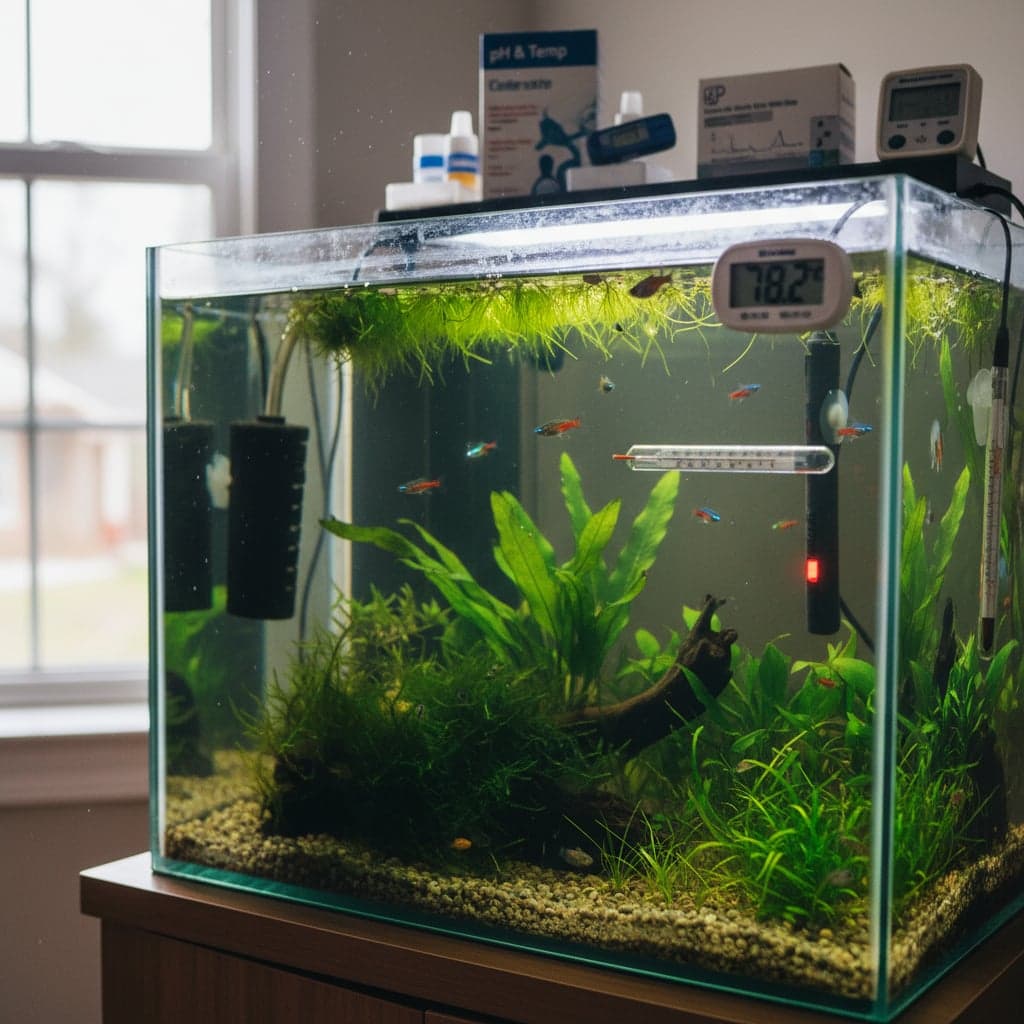
Temperature: The Metabolic Controller
Fish cannot thermoregulate like mammals—their body temperature matches the water. That makes temperature a master dial for digestion, immunity, oxygen availability, and breathing stress. It also means sudden swings (often from water changes or heater faults) cause more harm than being a degree off a textbook “ideal.”
Quick answer: What temperature should my tank be?
Match species to a stable band: most common tropical community fish do well around 24–27°C (75–81°F); coldwater fish like goldfish generally prefer cooler water than betta or discus. Always cross-check species sheets—this page gives framework, not a universal single number.
Tropical vs coldwater (how metabolism shifts)
Tropical fish (roughly 23–28°C / 74–82°F for many species)
- Higher metabolic rate — More appetite, faster growth, more waste → ammonia production scales with feeding.
- Immune function — Often optimized in mid-high tropical ranges for farm-raised stock.
- Risk if too cold — Sluggish behavior, ich susceptibility, poor digestion.
Coldwater fish (~10–22°C / 50–72°F for many species)
- Lower metabolism — Feed sparingly; long-term overheating stresses organs.
- Examples — Goldfish, white cloud minnow—do not park them at discus temperatures “for convenience.”
Stability beats chasing exact digits
A smooth daily rhythm of 1–2°F (~0.5–1°C) is less harmful than 10°F from a cold tap water dump. Thermal shock can trigger Ichthyophthirius outbreaks and acute stress.
Best practices during water changes:
- Match temperature within ~2°F when possible.
- Pour slowly or temper replacement water.
Heater failure: the hardware risk profile
Heaters fail eventually—usually in one of two ways:
- Stuck OFF — Temperature drifts down; often survivable if caught within a day in mild rooms.
- Stuck ON — Catastrophic in smaller volumes; can cook livestock.
Risk-reduction tactics
- Right-size or split heaters — Two smaller units reduce “single point of thermal runaway.”
- External controller — Inkbird-style cutoffs add a second thermostat layer.
- Daily glance — LED behavior, room temperature swings, and fish posture are free sensors.
Relationship to dissolved oxygen
Warmer water holds less O₂ than cold water. Hot high-biomass tanks with weak surface agitation are where low oxygen sneaks up—especially overnight in heavily planted systems when lights are off.
Common mistakes
- One cheap uncalibrated heater, no thermometer cross-check — Digital probes drift; verify periodically.
- Heating a coldwater species “because the room is cold” — Prefer room placement or species-appropriate stocking.
Frequently asked questions
Is a 78°F tank “too hot” for neons?
Many farmed neons tolerate mid-high 70s°F if stable; wild or cool-temperate species may not—research the exact stock.
Do I need a heater in summer?
Often yes—night drops and AC can swing tanks faster than open-air rooms.
How does temperature affect ammonia toxicity?
Higher temperature increases the proportion of toxic NH₃ at a given total ammonia reading—another reason to keep ammonia at zero, not “low enough.”