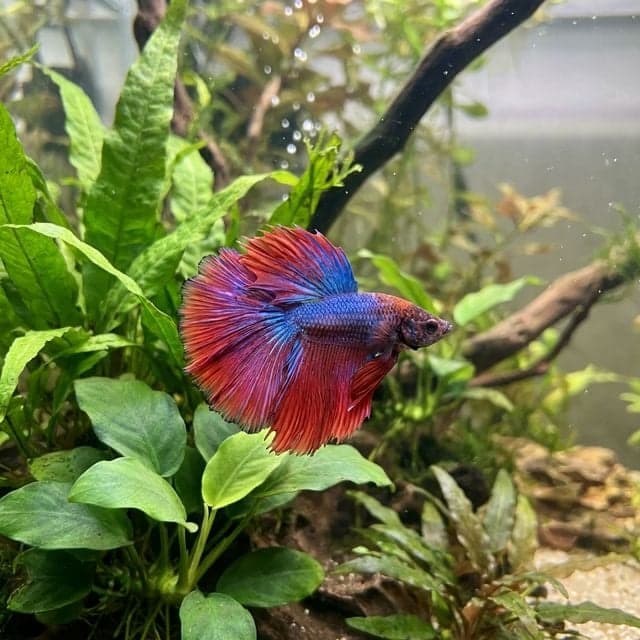
Female Bettas and Sororities: What Actually Works
Female bettas are not peaceful, and sororities fail more often than they succeed. What a sorority actually requires, why most collapse, and the honest alternatives.

The common belief is that male bettas fight and female bettas do not. The first half is true. The second half is the reason a lot of people have watched a carefully planned tank come apart over a weekend.
Female bettas are territorial, establish a hierarchy by force, and will kill each other. A sorority — a group of females kept together — is an advanced setup with a real failure rate, not the easy alternative to a single male that it is usually sold as.
Female bettas kept singly
Start here, because it is the option that gets skipped.
A single female betta is an excellent fish. She has the same personality, intelligence and responsiveness as a male, the same care requirements set out in betta tank size and setup, and shorter fins that make her a stronger swimmer and less prone to fin rot.
She is also a better community fish than a male, in a well-chosen setup. If what you wanted was "a betta in a planted community tank", a single female is very often the right answer and involves none of the risk below.
What a sorority actually requires
If you are going ahead, the requirements are not suggestions. Sororities fail on exactly these points.
Five to six females, minimum. The same logic as other aggressive-hierarchy fish: aggression concentrates on one victim in small groups. Two or three females is the worst possible number — one fish takes everything. Six spreads it.
75L / 20 gallons or more, and footprint matters more than volume. Territories are horizontal.
Heavy planting and broken sightlines. This is the requirement people underestimate most. The tank needs to be dense enough that a female can get out of another's line of sight completely — tall plants, driftwood, floating cover. An open tank with a few plastic plants at the back is not a sorority tank, and its failure is predictable rather than unlucky.
Introduce all at once. Every female goes in on the same day, into a tank none of them has claimed. Adding a female to an established sorority later usually means adding her to a hierarchy that has already decided she is an intruder.
Similar size and age, ideally sisters from the same spawn, which is why breeder-sourced sororities do better than shop-assembled ones.
A quarantine or hospital tank standing by, cycled. Not optional. This is the requirement that separates people who succeed from people who tell a sad story, because you will need to remove a fish at some point and you will need to do it that day.
Why they fail
Sororities collapse in a recognisable pattern, and it usually starts weeks after everyone has relaxed.
The group establishes a hierarchy in the first days with chasing and flaring, and this settles — which reads as success. Then something shifts the balance: one female matures faster, or the alpha weakens, or a fish gets ill. The hierarchy is renegotiated, and this time it is not display but sustained targeting of one fish, who stops feeding, hides, loses condition and dies or has to be removed. Removing her often just moves the target to the next fish down.
Signs that require action rather than observation:
- Sustained chasing rather than brief flare-and-separate
- One fish permanently hiding or holding in a corner
- Torn fins or missing scales on the same individual repeatedly
- One fish not feeding
The window between "settling in" and "one fish is being killed" is short, and the fix is always physical separation, never waiting.
The honest assessment
Sororities are genuinely beautiful when they work, and they work often enough that experienced keepers maintain them for years. They also fail often enough that most aquarium societies stopped recommending them to beginners.
The deciding factor is usually not skill — it is whether the keeper had somewhere to put a fish at short notice. A sorority is a two-tank project run in one tank most of the time.
If that sounds like more than you want, keep one female. You lose nothing except the group.
Female-specific things worth knowing
Egg binding. Females produce eggs whether or not a male is present, and occasionally become bound — visibly swollen with a distended abdomen. Usually it resolves on its own; distinguish it from dropsy by the pinecone scale profile, which egg binding does not produce.
The ovipositor. A small white spot between the ventral fins, sometimes mistaken for a parasite or a fungal growth. It is normal anatomy and is one way to sex a young betta.
Vertical stress stripes. Dark vertical bars across the body indicate stress or submission. Horizontal stripes usually mean something different — often readiness to breed. Both are useful signals in a sorority and worth learning to read.
They flare too. Females flare at each other and at their reflection, and a flaring female is not misidentified as a male. She is doing exactly what males do, with less fin.
Before you buy
- Consider a single female first — it is the better choice for most tanks.
- If committing to a sorority: 75L+, six females, bought together, heavily planted.
- Cycle a second tank before the sorority goes in.
- Watch feeding, not just fighting — a fish that stops eating is the early signal.
- Accept that it may not work, and decide in advance what you will do then.