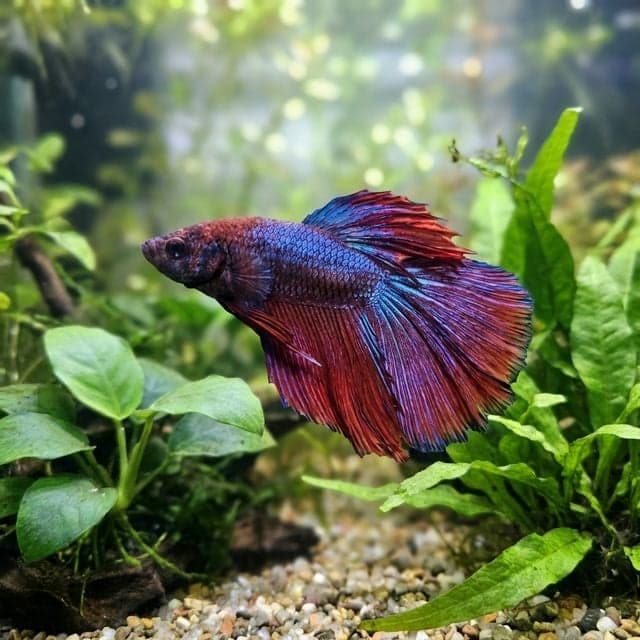
Betta Tail Types and Varieties Explained
Veiltail, halfmoon, crowntail, plakat, double tail and the rest — what the names mean, which are hardier, and why the most spectacular tails are the ones that cause the most problems.
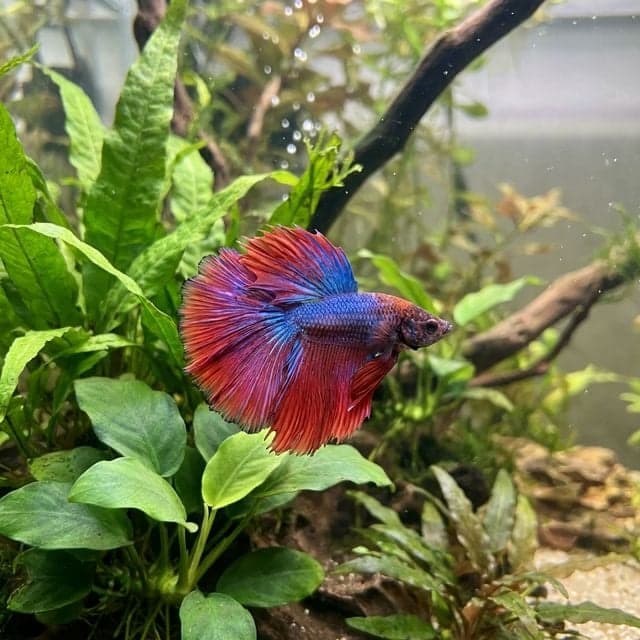
Betta names are two systems stacked on top of each other: one describing the shape of the fins, the other describing colour and pattern. A "koi plakat" is a pattern and a tail type. Once you can read the two halves separately, the wall of names in a shop tank stops being confusing.
There is also a practical dimension the labels do not advertise. Tail type affects how hard the fish is to keep, and the relationship is simple: the more spectacular the fin, the more the fish struggles with it.
Tail types
| Type | Shape | Notes |
|---|---|---|
| Veiltail | Long, drooping, asymmetrical | The default pet-shop betta. Cheap, widely available, and the fin is heavy for the fish. |
| Halfmoon | Spreads to a full 180° semicircle | The show standard. Spectacular and demanding — heavy fins tear and blow out easily. |
| Delta / Super Delta | Triangular, spreading to 120–160° | A middle ground. Most of the look, less of the fragility. |
| Crowntail | Rays extend past the webbing, giving a spiked edge | Striking, and the exposed rays are more prone to curling and damage in poor water. |
| Plakat | Short-finned, close to the wild form | The hardiest and most active. Strong swimmer, far less fin damage. |
| Double tail | Caudal split into two distinct lobes | Linked to a shortened body and often a compressed swim bladder — the most problem-prone type. |
| Halfmoon plakat (HMPK) | Short fins with a 180° spread | Increasingly the enthusiast's choice: the halfmoon shape without the fragility. |
| Dumbo / Elephant ear | Enlarged pectoral fins | A pectoral trait, combines with any tail type. |
Colour and pattern varieties
Pattern names sit on top of any of the above.
Solid — a single even colour: red, blue, black, white, yellow. Bi-colour — body one colour, fins another. Butterfly — a band of colour ending in a sharply defined pale outer edge. Marble — irregular patches that genuinely change over the fish's life, driven by a transposable element. A marble betta bought today may look substantially different in six months. This is normal and not a health sign. Koi — a marble variant selected for red, black and white patching. Currently the most sought-after pattern in the hobby. Dragon scale — thick, opaque, metallic scaling. Worth one caution: the same heavy scaling can grow over the eyes with age, causing "diamond eye" blindness. Mustard gas — dark body with contrasting yellow or orange fins. Alien — hybrids with wild Betta species; iridescent, more delicate, and not the same fish as a domestic splendens.
Which to actually buy
If you want the fish to do well with the least intervention, buy a plakat. Short fins mean a strong swimmer that is not exhausted by its own tail, does not snag on decor, and is far less prone to fin rot. Plakats are also the closest to the wild form and correspondingly robust.
If you want the display fish, a halfmoon or crowntail is worth it — but budget for the setup rather than only the fish. Long-finned bettas need gentle flow, soft decor and clean water more than plakats do, because their fins tear and then infect. The tank requirements in betta tank size and setup stop being recommendations and become requirements.
Approach double tails knowingly. The trait that splits the caudal fin also shortens the body, and swim bladder problems are meaningfully more common. They are a fine choice for someone who knows what they are watching for and a poor first betta.
What the labels do not tell you
Colour is not health. A pale betta in a shop cup is usually stressed and cold rather than poorly bred, and often colours up dramatically within a fortnight in a heated tank. Judge condition on fin edges, gill movement, alertness and whether the fish responds to you — not on saturation.
Fin size does not scale with tank requirement, but fin fragility does. Every tail type here fits the same 19L minimum. The long-finned ones simply punish a badly set up tank faster.
Females have tail types too. They are just shorter-finned versions of the same genetics, which is why female bettas look plainer even in expensive lines. See sororities and female bettas.
Before you buy
- Decide short-finned or long-finned first; it matters more than the colour.
- Plakat for a first betta, or for any tank with a filter you cannot fully baffle.
- Check fin edges for splits and the gills for redness before paying.
- Expect a marble to change pattern — that is the variety working as intended.
- Ignore the colour in the cup; look at the behaviour.