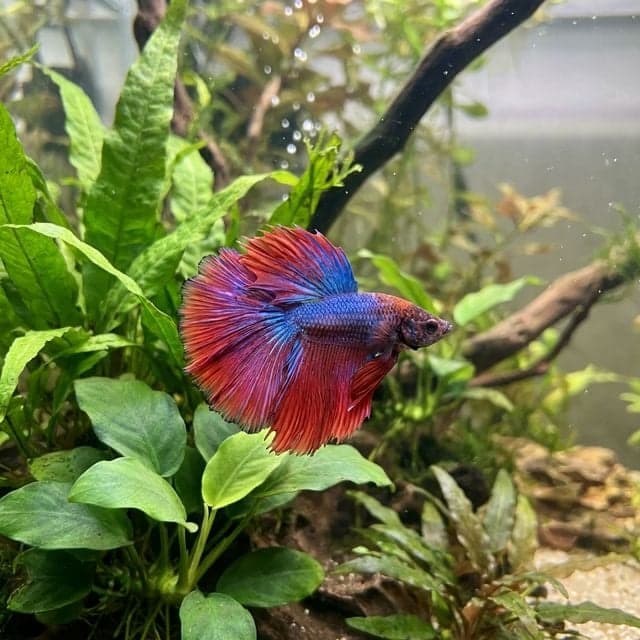
Betta Tank Size and Setup: What They Actually Need
The five-gallon minimum, why bowls and desktop cubes fail, and the four things a betta tank needs that a community tank does not: a lid, a heater, gentle flow and resting places.
Bettas are sold in cups, so people conclude they live in cups. The reasoning is understandable and the conclusion is wrong, and it is responsible for more premature betta deaths than every disease combined.
The origin of the myth is a real fact bent out of shape. Wild Betta splendens live in the shallow, slow, warm, vegetated waters of the Mekong basin — rice paddies, marshes and floodplains. Shallow is not the same as small. A rice paddy is warm, densely planted, biologically mature and effectively unlimited in area. A 1L vase on a desk is none of those things.
The minimum, and why
19 litres / 5 US gallons for a single betta. Not because a betta needs the volume to swim in, but because it needs it to survive your mistakes.
Small volumes fail on three counts at once. Waste concentrates fast, so a missed water change becomes an ammonia event rather than a slightly high reading. Temperature swings hard, because thermal mass scales with volume — and bettas are unusually sensitive to that. And most tanks under about 15L cannot hold a stable nitrogen cycle, which means the filter never fully matures.
| Tank | Verdict |
|---|---|
| Bowl / vase, unfiltered | No. Unheated, uncycled, and unstable in every dimension. |
| 10L / 2.5 gal desktop cube | Survivable, unforgiving. Constant maintenance, no margin. |
| 19L / 5 gal | The realistic minimum. Stable, cyclable, easy to heat. |
| 38L / 10 gal | The sweet spot. Room for planting, and the first size that suits tank mates. |
| 75L+ / 20 gal+ | Excellent. Required if you are considering a sorority. |
Footprint beats height. Bettas are surface-oriented and need to reach the surface easily; a tall narrow column is a worse tank than a long shallow one of the same volume.
The lid is not optional
Bettas are accomplished jumpers, and in the wild that is a feature — it is how they move between drying pools. In a home it is how they end up on the carpet.
Every betta tank needs a lid or a cover glass, with gaps around filter and cable cutouts blocked. Leave 2–3cm of air between the water surface and the lid, though, because bettas are labyrinth breathers: they have an accessory organ that lets them take atmospheric air at the surface, and they need to do it. A tank filled to the brim with a sealed lid removes the air gap they breathe from.
That same organ is why bettas tolerate oxygen-poor water that would kill most fish. It is not a licence to skip the filter — it just means low oxygen is not the thing that gets them.
Heating
Bettas are tropical and need 25–27°C (78–80°F), held steadily.
This is warmer than a lot of community tanks run, and it is not negotiable. A betta at room temperature is the classic "lethargic betta lying on the substrate" case: below about 23°C the immune system slows, appetite drops, and the fish becomes a candidate for every opportunistic infection going. Owners usually read this as personality or old age.
An adjustable 25–50W heater suits a 19L tank. Buy a separate thermometer — heater dials are routinely out by a couple of degrees, and two degrees matters here.
Flow, and why bettas hate it
A show betta is dragging a large ornamental fin behind a body that was not built to power it. Strong flow exhausts them, pins them against the glass and stops them feeding.
Aim for gentle circulation. A sponge filter on a low air setting is close to ideal. If you are using a hang-on-back or internal filter, baffle the outflow — a piece of filter sponge over the nozzle, or the outflow directed at the glass, is enough. If your betta is holding station behind decor or resting on the bottom near the substrate, check the flow before you check for disease.
Decor: soft, dense, and with places to rest
Two rules cover most of it.
Nothing sharp. Betta fins tear on hard plastic plants, rough ornaments and sharp rockwork, and torn fins are the route into fin rot. The old fabric test still works: drag a pair of tights over the decoration, and if it snags, it will snag a fin.
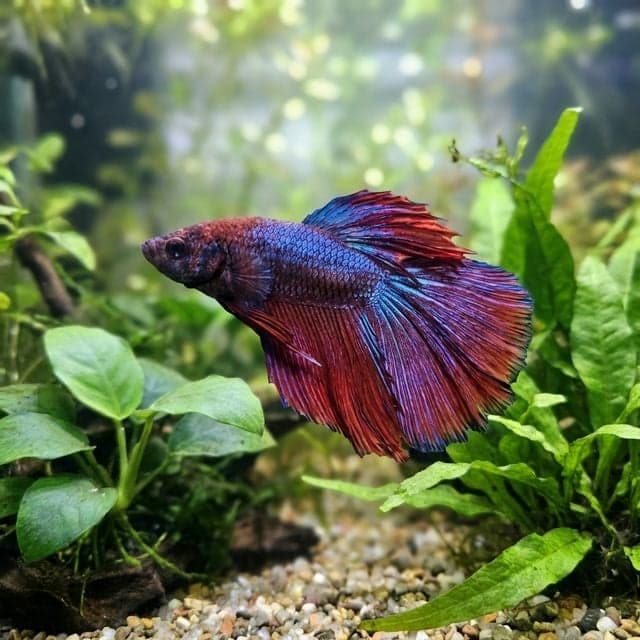
Somewhere to rest. Bettas sleep and loaf, often near the surface and often on top of something. Broad-leaved plants, floating plants, a betta hammock or a piece of driftwood near the top all get used, and a betta with resting spots is a visibly more relaxed fish than one in a bare tank.
Live plants suit them well — dense planting mimics the vegetated water they come from, and floating cover in particular reduces the skittishness bettas show in bright open tanks. Indian almond leaves are widely used and genuinely useful, releasing tannins that lightly tint the water toward what the fish evolved in.
Tank mates, briefly
A betta can live alone indefinitely and many do best that way. If you do want a community, 38L is the sensible floor and the constraints are real: nothing nippy, nothing brightly finned that reads as a rival, nothing that needs strong flow or cooler water.
Species-by-species verdicts are in the betta tank mate guide rather than here. Note that females are not automatically a safe community either — see sororities and female bettas.
Before you buy
- 19L minimum, 38L if you want any flexibility.
- Heater and separate thermometer, targeting 25–27°C.
- A lid, with an air gap beneath it.
- Gentle filtration — sponge filter, or baffle what you have.
- Soft decor, live or silk plants, and something broad near the surface to rest on.
- Cycle the tank before the fish arrives, not after.