Are Zebra Danios Fin Nippers? Behaviour Explained
Zebra danios nip, but not in the way people assume. What the chasing actually is, which tank mates it ruins, and the counterintuitive fix.
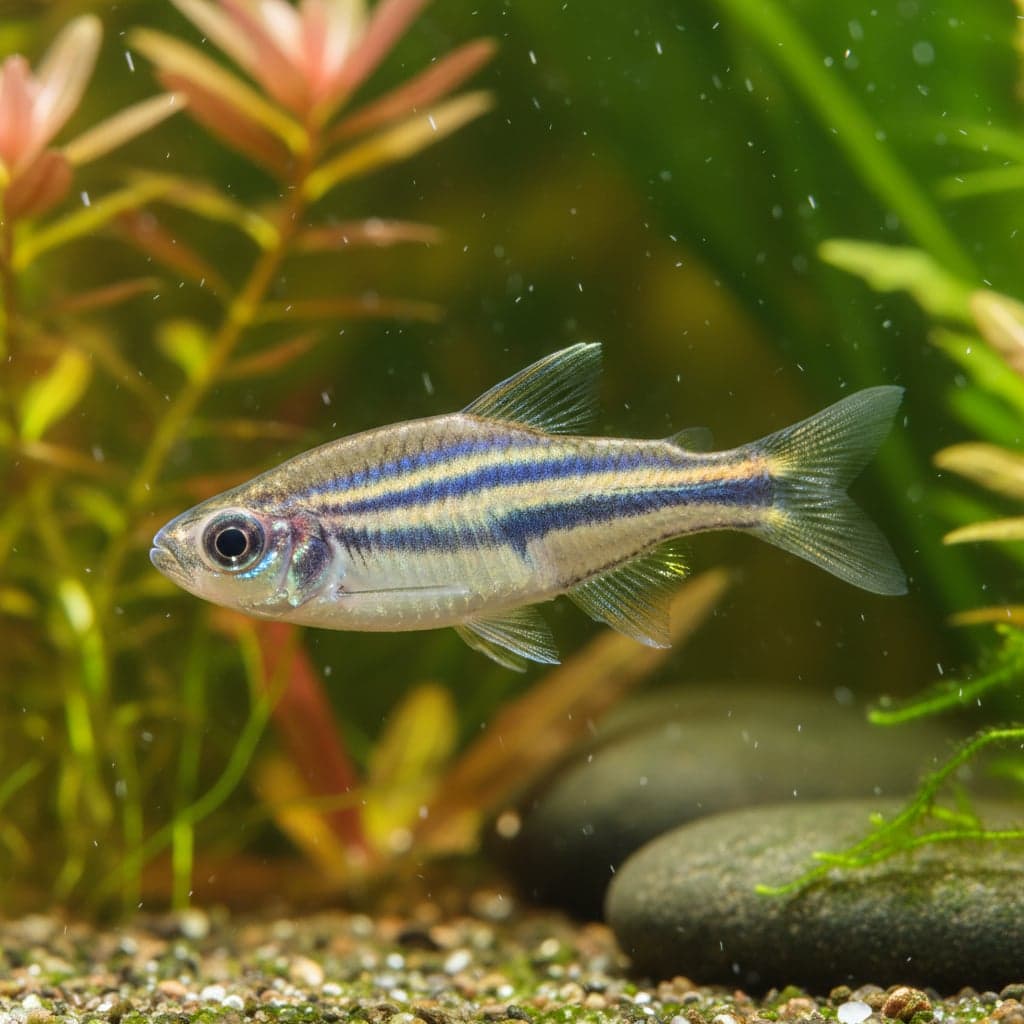
Zebra danios have two reputations that contradict each other: bulletproof beginner fish, and menace that destroys a betta's fins. Both are earned, and the difference between them is mostly the tank they are in.
The useful reframe: danios are not aggressive, they are relentless. There is very little malice in the behaviour and a great deal of speed, and the damage comes from that speed applied constantly to a fish that cannot get away.
What the chasing actually is
Danios maintain a loose dominance hierarchy through near-continuous pursuit. Two fish chase, one gives way, the order updates, and it happens again a minute later all day long. In a stream this plays out across a large area and nobody is cornered.
In a tank, three things change it into a problem:
Too few fish. With four or five danios, the pursuit concentrates. One individual absorbs most of it, cannot rest, cannot feed properly, and develops frayed fins and faded colour. With twelve, the same behaviour distributes and nobody is a permanent target.
Too short a tank. Chasing needs somewhere to go. Under 60cm the pursued fish runs out of tank, turns, and is pursued again immediately. Length converts harassment into exercise.
A tank mate that cannot escape. This is where the reputation comes from — and it is a compatibility failure rather than a danio behaviour problem.
Which fish it ruins
The rule is simple: anything slow with long fins.
Bettas are the classic disaster. A betta cannot outswim a danio and its fins are an obvious target. The pairing is sold constantly and works badly — see betta and zebra danio.
Fancy guppies, particularly heavily finned veiltail males, for the same reason. Guppy and zebra danio can work in a long, well-stocked tank and often does not in a small one.
Angelfish, whose trailing ventral fins are irresistible, and which are slow enough to be caught.
Gouramis with long feeler rays.
Fish that are fine: anything fast and short-finned. Other danios, rasboras, barbs, and robust tetras. Bottom dwellers like corydoras and kuhli loaches are largely ignored, though they may lose out at feeding time.
The counterintuitive fix
Add more danios.
Every instinct says that adding more of the fish causing the problem will make it worse. It does the opposite, and it is the single most effective intervention available. Going from six to twelve typically resolves visible fin nipping within a week or two, because the behaviour that was concentrated on one victim is now spread across a proper shoal.
In order of effect:
- Increase the group to 10–12.
- Increase tank length to 60cm or more, if it is shorter.
- Remove the long-finned species, or rehome the danios. Some pairings do not work in any tank, and a betta with danios is one of them.
- Break sightlines with planting at the sides while keeping an open central lane, so a pursued fish can break contact.
- Feed at two points in the tank at once, so speed does not monopolise food.
More detail on group and tank sizing is in tank size and schooling.
Telling nipping from disease
Damage caused by nipping and damage caused by fin rot look different once you know.
Nipping leaves clean, sharp, often V-shaped tears, appearing suddenly and usually on the trailing edges. The fin tissue either side is healthy.
Fin rot produces ragged, receding edges with discoloured — dark, red or white — margins, and progresses gradually over days.
They combine, which is the real risk: a nipped fin is an open wound, and in a tank with marginal water quality it becomes fin rot within a week. If you see nipping damage, check ammonia and nitrite as well as fixing the social cause.
Normal behaviour you do not need to fix
Constant motion. Danios never settle. This is not stress. Surfing the filter outflow. They like current and will play in it deliberately. Sudden coordinated dashes. Normal shoaling response. Chasing at feeding time. Expected; only a concern if one fish is never eating. Jumping. Real, and the reason a lid is mandatory.
The signals that do warrant action are one fish being permanently isolated, a fish that is never getting food, clamped fins, or damage that keeps appearing on the same individual.
Before you buy
- Assume you need ten or more, not six.
- Do not buy danios for a tank containing a betta, fancy guppies or angelfish.
- Measure the tank length; under 60cm the behaviour concentrates.
- If nipping starts, add danios before you remove them.
- Check water quality whenever you see fin damage, whatever caused it.