Zebra Danio Tank Size and School Size
Zebra danios need length, not volume, and a group of at least eight. In a short tank or a small group they become the fin-nipper everyone complains about.
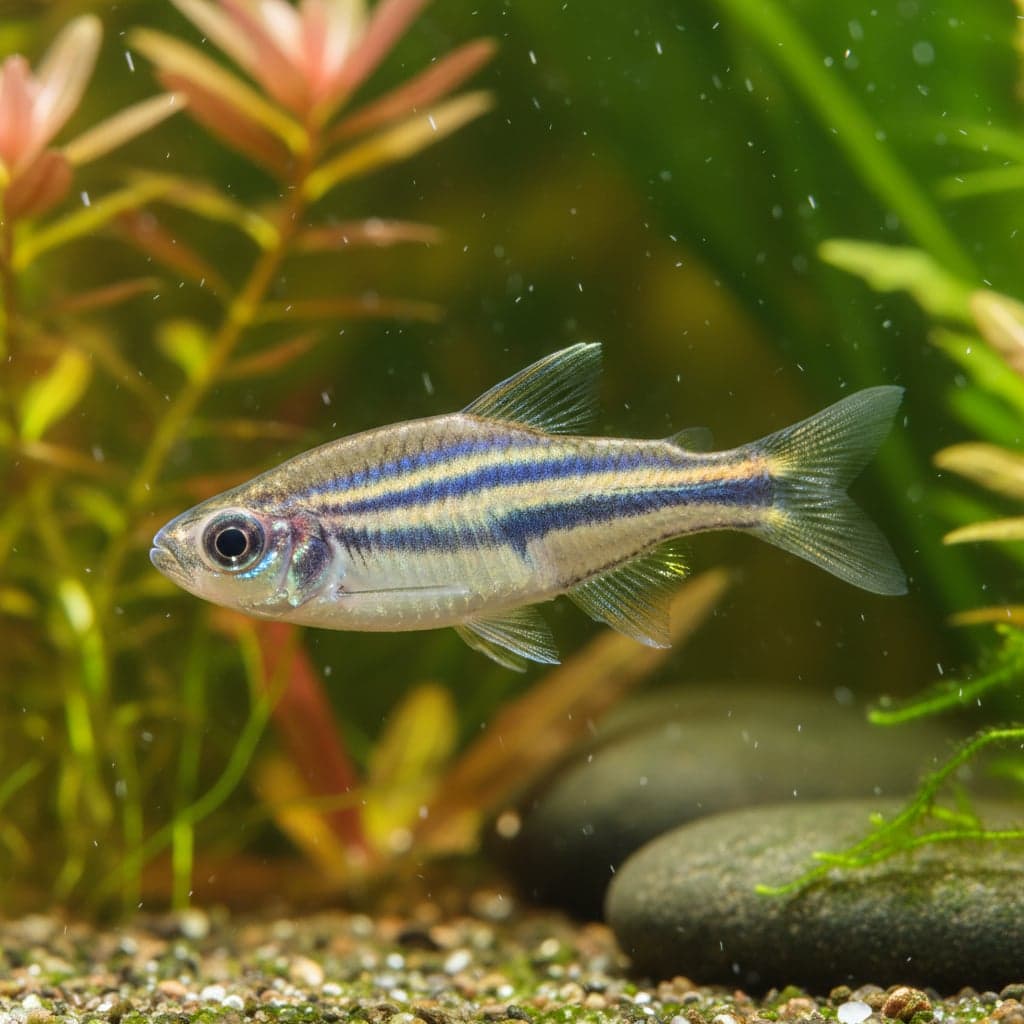
Zebra danios are the fish people buy because they are indestructible and then complain about because they never stop moving. Both things are true, and the second one is the constraint that decides the tank.
They are not a small fish in the sense that matters. They are a small fish that needs a long tank, and almost every problem attributed to them — fin nipping, harassment of slower species, jumping — traces back to a tank too short or a group too small.
Length is the whole specification
Zebra danios are stream fish from fast-flowing water in northern India, Bangladesh and Nepal, and they swim continuously along a horizontal axis. In a tall tank they use the top third and ignore the rest.
| Tank | Group | Notes |
|---|---|---|
| 40L / 10 gal (50cm) | Not recommended | Too short. Sold as a danio tank constantly and it produces the nipping behaviour. |
| 60L / 15 gal (60cm) | 8–10 | Workable minimum, with the length being the point rather than the volume. |
| 100L / 25 gal (80cm) | 12–15 | Comfortable. Behaviour visibly calmer. |
| 180L+ / 45 gal+ (100cm+) | 20+ | Where they look genuinely good — a fast shoal along a long tank. |
A 60cm tank of 54 litres is a better danio tank than a 60-litre cube. Compare footprints, not capacities.
Eight or more, and why fewer causes problems
Danios establish a loose hierarchy and chase constantly as part of normal social behaviour. This is not aggression in the usual sense — it is the species being itself — but the distribution of that chasing depends entirely on how many fish there are.
In a group of four, one fish absorbs most of it and ends up with shredded fins and no time to feed. In a group of twelve, the same total amount of chasing is spread thin and looks like play.
Eight is the practical minimum; twelve is better. This is also the fix for the fin-nipping reputation, which is covered fully in fin nipping and behaviour.
Adding more danios is the counterintuitive solution to danios being a problem, and it works more reliably than any other intervention.
Flow, oxygen and a lid
Three setup details that matter more for this species than for most.
They want flow. Unlike most community fish, danios genuinely enjoy current and will play in a filter outflow. A powerhead or a slightly oversized filter is a feature, not a problem. Well-oxygenated moving water is closer to their stream habitat than the still tank most community fish prefer.
They jump. Reliably, and further than you expect. A lid or cover glass is not optional, and the gaps around filter cutouts are where they get out.
They tolerate cooler water than a heater usually provides, which is a real option worth its own discussion — see temperature and unheated tanks.
Layout
Open water in the middle, planting at the back and sides. Danios use the top two thirds and want a clear run; heavy planting throughout a small tank removes the swimming lane and concentrates them.
Their speed at feeding time is worth planning around. Danios reach food first, every time, and slower tank mates — corydoras, kuhli loaches, anything bottom-dwelling — can be quietly outcompeted over months. Sinking food dropped at the opposite end of the tank while the danios are busy at the surface is the standard workaround.
What they are good with
Fast, robust, similarly paced fish. They are poor company for anything slow and long-finned: bettas and fancy guppies are the two classic mismatches, since trailing fins invite nipping. Verdicts by species are in the zebra danio tank mate guide.
Notably, danios are efficient fry predators. A danio in a livebearer tank will hold the population near zero recruitment on its own — occasionally exactly what someone with a guppy population problem actually wants.
Before you buy
- Measure length, not litres. 60cm minimum.
- Buy eight at once, ideally twelve.
- Fit a lid and block the filter cutouts.
- Give them flow rather than protecting them from it.
- Do not pair them with long-finned or slow fish.
- Plan how bottom dwellers will get fed.