Do Zebra Danios Need a Heater? Temperature Explained
Zebra danios are the one common community fish that genuinely does well unheated — in the right room. The real range, when to skip the heater, and why warm tanks shorten their lives.
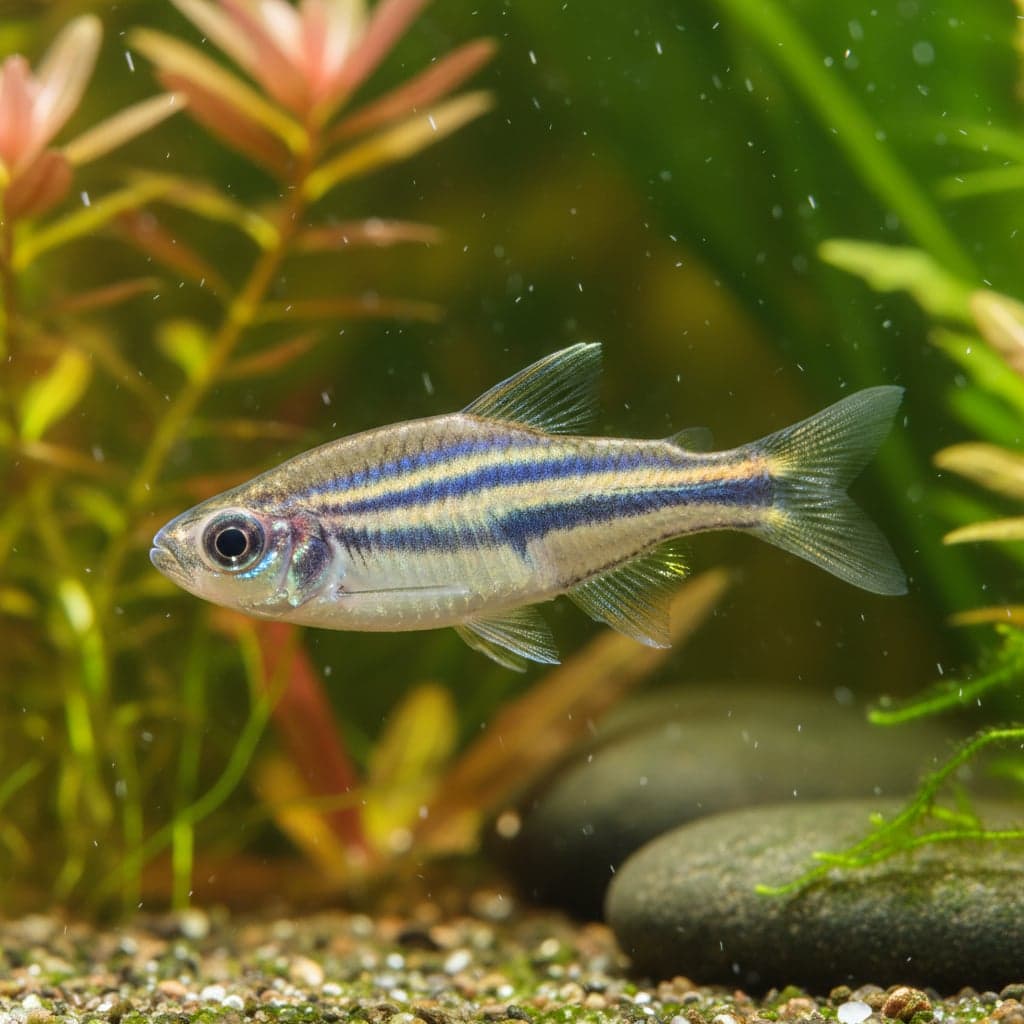
Almost every "can I keep this fish without a heater" question deserves a no. This is the exception, and it is worth being precise about, because the exception gets overstated as often as it gets ignored.
Zebra danios are subtropical, not tropical. They come from rivers and paddy fields in northern India, Bangladesh and Nepal that swing seasonally from around 16°C to the high twenties. A stable room-temperature tank sits comfortably inside that range.
The range
| Temperature | Effect |
|---|---|
| Below 15°C | Too cold. Immune function drops; risk of white spot. |
| 16–18°C | Survivable and used in outdoor tubs seasonally. Slow, subdued fish. |
| 18–24°C | The target band. Best colour, best activity, longest life. |
| 25–26°C | Fine, common in community tanks. Slightly accelerated ageing. |
| 27–28°C | The top of tolerance. Oxygen drops as demand rises; noticeably shorter lives. |
| Above 28°C | Stressful. Surface gasping. |
The useful figure is 20–22°C — comfortably achieved in most heated homes with no aquarium heater at all.
When to skip the heater
Skip it if the room genuinely holds 18°C or above, day and night, all year. In a centrally heated home that is usually true. Check at 6am in February before committing, because the overnight low is what matters, not the daytime feel.
Fit a heater if any of these apply:
- The room drops below 18°C overnight in winter.
- The tank is in a conservatory, porch, garage or against a poorly insulated outside wall.
- You keep tank mates that need warmth — most do. Danios are usually the only fish in a community that would tolerate an unheated tank, so the heater is generally there for everyone else.
Where a heater is fitted, set it low — 21 or 22°C rather than the 25–26°C most people default to. This is free lifespan.
A heater set to 20°C also has a useful secondary role in an unheated tank: it does nothing most of the time and catches the cold snap.
Why warm water costs them
Danios are ectotherms, so temperature sets metabolic rate directly. Kept at 27°C they grow faster, breed sooner, and age faster. Kept at 20–22°C they live substantially longer.
There is a second effect specific to this species. Danios have a high oxygen demand for their size — they are continuous swimmers from fast, well-aerated water — and warm water holds less dissolved oxygen. A warm, heavily stocked danio tank runs closer to the oxygen limit than most, which is why surface gasping shows up in danios before it shows up in tank mates.
Danios are also widely used as a laboratory model organism, and the standard husbandry temperature there is around 28°C for exactly the reason you would expect: it accelerates development and shortens generation time. That is optimal for producing fish quickly, and the opposite of what you want in a display tank.
Stability, and the actual risk of an unheated tank
The real hazard of running without a heater is not cold. It is swing.
A room that sits at 21°C by day and 15°C by night puts the fish through a 6°C cycle every 24 hours, and that suppresses the immune system independently of the average. A steadily cool tank is fine; a swinging one is not.
Larger tanks swing less. If you are running unheated, volume is genuinely protective, and a 100L tank is far more forgiving than a 40L one.
Watch for cold-related white spot, which is the usual consequence of a cold snap in an unheated tank. Treat by raising the temperature slowly with a heater and adding aeration.
Other parameters
Danios are indifferent to chemistry by community fish standards.
- pH 6.5–8.0 — a genuinely wide band.
- GH 5–19 dGH — soft to hard, all workable.
- Ammonia and nitrite zero, nitrate under 40 ppm.
This tolerance is why they were historically used as cycling fish, a practice worth abandoning: they survive it, but they are being harmed to do it, and fishless cycling works better anyway.
Their one real preference is oxygen and movement. Surface agitation, a filter returning above the waterline, or a powerhead all suit them.
Before you buy
- Measure the room at 6am in winter before deciding on a heater.
- If you fit one, set it to 21–22°C, not 25°C.
- Remember the heater is usually for the tank mates, not the danios.
- Prioritise surface agitation and oxygen over precise chemistry.
- Bigger tanks swing less — worth it if running unheated.