Breeding Zebra Danios: The Easiest Egg Layer
Zebra danios are the easiest egg-scattering fish to breed and the standard first project. Conditioning, the marble trick, and raising fry that are too small for brine shrimp.
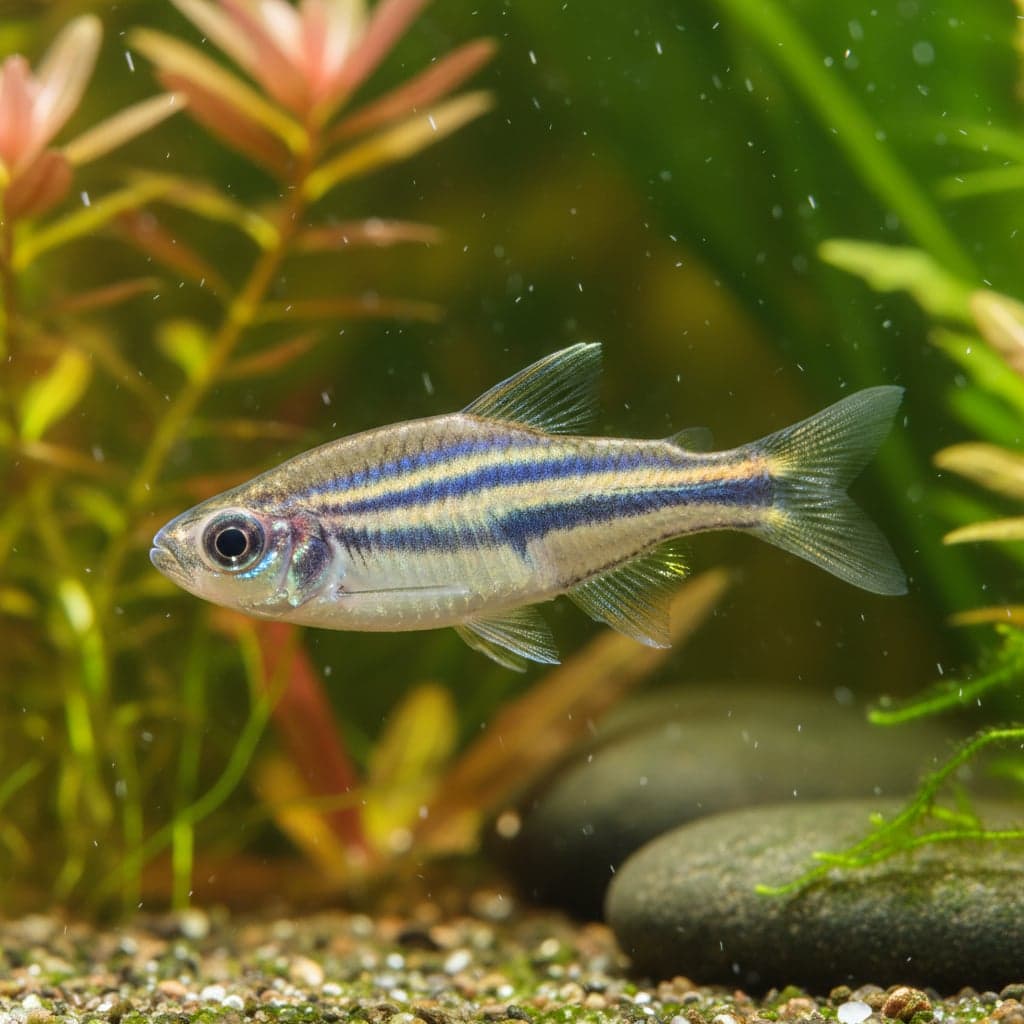
If you want to breed an egg-laying fish for the first time, this is the one. Zebra danios spawn readily, in ordinary tap water, at room temperature, without blackwater chemistry or blacked-out tanks — the exact opposite of breeding neon tetras.
The only genuinely hard part is that the parents eat the eggs within seconds, and the entire method is built around solving that.
Sexing
Easier than most egg layers once the fish are mature at around three months.
Females are deeper bodied with a distinctly rounded, fuller belly, and their background colour is more silver. A conditioned female is unmistakably plump.
Males are slimmer and more torpedo-shaped, with a stronger golden-yellow cast between the blue stripes, particularly toward the anal fin.
In a group the difference is obvious. On a single fish it is not, which is one more reason to keep them in numbers.
The spawning tank
Small and simple. A 20–40 litre bare tank is ample.
The critical feature is a barrier the eggs can pass through and the adults cannot. Danio eggs are non-adhesive and sink, so:
- A layer of marbles covering the bottom, one or two deep. Eggs fall between them and the adults cannot reach. The classic method, and the cheapest.
- A mesh grid raised 3–4cm off the bottom, with holes large enough for eggs and too small for adults.
- A dense mat of java moss or spawning mops as a lower-effort alternative, though egg recovery is poorer.
Fill with water from the main tank, add a gentle sponge filter, and hold at 22–24°C. A slight rise in temperature helps trigger spawning. Position the tank so it catches morning light — danios spawn at first light, and this is the cue.
No substrate beyond the marbles, no décor. You are building an egg trap.
Conditioning and spawning
Separate the sexes for one to two weeks and feed heavily on live and frozen food — daphnia, brine shrimp, bloodworm, mosquito larvae. Females fill out visibly; this is the main preparation and it does most of the work.
Introduce two males per female in the evening. A trio or two trios is plenty.
Spawning happens at dawn the following morning, usually within the first hour of light. The males drive the female over the marbles and eggs are scattered a few at a time — 300 to 500 over an hour or two from a well-conditioned female.
Remove the adults as soon as spawning finishes. Not later that day — the eggs are gone by then. If you cannot be present, the marble layer is what saves the spawn, which is why it beats moss.
Adults can be re-conditioned and spawned again after two or three weeks.
Eggs and fry
Eggs hatch in 48–72 hours at 24°C. The fry hang motionless on the glass for a further two to three days, absorbing their yolk sacs, and are easy to mistake for debris or to conclude have died. They have not; leave them alone.
Once free-swimming, feeding follows the usual small-mouth sequence:
| Days after hatching | Food |
|---|---|
| 0–3 | Nothing — yolk sac |
| 3–10 | Infusoria, green water, or liquid fry food |
| 10–18 | Microworms, vinegar eels |
| 18+ | Newly hatched brine shrimp |
| 4 weeks+ | Crushed flake, micro pellets |
Danio fry are small but not as small as neon fry, so the infusoria stage is shorter and more forgiving. Still, start the culture before you spawn the fish — a week of green water on the windowsill is enough.
Keep water changes small, frequent and temperature-matched. Fry are more sensitive to fouling than adults are, and uneaten food is the usual cause.
Growth is quick: recognisable stripes at three to four weeks, sexable at around ten weeks, and sexually mature at three to four months.
Why bother
Two good reasons beyond the fish themselves.
It is the standard first breeding project, and everything you learn — conditioning, egg traps, culturing infusoria, staged fry feeding — transfers directly to harder species.
And danios are the vertebrate model organism used in laboratories worldwide, which is precisely because they breed readily, produce large clutches, and have transparent, externally developing embryos. You can watch a danio embryo develop under a cheap hand lens, which is a genuinely remarkable thing to have in a kitchen.
Before you start
- Condition the sexes separately for two weeks on live food.
- Build the marble layer before you introduce the fish.
- Put the tank where it gets morning light.
- Two males per female, introduced in the evening.
- Start an infusoria culture a week ahead.
- Remove the adults immediately after spawning — the eggs will not survive a delay.