Breeding Neon Tetras: Why It Is Hard and How It Works
Neon tetras will not breed in a normal community tank, and the reason is specific: they need near-mineral-free water and darkness. The full method, honestly described.
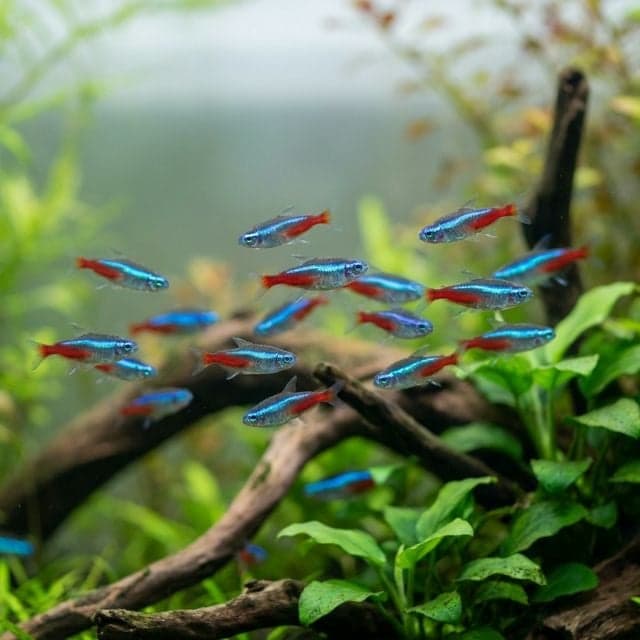
Neon tetras are among the most commonly kept fish in the world and among the least commonly bred at home. Both facts have the same cause: they need water so soft that ordinary tap water cannot produce it, and eggs so light-sensitive that an ordinary lit tank destroys them.
This is a project, not an accident. Nothing you do in a community tank will result in neon fry.
Why the community tank never works
Three hard blocks, all of which must be removed at once.
Hardness. Neon eggs will not fertilise properly above roughly 2 dGH. In harder water the egg membrane behaves differently and the sperm cannot reach the egg. Most tap water is far above this, so in a normal tank the fish may spawn and nothing viable results.
Light. The eggs are strongly photosensitive and are destroyed by even moderate light. A lit tank kills a spawn within hours.
Predation. Neons eat their own eggs immediately and enthusiastically, and so does everything else in a community tank. Eggs are scattered and unguarded.
The breeding tank
Small, bare and dark.
- 20–40 litres, bare-bottomed. Substrate traps eggs and fouls.
- RO or distilled water, remineralised only very slightly. Target GH under 2 dGH, KH 1 or below, pH 5.5–6.0. This is not achievable from tap water in most of the world.
- Temperature 23–24°C.
- Blacked out. Tape paper over the glass or keep it in a dark room. Dim, indirect light at most.
- A gentle sponge filter only, run on a low air setting.
- A spawning substrate — java moss, spawning mops, or a mesh grid raised off the bottom so eggs fall through out of reach.
Peat filtration or almond leaves help acidify the water naturally and add the tannins the fish expect. Let the tank sit for a week before using it.
Conditioning and spawning
Separate the sexes for one to two weeks and condition both on live and frozen food — baby brine shrimp, daphnia, microworms. Well-conditioned females become visibly rounder.
Sexing is subtle but workable in adults. Females are deeper bodied and rounder in the belly, and the blue line has a slight kink where it passes over the fuller abdomen. Males are slimmer with a straighter blue line. It is easier in a group than on an individual fish.
Introduce one or two pairs — or a trio of two males to one female — in the evening. Spawning typically happens at first light the following morning, or the morning after. The male drives the female through the plants and eggs are scattered a few at a time, 60 to 130 in total.
Remove the adults immediately once spawning finishes. They will eat the eggs otherwise, and they have no further role.
Eggs and fry
Eggs hatch in 22–30 hours. The fry are almost invisible — tiny slivers that hang on the glass and plants, absorbing their yolk sacs for a further three to four days before they swim freely.
Keep the tank dark through this period. Light damages the eggs and the very young fry.
Feeding is the hard part. Newly free-swimming neon fry have mouths too small for baby brine shrimp, which defeats most first attempts. The sequence that works:
| Days | Food |
|---|---|
| 0–3 | Nothing — yolk sac |
| 4–10 | Infusoria, green water, or a commercial liquid fry food |
| 10–21 | Microworms, vinegar eels |
| 21+ | Newly hatched brine shrimp, then crushed flake |
Culture infusoria or green water before you spawn the fish. Starting once the fry are free-swimming is too late — they starve in days.
Raise light levels very gradually from around week two. Colour appears at four to six weeks, and by three months they look like small neons.
Small, frequent water changes with matched RO water are essential; fry are intolerant of both fouling and sudden change.
Is it worth doing?
Honestly, for most keepers, no — and that is a fair answer rather than a discouraging one. Farmed neons cost very little, the setup requires RO equipment and live food cultures, and success rates are low for the first several attempts.
It is worth doing if you want the challenge, or if you keep a blackwater tank already and have the water on hand. If you want livebearing fish that breed without any of this, guppies and mollies do it whether you want them to or not — see guppy breeding and fry.
Before you start
- Confirm you can produce water under 2 dGH — usually RO, not tap.
- Set up and mature the breeding tank a week ahead.
- Start an infusoria or green water culture before spawning.
- Black out the tank completely.
- Condition the adults separately for two weeks.
- Remove the adults the moment spawning ends.