Neon Tetra vs Cardinal Tetra: How to Tell Them Apart
The red stripe is the whole answer: half the body on a neon, the full length on a cardinal. Plus the differences in size, price, hardiness and water that actually decide which you should buy.
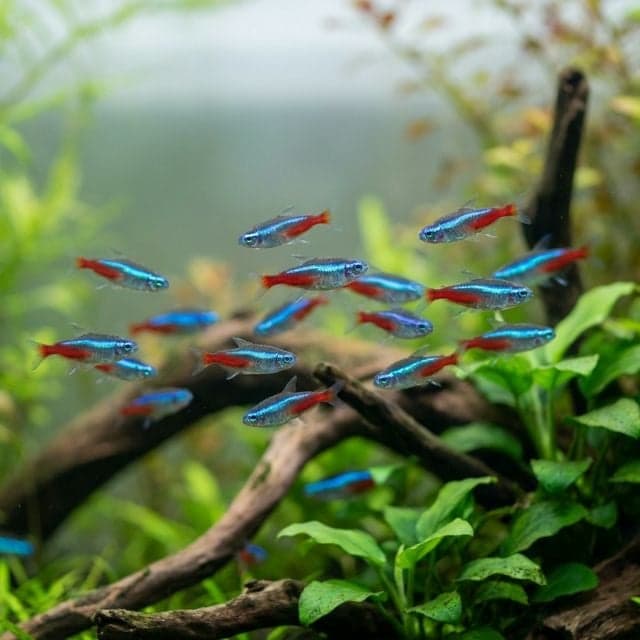
They are sold side by side, often mislabelled, and the cardinals usually cost more. The visual difference takes one second to check once you know where to look, and the practical differences matter more than most people are told.
The one-second identification
Look at the red.
On a neon tetra (Paracheirodon innesi), the red stripe starts around the middle of the body and runs to the tail. The front half, below the blue line, is silvery white.
On a cardinal tetra (Paracheirodon axelrodi), the red runs the entire length of the body, from the nose to the tail.
Both carry the iridescent blue-green line along the top, which is why people confuse them. The blue is nearly identical; the red is not.
Cardinals are also visibly larger — 4–5cm against 3–3.5cm — and deeper bodied. Side by side this is obvious. In separate shop tanks it is not, which is where the mislabelling happens.
The comparison that matters
| Neon tetra | Cardinal tetra | |
|---|---|---|
| Red stripe | Rear half only | Full body length |
| Adult size | 3–3.5cm | 4–5cm |
| Temperature | 21–24°C | 24–28°C |
| pH | 5.5–7.0 | 4.5–6.5 preferred |
| Hardness | GH 1–8 | GH 1–4, softer still |
| Hardiness | Hardier; mostly captive bred | More demanding; often wild caught |
| Price | Cheaper | Typically 2–3× more |
| Lifespan | 3–5 years | 4–5 years |
| Breeding | Difficult | Very difficult |
The differences that decide it
Temperature runs the opposite way. This is the most useful and least mentioned difference. Neons want a cooler tank at 21–24°C; cardinals come from warmer water and want 24–28°C. In a community tank running at 26°C the cardinal is comfortable and the neon is being slowly shortened. If your tank runs warm — because of a betta, discus, or simply a warm room — cardinals are the better fish, not the fancier one.
Cardinals are often wild caught. A large share of the cardinal trade is still wild collection from the Rio Negro, which has two consequences: the fish arrive less adapted to hard tap water and to shipping stress, and the fishery is an established sustainable-livelihood operation in the region rather than something to avoid. Neons are almost entirely farmed.
Cardinals need softer water to look right. Both want soft and acidic, but cardinals are less forgiving. In moderately hard tap water a neon colours up acceptably and a cardinal often does not.
Neons get a named disease. Neon tetra disease affects both species — the name is misleading — but cardinals are meaningfully more resistant to Pleistophora. If you have lost a school to it before, cardinals are the safer retry.
Which should you buy?
Buy neons if your tank runs at the cooler end, your water is moderately hard, the tank is newer, or budget matters. They are the more forgiving fish across a wider range of conditions.
Buy cardinals if your tank is mature, soft and warm — 25–27°C — or if you want the stronger display. A shoal of twenty cardinals in a planted blackwater tank is a better-looking fish than a neon, and in the right water they are no harder to keep.
Do not mix them expecting one shoal. They will loosely associate but they do not shoal together properly, and the temperature compromise leaves one species wrong. Pick one and buy more of it — school size does more for the display than species choice ever will, and the reasoning is in school size and tank size.
What about green neons and black neons?
Two other fish get shelved alongside these.
Green neon tetra (Paracheirodon simulans) — smaller again at 2–2.5cm, with the blue line dominant and very little red. Wants the warmest and softest water of the three, and is the most delicate.
Black neon tetra (Hyphessobrycon herbertaxelrodi) — not a Paracheirodon at all. A white-and-black striped fish with no red, hardier than any of the above, and a genuinely good choice for harder water where true neons struggle.
Before you buy
- Check the red stripe yourself; shop labels are unreliable.
- Match the species to your tank's running temperature, not the other way round.
- Cardinals need soft water to be worth the money.
- Buy one species in numbers rather than a few of each.
- Quarantine either, for the reasons in neon tetra disease.