How Many Neon Tetras? School Size and Tank Size
Six is the number people repeat and it is too few. Why neon tetras need ten or more to behave like neon tetras, and what tank actually holds them.
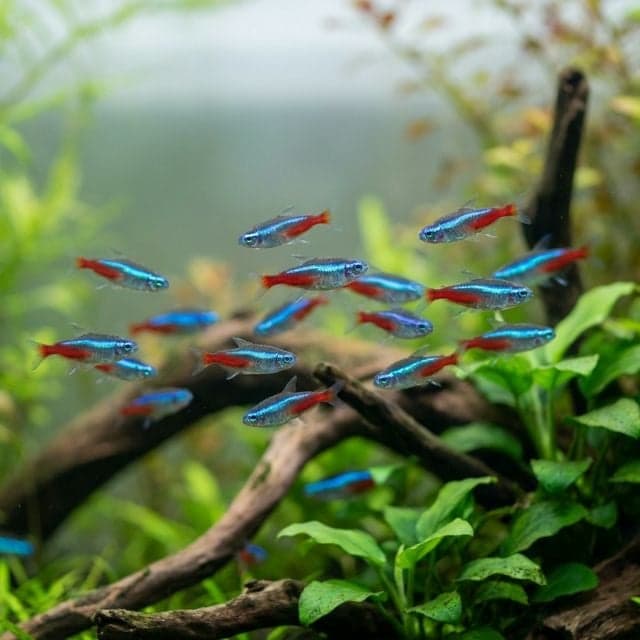
"Six or more" is the most repeated number in the hobby and it is the floor of survival, not the threshold of good behaviour. A group of six neon tetras is a group of nervous fish. A group of twelve is the fish you thought you were buying.
This is the difference between a tank where the tetras hang at the back looking washed out, and one where they hold a tight shoal in open water with the blue line lit up. Same fish, same tank, different number.
Why six is not enough
Neon tetras are obligate shoaling fish. Shoaling is not a preference they express when comfortable — it is their entire predator-avoidance strategy, and the behaviour is driven by how many neighbours a fish can see.
Below about eight, the shoaling response does not reliably switch on. What you get instead is a group of individuals doing threat assessment on their own: hiding in planting, holding near the substrate, and showing the muted colour of a stressed tetra. Chronic low-level stress also suppresses immune function, which is why small groups get sick more often.
At ten to twelve the behaviour changes visibly, usually within a few days. The fish move into open water, hold formation, and colour up. Fifteen or twenty in a long tank is genuinely different again — this is a species where the display scales with the number far more than most people expect.
Buy the full school in one purchase if the tank is cycled and ready. Adding three now and three next month means the first three spend a month understocked and stressed, and new arrivals join an established group rather than forming one.
Tank sizes
| Tank | School | Notes |
|---|---|---|
| 40L / 10 gal | Not recommended | Too short for a shoaling fish that swims horizontally. Sold as a neon tank constantly. |
| 60L / 15 gal | 10–12 | The realistic minimum. A 60cm footprint gives them a lane to shoal along. |
| 100L / 25 gal | 15–20 | Where the species genuinely looks like itself. |
| 180L+ / 45 gal+ | 25–30+ | A large neon shoal in a planted tank is one of the best displays in the hobby, and costs very little. |
Length matters more than volume. Neons use horizontal space and essentially ignore height, so a 60 × 30cm tank beats a tall cube of the same litres.
Bioload is not the constraint here — these are tiny fish. Swimming lane and group size are the constraints, which is why the usual per-gallon rules give misleading answers in both directions.
The mistake that kills them: a new tank
More neon tetras die from being added to an immature tank than from anything else. They are sold as a beginner fish and they are emphatically not a cycling fish.
Neons are sensitive to ammonia and nitrite, and they are sensitive to the parameter instability of a tank that has been running for three weeks. The "neons always die on me" experience is usually a tank that was not ready, compounded by a school too small to be calm.
Wait for a fully cycled tank — ideally one that has been stable and lightly stocked for a month or two. Neons are a fish for an established tank, and they are worth the wait.
Planting and layout
Neons come from shaded blackwater streams under dense forest cover, and a bright bare tank reads to them as open water with no refuge.
Plant the back and sides, leave a clear channel through the middle, and use floating plants to break up overhead light. The combination of cover at the edges and open lane in the centre is what produces confident shoaling — cover alone just gives them somewhere to hide.
Dark substrate makes a substantial difference to visible colour. Neons pale over bright sand and intensify over dark gravel or soil, partly as background adaptation and partly because they are simply calmer.
Tank mates and the maths
Neons are prey. Anything that can fit one in its mouth eventually will, and the list of fish that can is longer than people think — an angelfish is the textbook example, since a full grown scalare eats neons and the two are still sold together constantly.
Good company is small, peaceful, and not aggressively fast at feeding time: corydoras, otocinclus, small rasboras, shrimp in a planted tank. Verdicts by species are in the neon tetra tank mate guide.
Before you buy
- Ten minimum, twelve or more preferred. Six is a survival number, not a target.
- 60L and 60cm long as the floor.
- Buy the whole school at once.
- Never into a tank younger than about two months.
- Plant the edges, leave a swimming lane, dim the top with floating plants.
- Check your water first — neons want soft, acidic water, the opposite of what livebearers need.