How Long Do Neon Tetras Live?
Neon tetras can live five years and most die within one. The gap is almost entirely tank maturity, temperature and school size — not the fish.
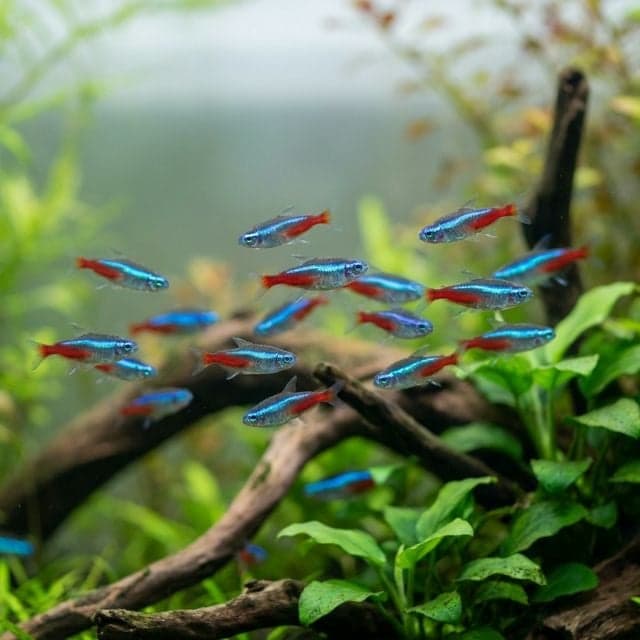
Three to five years, with five achievable and occasionally exceeded. The experience most people have is under a year, and a large share die in the first month.
That gap is not the species being fragile. It is a fish from soft, cool, shaded, stable water being put into a hard, warm, bright, three-week-old tank in a group of six.
The first month, which is where most losses happen
Neons are sold as a beginner fish and used as a cycling fish, and those two facts kill more neon tetras than every disease combined.
The typical sequence: a tank is set up, runs for two or three weeks, and a school of six neons goes in. Ammonia and nitrite spike, the fish are already stressed from shipping and a small group, and they die over the following fortnight. The keeper concludes neons are delicate.
Neons are not a cycling fish. They want a fully cycled tank that has been stable for a month or two, and they reward the wait.
The second first-month killer is acclimatisation. Shop water and home water are often very different in hardness and pH, and a ten-minute float does not bridge that. Drip acclimatise over 30–45 minutes.
What shortens the rest
In order of how many fish each accounts for:
Running too warm. The most common chronic mistake. Neons want 21–24°C, and community tanks routinely run at 26–27°C. A neon at 27°C has an elevated metabolic rate for its whole life and ages accordingly — this alone can halve the lifespan. Full detail in water and temperature.
Hard, alkaline water. They survive it and do not thrive in it. Colour is duller, stress is chronic, disease resistance is lower.
Too small a school. A group of five or six never switches off its threat response. Chronic stress is immunosuppression, and it shows up as a school that loses one fish every few weeks. Ten or more changes this, as covered in school size and tank size.
Bright, bare tanks. Neons come from shaded forest streams. An open tank with strong overhead light and no cover keeps them permanently on alert.
Predation you did not count as predation. A fish that vanishes has often been eaten. Angelfish are the classic case — a juvenile angel is a fine neon tank mate and an adult is not, and the transition happens quietly over months.
Neon tetra disease, which is real but over-diagnosed and picks off individuals over weeks rather than emptying a tank. See neon tetra disease.
What extends it
- Wait for a mature tank. Two months of stable running beats any other single change.
- Run cool — 21–24°C. Free, and one of the largest effects available.
- Soften the water if yours is hard, using RO or botanicals rather than pH chemicals.
- Keep twelve or more.
- Plant heavily and shade the surface with floating plants.
- Drip acclimatise and quarantine new arrivals.
- Feed small and varied — crushed flake, micro pellets, frozen daphnia and baby brine shrimp. Neons have tiny mouths and much sinking food is never eaten.
Note that four of these seven are settled before the fish arrives. Neon longevity is mostly a setup problem.
What ageing looks like
Colour dims evenly — a whole-body dulling rather than the patchy loss that suggests disease. The fish sits lower in the water, holds toward the back of the shoal, and feeds less urgently. Some spinal curve is normal in genuinely old fish and, unlike the sharp kink of NTD, develops slowly over months.
An old neon that still shoals and eats is not sick and should not be medicated.
Before you buy
- Do not buy neons for a tank under two months old.
- Set the heater to 22–23°C before they arrive, not after.
- Buy twelve, not six.
- Drip acclimatise over 30–45 minutes.
- Expect three to five years, and treat a first year with no losses as the real milestone.