Neon Tetra Water Parameters and Temperature
Soft, acidic and cooler than most tropical tanks. Why neon tetras are the one common community fish that suffers in hard water, and the temperature most people get wrong.
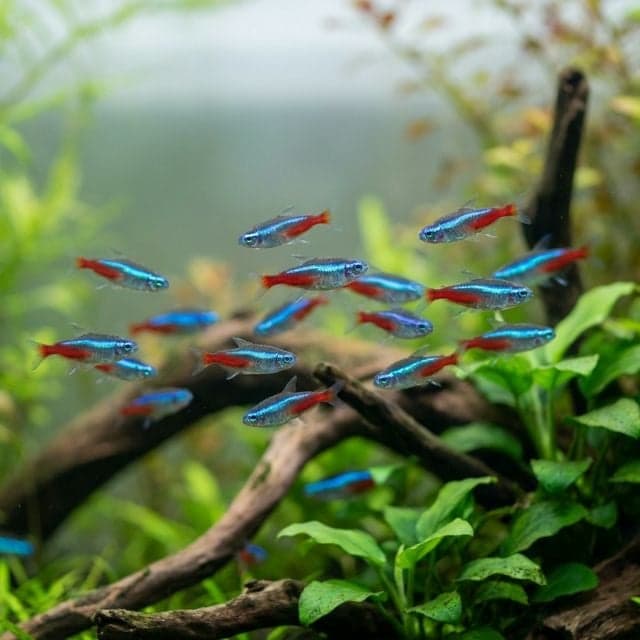
Neon tetras are the reason "community fish" is a misleading category. They are sold alongside guppies, platies and mollies as though all four want the same water, when in fact neons want almost exactly the opposite of what livebearers need.
They also want a cooler tank than most people run, and that single fact accounts for a large share of the short lifespans this species is known for.
Where they actually come from
Neons come from blackwater and clearwater tributaries of the upper Amazon, in shaded forest streams stained by tannins from leaf litter. That water is soft to the point of being nearly mineral-free, acidic, and — because it sits under a closed canopy — cooler than open tropical water.
Every parameter below follows from that habitat, and so does most of what goes wrong when people ignore it.
Temperature: cooler than you think
21–24°C (70–75°F). Many community tanks run at 26–27°C, and neons kept there live noticeably shorter lives.
| Temperature | Effect |
|---|---|
| Below 20°C | Too cold. Immune suppression, lethargy. |
| 21–24°C | Target. Best colour, best longevity, lowest disease rate. |
| 25–26°C | Tolerated. Faster metabolism, shorter life. |
| 27°C+ | Actively harmful long term. Common in tanks shared with discus or bettas, and a frequent cause of "neons only lasted a year". |
This creates a real conflict with tank mates. Bettas want 25–27°C and neons want 21–24°C, which is why betta and neon tetra is a compromise rather than a match. Where a pairing forces a choice, meet in the middle at 25°C and accept that neither fish is optimal.
Hardness and pH
GH 1–8 dGH, KH 1–4 dKH, pH 5.5–7.0.
Neons tolerate harder water than this — most shop stock is raised commercially in water far removed from the Amazon — but tolerance is not the same as thriving. In hard, alkaline water neons show duller colour, breed not at all, and are more prone to the health problems below.
The comparison worth internalising: guppies genuinely require hard water at GH 8–20 and pH up to 8.5. Neons want GH 1–8 and pH below 7. There is no water that suits both properly. A tank containing guppies and neons is a compromise for one of them, whatever the shop said.
Do not chase pH with chemicals. pH-down products move the number, exhaust themselves and let it rebound, and the swing does more harm than the original value. A stable pH of 7.6 beats one oscillating around 6.5.
If you want to move toward their natural water, do it biologically. Indian almond leaves, alder cones, peat and driftwood release tannins that lower pH gently, stain the water and bring mild antibacterial benefit. Tinted water is not a defect — it is the habitat, and neons look their best in it.
For genuinely hard tap water, cutting with RO water is the reliable route. Mix to target, and change it gradually.
Stability beats ideals
Neon tetras are more sensitive to change than to any particular value. Their reputation for dying suddenly in an established tank usually traces to a swing: a large cold water change, a pH crash in a tank with no carbonate buffer, or being moved from shop water into different water too quickly.
Two practical consequences.
Acclimatise slowly. Drip acclimatisation over 30–45 minutes, not a ten-minute float. The difference between shop water and yours is often large.
Watch your KH. Below about 2 dKH there is little buffering, and pH can crash overnight — particularly in a planted or heavily stocked tank. Blackwater setups run low KH deliberately, but they need monitoring, and this is where beginners lose whole schools at once.
Ammonia, nitrite, nitrate
Zero, zero, and under 20 ppm. Neons are among the less tolerant community fish for ammonia, which is why they fail in tanks that are still cycling. A tank must be fully cycled and ideally mature before neons go in — see school size and tank size.
Before you buy
- Test your tap water's GH and pH before choosing this species at all.
- Target 21–24°C, and resist the urge to run the tank warmer.
- If you keep livebearers, accept that neons are a compromise in that water.
- Soften with RO or botanicals, never with pH-down.
- Keep KH above 2 unless you are deliberately running blackwater and testing.
- Drip acclimatise over 30–45 minutes.