Guppy Water Hardness: GH, KH and pH
Guppies need hard, mineral-rich water. Soft water is the most common cause of clamped fins, faded colour and unexplained losses — here is what to test and how to fix it.
Guppy water hardness
Guppies are described everywhere as bulletproof beginner fish, and then people put them in soft water and they die, and nobody connects the two facts.
This is the most useful thing on this site about guppies: they are a hard water fish. Not hard-water-tolerant — hard-water-requiring. If your tap water is soft, or you use RO without remineralising, guppies will underperform and die no matter how good the rest of your husbandry is. It explains a very large share of the "my guppies keep dying and I don't know why" cases in the hobby.
Why they need it
Wild guppies come from Trinidad, Tobago, Venezuela, Guyana and the surrounding region, in streams running over limestone and mineral-rich substrates. The water is hard, alkaline and full of dissolved calcium and magnesium. Everything about guppy physiology assumes that supply.
Freshwater fish continuously lose salts to the water and take on water by osmosis. They spend energy pumping salts back in and water back out. A fish adapted to mineral-rich water in mineral-poor water is fighting a steeper gradient permanently — it is a constant, low-grade metabolic tax that shows up as poor growth, weak immune response and shortened life rather than as sudden death.
Calcium and magnesium also do specific jobs: skeletal development, muscle function, and the mineral demand of a female producing brood after brood of live young. A gravid female in soft water is drawing on reserves she cannot replace.
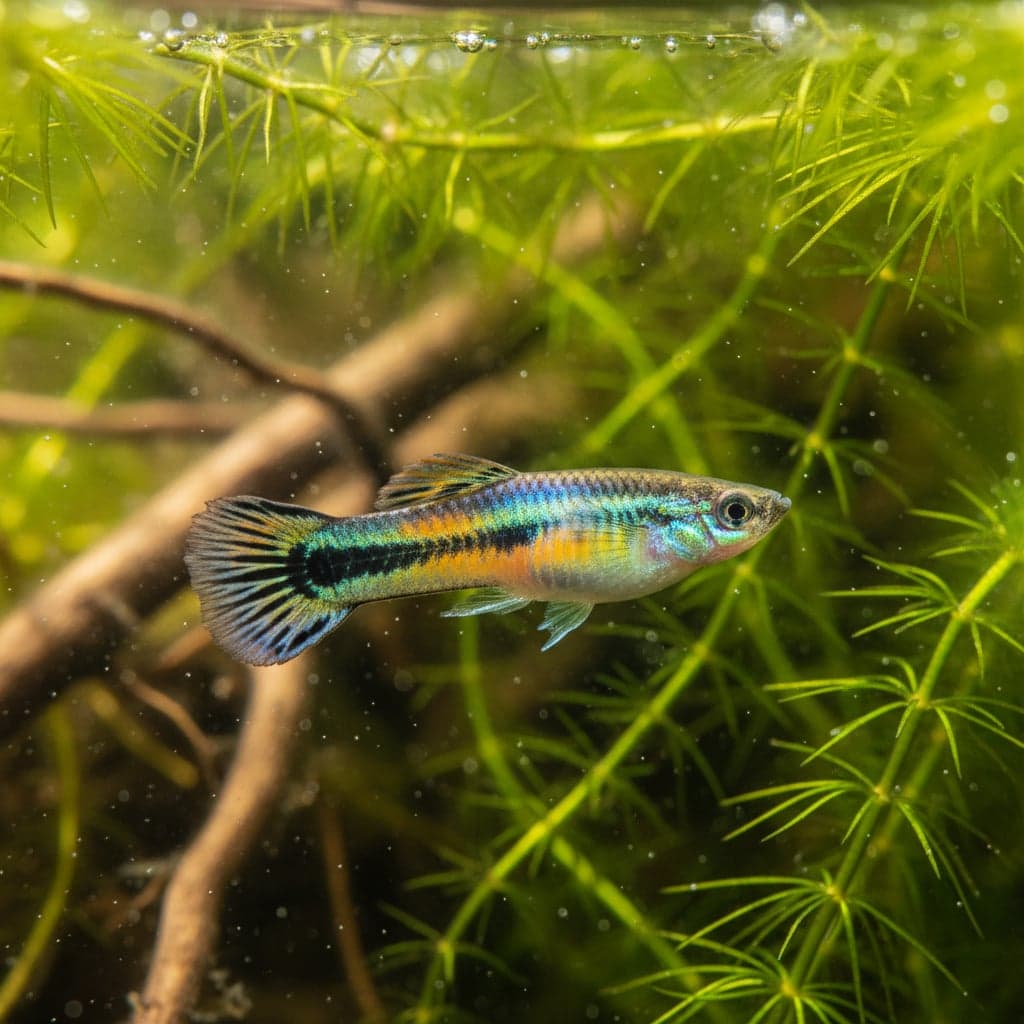
Modern fancy guppies are worse at coping with this than wild-type fish, because decades of intensive line-breeding for colour and fin shape have narrowed the gene pool considerably. Endler's livebearers and wild-type guppies are noticeably more forgiving of imperfect water, though they prefer the same conditions.
What soft water actually looks like
The symptoms are unspecific, which is exactly why they get misdiagnosed as disease and treated with medication that does not help:
- Clamped fins — the dorsal held folded rather than spread. This is the classic early sign, and it is usually read as illness rather than as a water problem.
- Faded colour. Strains that looked brilliant in the shop go dull within weeks.
- Spinal curvature, particularly in fish grown out in soft water from fry. Once bent, it does not straighten.
- Poor fry survival, and fry that grow slowly and stay small.
- Repeated bacterial and fungal infections — fin rot that keeps returning after treatment, or fungal patches on fish that should shrug them off. The infection is real; the reason it keeps winning is the fish's immune function, not the pathogen.
- Shimmying — rocking in place without moving forward. A livebearer-typical osmotic stress sign.
If several of these appear together in a tank with clean water and no identifiable pathogen, test hardness before you treat anything.
What to test and what to aim for
| Parameter | Target for guppies | What it does |
|---|---|---|
| GH — general hardness | 8–20 dGH (140–350 ppm) | Dissolved calcium and magnesium. This is the one that matters physiologically. |
| KH — carbonate hardness | 4–15 dKH (70–270 ppm) | Buffers against pH swings. Low KH is why pH crashes overnight in some tanks. |
| pH | 7.0–8.5 | A consequence of KH, not an independent dial. Guppies tolerate 6.8 in stable, hard water better than 7.5 in water with no buffer. |
| TDS | 250–500 ppm | Useful as a quick daily proxy once you know your GH/KH, not as a substitute for them. |
| Temperature | 22–26°C | See below — this interacts with hardness more than people expect. |
Use a liquid drop test for GH and KH. Test strips for hardness are notoriously imprecise, and the difference between 4 dGH and 10 dGH is the difference between a problem and no problem.
Your water company publishes hardness figures for your postcode, usually in mg/L CaCO₃ or in "clarke" degrees. It is a good starting point, but test the water out of your own tap regardless — softeners, filter jugs and long pipe runs all change it, and a domestic ion-exchange softener replaces calcium with sodium, which produces water that reads soft and is worse for fish than the untreated supply.
Raising hardness
The goal is to add calcium and magnesium in a way that holds steady. Do not chase pH with pH-up products — they move pH without adding the minerals the fish actually need, and in low-KH water the effect reverses within days.
Crushed coral or aragonite. The standard answer, and the most stable. A mesh bag of crushed coral in the filter, or aragonite as part of the substrate, dissolves slowly and self-limits as the water approaches saturation. Start with roughly a handful per 40L, test weekly for a month, and adjust. It is slow — expect a fortnight before readings move meaningfully — which is exactly what you want. Replace or rinse it every six to twelve months as it fouls.
Remineralising salts. A GH/KH+ remineraliser added to fresh water at each water change. This is the right approach if you are starting from RO water, and it gives precise, repeatable results. It requires you to actually do it, every time, which is where it fails in practice.
Mineral-rich hardscape. Certain rocks leach carbonates — Seiryu stone in particular raises KH, which is a nuisance in a soft-water aquascape and a gift in a guppy tank. Limestone and Texas holey rock do the same. Slow, passive and free if you were buying hardscape anyway, but hard to dose precisely.
Wonder shells and cuttlebone. Convenient, popular, and fine for small adjustments. Less controllable than crushed coral over the long run.
Whichever route you take, move slowly. A fish that has been sitting in 3 dGH for six months should not be in 15 dGH tomorrow. Raise by a few degrees a week, using water changes with treated replacement water as the mechanism.
When your water is already hard
Much of the UK, the US Midwest and Southwest, Spain and Australia have hard tap water, and guppies in those regions largely look after themselves. If your GH is above 20 dGH the fish will still be fine — guppies handle very hard water well, and the wild populations in Trinidad sit at the top of that range.
The thing to watch in hard-water areas is that the same water is wrong for a lot of the fish people keep with guppies. Neon tetras and most South American characins want the opposite conditions. That tension is a real one, and it is covered in the tank mate guide.
The temperature myth
Guppies are frequently kept at 26–28°C on the grounds that they are tropical. They tolerate it, but it shortens their lives considerably — metabolism, growth and ageing all accelerate. Guppies kept at 22–24°C live substantially longer, colour up just as well, and are less prone to the bacterial problems that thrive at the top of the range.
Wild guppies experience 18–28°C seasonally. There is no requirement to sit at the top of that band, and good reason not to. The full picture — target range, heater sizing and what warmth costs you — is in guppy temperature and heating, and the effect on how long the fish last is in guppy lifespan.
The short version
- Test GH and KH with a liquid kit before you buy the fish.
- GH 8–20, KH 4–15, pH follows.
- If you are below that, add crushed coral to the filter and raise it over a few weeks.
- If your fish show clamped fins, faded colour or recurring infections in a clean tank, suspect hardness before you reach for medication.
- Do not use a domestic water softener's output.
- Keep them cooler than you think — 22–24°C, not 28°C.