Neon Tetra Disease: Symptoms, Truth and What to Do
Neon tetra disease is real, incurable and over-diagnosed. How to tell it from false neon tetra disease and from ordinary stress, and what to do when you see it.
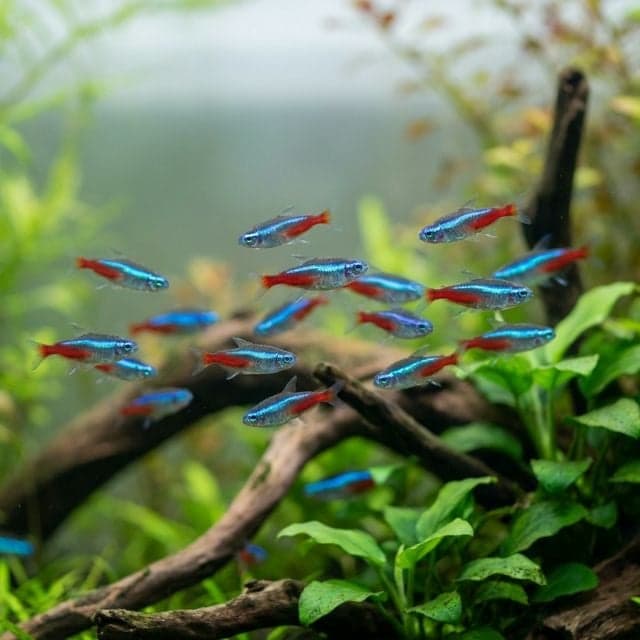
Neon tetra disease has a name, a reputation and a very high false-positive rate. Most fish diagnosed with it in home aquariums do not have it. Knowing the difference matters, because the real thing is incurable and the common lookalikes are all fixable.
What neon tetra disease actually is
True neon tetra disease is caused by Pleistophora hyphessobryconis, a microsporidian parasite that infects muscle tissue. Spores are eaten — usually in the body of a dead infected fish, or in live food — hatch in the gut, and migrate into muscle, where they destroy tissue from the inside.
The progression is characteristic:
- Restlessness at night, the fish leaving the shoal to sit alone. Often the first sign, and almost always missed.
- Colour fading in patches. The blue-and-red stripe loses definition over a section of the body rather than dimming evenly. Patchiness is the tell.
- A whitish or cloudy area under the skin as muscle is replaced by cysts.
- Spinal curvature and difficulty swimming as muscle damage becomes structural.
- Secondary infections — fin rot and bloating — as the fish declines.
There is no cure. No commercially available medication reliably clears Pleistophora from an infected fish. Anyone selling one is selling hope.
The lookalikes, which are far more common
Before concluding NTD, work through these. In most tanks the answer is here.
Stress and poor conditions. A neon in a school of five, in a bright bare tank, or at 27°C, fades evenly and hides. This is the single most common cause of "my neon lost its colour" and it reverses when the group and the tank are corrected.
Sleeping. Neons genuinely go pale at night — colour is under nervous control and dims when the fish is at rest. A pale neon at lights-on is normal.
"False neon tetra disease" — usually Mycobacterium or a columnaris-type bacterial infection. It looks similar, and unlike true NTD it may respond to antibacterial treatment. Since you cannot distinguish them reliably without microscopy, and one is treatable, a course of antibacterial in a hospital tank is a defensible first move.
Ammonia or nitrite. Causes rapid colour loss across the whole school at once. If several fish fade simultaneously, suspect water before parasites — NTD picks off individuals over weeks.
The distinction that does most of the work: NTD affects one fish at a time and progresses over weeks. Water quality affects everyone at once.
What to do when you suspect it
- Test the water. Ammonia, nitrite, nitrate, temperature. Rule out the common cause first.
- Isolate the affected fish into a hospital tank. Spores spread mainly through cannibalism of dead fish, so removing a dying individual protects the rest more than any medication would.
- Treat with an antibacterial in the hospital tank, on the chance it is the false version. If there is no improvement in a week, it is not.
- Remove dead fish immediately. This is the highest-value action on the list. An infected corpse eaten by the school transmits the parasite directly.
- Do not treat the whole tank. There is nothing to treat with, and dosing an entire display for an incurable parasite just stresses healthy fish.
Euthanasia is the honest endpoint for a fish with confirmed spinal curvature. Clove oil is the standard humane method.
Prevention, which is the whole strategy
- Quarantine every new fish for two to four weeks. NTD arrives with new stock, and neons are farmed at density where it circulates. See quarantine protocol.
- Remove dead fish promptly, every time.
- Avoid live food from unreliable sources, particularly live tubifex.
- Keep a big enough school — chronic stress from a group of five is immunosuppression by another name.
- Run at 21–24°C with stable soft, acidic water.
- Buy from a tank you can inspect. Look for even colour across the whole batch and reject any tank containing a fish with a patchy stripe or a curved spine — the parasite is already circulating in that water.
Other things neons get
Ich / white spot — distinct salt-grain spots. Very treatable; see white spot. Raise temperature only to 26°C for neons rather than the usual 28°C, and add aeration.
Fin rot — ragged receding fin edges, secondary to water quality. Clean water first, medication second.
Columnaris — greyish-white fuzzy patches, often around the mouth. Fast moving and accelerated by heat, so do not raise the temperature.
Before you buy
- Inspect the shop tank for patchy stripes and curved spines, and walk away if you see either.
- Quarantine, without exception.
- Have a plan for dead fish: out of the tank the day you see them.
- Fix stress before reaching for medication — most faded neons are not sick.