Zebra Danio Varieties: Longfin, Leopard and GloFish
Longfin, leopard, golden and the fluorescent GloFish — what each one is, which are genuinely different fish, and the care implications nobody mentions on the label.
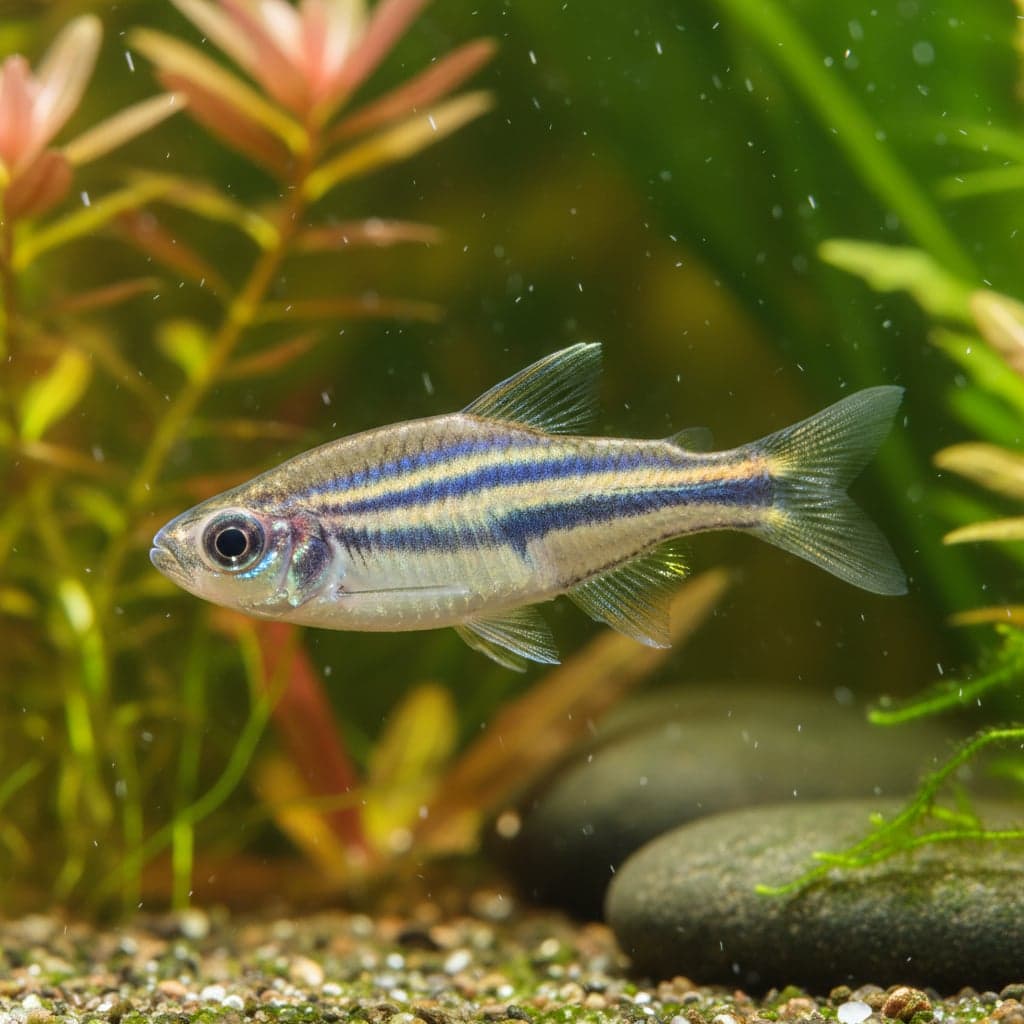
Zebra danios come in more forms than most people realise, and two of them carry care implications that the shop label will not mention: longfins get nipped by their own species, and GloFish are a genetically modified animal with a specific legal status depending on where you live.
The varieties
Standard zebra danio. The wild-type fish: silver-gold with four horizontal blue stripes running from gill to tail. Hardy, cheap and the baseline for everything below.
Longfin zebra danio. The same fish with extended, flowing fins. Visually striking, and the one variety with a genuine care difference — covered below.
Leopard danio. Spotted rather than striped. Historically sold as a separate species (Danio frankei), it is now understood to be a spotted variant of Danio rerio rather than a distinct species. Identical care, and it interbreeds freely with the striped form.
Golden zebra danio. A reduced-pigment form; pale gold body with faint stripes. Sometimes marketed as "albino", though it is not a true albino.
Longfin leopard. The two traits combined, and the most fragile of the set.
GloFish. Fluorescent danios in red, green, orange, blue, pink and purple.
The longfin problem
This is the practical point that matters, and it is a neat irony.
Zebra danios nip long fins. Longfin zebra danios have long fins. A mixed group of standard and longfin danios frequently results in the longfins being harassed, and even an all-longfin group nips more than a standard group does, because the targets are present.
Longfins are also slower — they are carrying more fin on the same body — so they lose out at feeding time and cannot break away from pursuit as easily.
If you want longfins, keep them on their own, in a group of ten or more, in a tank of 60cm or longer. Do not mix them with standard-finned danios and expect the fins to survive. The mechanism is the same one described in fin nipping and behaviour.
GloFish, honestly
GloFish are genuinely genetically modified. Fluorescent protein genes — originally from jellyfish and coral — were inserted into the danio genome, and the trait is heritable. They are not dyed, injected or painted, which is a real and important distinction: dyed fish are a separate, cruel practice involving injection of colour into a fish that then fades, and GloFish are not that.
What to know:
Care is identical. Same water, temperature, group size and tank length as any zebra danio. The fluorescence costs the fish nothing detectable in health or lifespan.
They are still danios. Same speed, same chasing, same jumping, same need for a group of eight or more. A GloFish is not a novelty ornament with different needs.
Legality varies. GloFish are approved for sale in the United States but are prohibited in the European Union, and restricted in Australia and elsewhere, under GMO rules rather than animal welfare rules. Check your jurisdiction; they are not legally available everywhere they are advertised online.
They breed true. The fluorescence is heritable, so GloFish offspring are fluorescent. Selling or distributing them may be restricted even where keeping them is not.
Lighting sells them. The colour is most vivid under blue or actinic light. Under normal white light they look like brightly coloured danios, which is worth knowing before buying a tank kit sold on the strength of the photographs.
There is a reasonable ethical debate about GMO ornamental fish, and it is genuinely about the modification rather than the welfare — the fish themselves are ordinary danios that happen to fluoresce.
Do the varieties mix?
Yes, with the longfin caveat. All of these are the same species and will shoal together, interbreed, and behave identically. A mixed group of standard, leopard, golden and GloFish danios is a perfectly sound single shoal, and counts as one group for the "eight or more" rule.
Offspring of mixed varieties are unpredictable and generally revert toward the wild type over generations — the same pattern as guppy strains.
Before you buy
- Care is the same for every variety — do not pay for a "special" setup.
- Keep longfins separately, and only in a large calm group.
- Check GloFish legality where you live before ordering.
- Mixed varieties count as one shoal for group size.
- Whatever the variety, it still needs 60cm of length and a lid.