Breeding Angelfish: Pairs, Eggs and Fry
Angelfish pair up and spawn readily, then eat the first several clutches. Why that happens, when to leave them to it, and how to raise the fry when you decide to intervene.
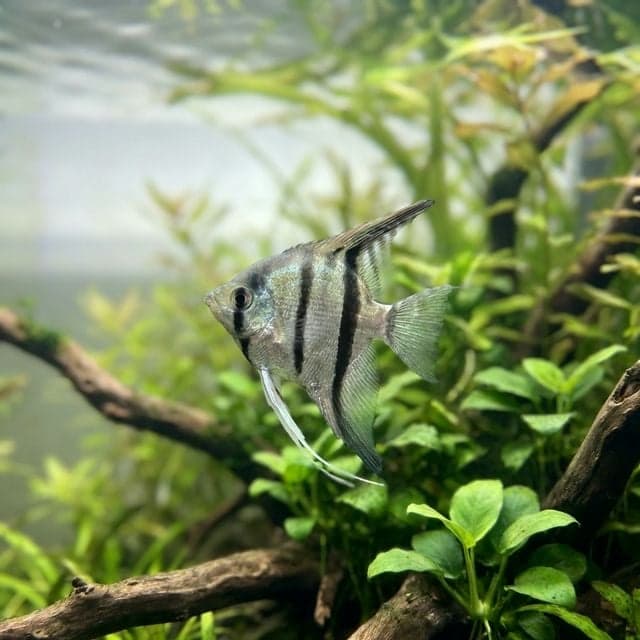
Getting angelfish to spawn is easy — a bonded pair in warm, clean water will do it every two to three weeks without encouragement. Getting fry out of it is the part that takes practice, and the reason is almost always the parents.
Getting a pair
You do not choose an angelfish pair — they choose each other. Sexing outside of spawning is unreliable, and anyone who claims to sex juveniles confidently is guessing.
The standard route is to buy six juveniles and grow them out, letting a pair form naturally at six to twelve months. That works, and the consequence is the territorial fallout described in aggression and pairing — have a plan for the other four.
At spawning the sexes become obvious for the only time. The breeding tube (papilla) drops between the ventral fins: broad and blunt on the female, narrower and pointed on the male. This is the one reliable sexing moment.
Conditions
- Temperature 27–28°C. The upper end of normal encourages spawning.
- Soft, slightly acidic water — GH under 6, pH around 6.5. This matters more for breeding than for keeping. In hard alkaline water eggs frequently fail to fertilise, and a pair spawning repeatedly with white eggs every time is usually telling you the water is too hard.
- A vertical spawning surface. Angelfish are substrate spawners that use vertical surfaces: a broad Amazon sword leaf, a piece of slate leaned against the glass, a length of PVC pipe, or a purpose-made spawning cone. Provide one deliberately or they will use the heater or the filter intake.
- Clean water. 25–30% changes weekly. A large water change is itself a common spawning trigger.
- Condition on live and frozen food — bloodworm, brine shrimp, daphnia.
Spawning
The pair cleans the chosen surface obsessively for a day or two beforehand — the clearest signal that a spawn is imminent.
The female makes repeated passes laying rows of eggs; the male follows fertilising them. A clutch is typically 200–500 eggs, sometimes more from a large female.
Both parents then guard and fan the eggs continuously, and they become extremely aggressive toward everything else in the tank. In a community tank this is when tank mates get hurt.
Eggs hatch in 48–60 hours at 28°C. The wrigglers stay attached to the surface by a mucus thread for a further three to five days, absorbing yolk sacs, and the parents move them repeatedly between cleaned surfaces. At around day five to seven they become free-swimming, and the parents herd them as a cloud.
Why they eat the eggs
Almost every first-time pair eats their first several clutches. This is normal and not a sign of anything wrong.
Contributing causes:
- Inexperience. Young pairs frequently get it wrong three, four or five times before rearing successfully. Commercial breeders expect this.
- Disturbance. Tank traffic, lights snapping on, torches, a hand in the tank.
- Tank mates. A pair under constant pressure from other fish will often eat the clutch rather than lose it.
- Infertile eggs going fungal. Parents remove white fungused eggs — which is correct behaviour — and sometimes carry on through the healthy ones.
Give a pair three or four attempts before intervening. Many settle down and become excellent parents, and parent-raised fry are the lower-effort route.
Artificial rearing
If a pair repeatedly eats clutches, remove the eggs.
- Move the spawning surface to a separate bare tank with water from the parents' tank, at the same temperature.
- Add an airstone positioned to move water gently across the eggs, replacing the parents' fanning.
- Add methylene blue to the water, or use an antifungal, to prevent fungus spreading from infertile eggs.
- Remove white eggs as they appear. Fertile eggs are translucent amber; white eggs are dead and will fungus.
Hatching and development then follow the same timeline.
Raising the fry
Angelfish fry are small and need a proper first food.
| Stage | Food |
|---|---|
| Days 0–5 (wrigglers) | Nothing — yolk sac |
| Free-swimming, first 2 weeks | Newly hatched brine shrimp, 3–4 times daily |
| Weeks 2–4 | Brine shrimp plus microworms, finely crushed flake |
| Week 4+ | Crushed flake, powdered pellets, frozen daphnia |
Newly hatched brine shrimp is close to essential for the first fortnight — start a hatchery when the eggs are laid, not when the fry are swimming. Angelfish fry grow fast on it and poorly on anything else.
Water quality drives growth. Daily or alternate-day small water changes in a bare grow-out tank, and generous feeding. Fry are sensitive to nitrate, and stunted fry never develop proper fins — the same mechanism described in water and temperature.
Sort by size as they grow. Angelfish fry grow at very different rates and the larger ones outcompete and occasionally cannibalise the smaller.
They are recognisable little angelfish at six to eight weeks and saleable at around 2.5cm body size, roughly three months.
Before you start
- Buy six juveniles; do not try to buy a pair.
- Provide a vertical spawning surface deliberately.
- Soften the water if eggs keep coming out white.
- Expect the first three or four clutches to be eaten.
- Set up a brine shrimp hatchery when the eggs are laid.
- Have somewhere for several hundred fry to go.