Angelfish Aggression: Why They Turn on Each Other
Six juveniles become one pair and four casualties. Why angelfish turn aggressive at maturity, how pairing works, and what to do when the tank changes overnight.
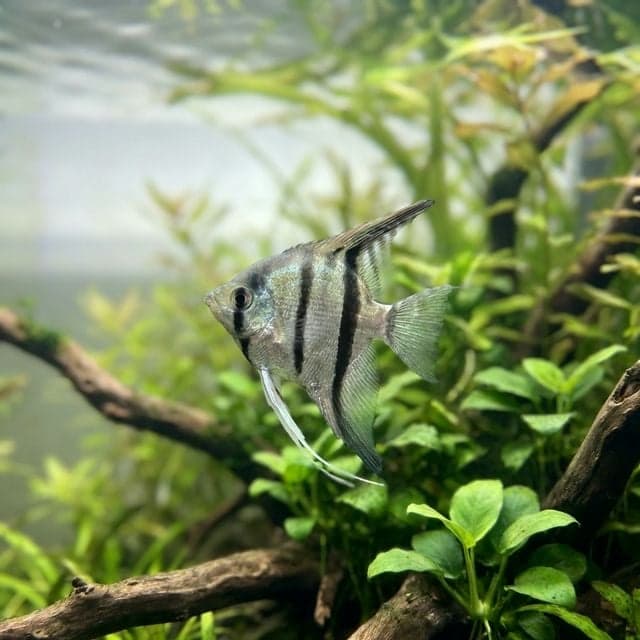
The most common angelfish story goes like this. Six juveniles are bought, grow together peacefully for eight months, and then over the course of a fortnight two of them become inseparable and the other four are pinned in a corner with torn fins.
Nothing went wrong. Angelfish are cichlids, and this is the species behaving exactly as it evolved to. The mistake was expecting a shoaling fish and buying a territorial one.
The timeline
Months 0–6, juveniles. Genuinely peaceful. They shoal loosely, share food, and give every impression of being a community fish. This is the period during which people plan their tank.
Months 6–12, maturity. Individuals begin to size each other up. Chasing starts and stops. A loose hierarchy forms.
Pairing. Two fish begin associating constantly, swimming together and defending a patch of tank. Once a pair forms, everything else in the tank becomes an intruder.
The aftermath. The pair claims territory — often a third to a half of the tank — and drives the remaining fish into whatever space is left. In a tank under about 250L there is nowhere for them to go.
What pairing looks like
Recognising it early is what gives you time to act.
- Two fish moving as a unit, consistently, over days rather than hours.
- Cleaning a vertical surface — a leaf, the glass, a piece of slate. This is spawning preparation and it is unambiguous.
- Joint defence. Both fish driving off the same intruders.
- Lip-locking, which looks alarming and is normal — angelfish test strength mouth to mouth. Between a bonding pair it is courtship. Between rivals it is a fight, and the difference is whether it ends in chasing or in swimming together.
- Darkened vertical stress bars in the fish being driven off, not the pair.
Sexing angelfish outside of spawning is famously unreliable. Body shape and forehead slope are weak signals at best. The dependable moment is spawning itself, when the breeding tube is visible: broad and blunt on the female, narrower and pointed on the male. Until then, assume you cannot tell.
What to do about it
Option 1 — accept the pair. Rehome the others and keep the bonded pair in the tank. This is the honest outcome most angelfish keeping arrives at, and a bonded pair in a well-planted tall tank is a genuinely good display. Have this plan in advance.
Option 2 — go bigger. In 300L or more with heavy planting and broken sightlines, a group of five or six adults can coexist because the pair's territory does not consume the whole tank. Below that it does not work reliably, whatever the stocking calculator says.
Option 3 — keep a single angelfish. They do fine alone. A solitary angelfish in a community of appropriately chosen tank mates is a low-drama setup and a perfectly reasonable choice.
What does not work: adding more angelfish to dilute aggression. This is the opposite of the zebra danio fix, and the difference is the mechanism. Danio chasing is hierarchy maintenance that spreads across a group. Angelfish aggression is territorial defence by a pair, and adding fish adds intruders.
Breeding aggression is worse
Once a pair actually spawns, the aggression steps up again. Both parents defend the eggs and will drive off fish several times their size, and in a smaller tank tank mates can be genuinely injured.
If a pair spawns in a community tank, either move the pair, move the tank mates, or accept a fortnight of disruption per spawn — and they will spawn every two to three weeks. More in breeding and raising fry.
Aggression toward other species
Two separate problems, both flowing from being a slow, tall predator.
They eat small fish. An adult angelfish takes neon tetras, guppy fry, chili rasboras and anything else that fits. This is not aggression, it is feeding, and it cannot be trained out. See neon tetra and angelfish.
They get nipped. Their trailing ventral filaments are an obvious target for fast nippers — zebra danios, tiger barbs, serpae tetras. An angelfish cannot outswim any of them.
So the tank mate window is narrower than for most community fish: too big to eat, too slow to nip, and tolerant of warm water.
When to intervene urgently
Separate a fish immediately if you see:
- One fish permanently pressed into a corner or at the surface
- A fish not eating for more than a day or two
- Persistent dark vertical stress bars on one individual
- Fin damage that keeps reappearing on the same fish
- A fish hanging vertically, nose down, away from the group
A cornered angelfish declines fast. It stops feeding, its immune function drops, and secondary fin rot follows within a week or two.
Before you buy
- Know that six juveniles ends as one pair. Plan for it.
- Have a second tank, a rehoming outlet, or the intention to keep a pair.
- 300L+ if you genuinely want a group of adults.
- A single angelfish is a legitimate and easy choice.
- Never add more angelfish to fix angelfish aggression.