Angelfish Tank Size: Why Height Matters Most
Angelfish are measured wrong. They reach 15cm long and 25cm tall, and tank height is the specification that decides whether their fins develop properly.
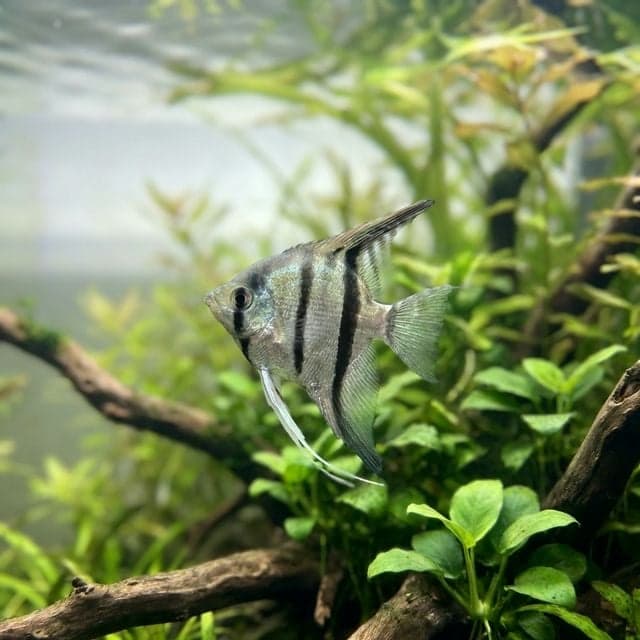
Angelfish are sold as 3cm discs and reach the size of a side plate. That much is widely known. What is less widely stated is that the dimension that matters is height, not length or volume, and it is the one aquarium marketing never mentions.
An adult Pterophyllum scalare is around 15cm long and 20–25cm tall including the dorsal and anal fins, with ventral filaments trailing further still. In a tank shorter than about 45cm, those fins do not develop properly and the fish is permanently compromised.
Height is the specification
| Tank height | Verdict |
|---|---|
| Under 35cm | No. Fins cannot extend; fish grow deformed or stunted. |
| 35–40cm | Marginal. Juveniles only, and not for life. |
| 45cm+ | Minimum for adults. Fins develop normally. |
| 50–60cm | Ideal. A fully finned adult angelfish in a tall planted tank is the display this species is kept for. |
This is why the standard "long" aquarium footprint suits angelfish poorly. A 120 × 30 × 35cm tank holds a lot of water and is a bad angelfish tank. A 80 × 40 × 50cm tank holds less and is a good one.
Check the height before the volume. It is the only fish in this care guide series where that is true — everything else wants length.
Volume and numbers
| Tank | Angelfish |
|---|---|
| 100L / 25 gal | 1 adult, or a bonded pair at a push |
| 150L / 40 gal | A bonded pair comfortably |
| 200L / 50 gal | A pair plus community, or 4–6 juveniles to grow out |
| 300L+ / 75 gal+ | A genuine group of 5–6 adults |
The awkward truth about numbers: angelfish are cichlids, and adults do not reliably tolerate each other. The common approach — buy six juveniles and let them pair off — works, but it ends with a bonded pair that claims the tank and drives everyone else into a corner. That is not a failure of your husbandry; it is what the species does, and it is covered in aggression and pairing.
Plan for the endgame before you buy six. Either have a second tank, or accept that you are ultimately keeping a pair.
Layout
Tall planting and vertical structure. Angelfish evolved among flooded timber and vertical stems in slow Amazon backwaters. Amazon swords, vallisneria, tall cryptocoryne and vertical driftwood all suit them and make them visibly more confident.
Open swimming space in the middle. They patrol, and they need a lane.
Gentle flow. Their body shape is a sail. Strong current pushes them around and exhausts them, and it is a common cause of an angelfish holding station in a corner. Baffle the filter outflow if needed.
Nothing sharp. The trailing ventral filaments and long fins tear easily on hard plastic plants and rough ornaments.
A lid. Less jumpy than danios, but they do it.
Bioload and filtration
Angelfish are substantial fish that eat heavily. Filter for 4–5× tank volume per hour, keep nitrate under 20 ppm, and change 25–30% weekly. They are more sensitive to nitrate than most community fish, and chronic elevation shows up as poor fin development in growing fish.
Tank mates, briefly
The two rules follow directly from the shape of the fish.
Nothing that nips long fins. Zebra danios, tiger barbs and other fast nippers will shred the ventral filaments of a slow, tall fish that cannot escape them.
Nothing small enough to eat. An adult angelfish is a predator of small fish, and neon tetras are the textbook casualty. The pairing is sold constantly and works only while the angelfish is a juvenile — the transition happens quietly over months.
Good company: larger tetras (rummynose, black skirt, lemon), corydoras, bristlenose plecos, peaceful gouramis, keyhole cichlids. Verdicts by species are in the angelfish tank mate guide.
Before you buy
- Measure tank height first. Under 45cm, choose a different fish.
- 150L minimum for a pair; 100L for a single adult.
- Understand that six juveniles becomes one pair.
- Keep the flow gentle and the decor smooth.
- Do not stock neon tetras alongside them expecting it to last.
- Run warm — 26–28°C, warmer than most community tanks.