Angelfish Water Parameters and Temperature
Warm, soft and clean. Angelfish want a hotter tank than most community fish, and the temperature they need rules out several species they are routinely sold with.
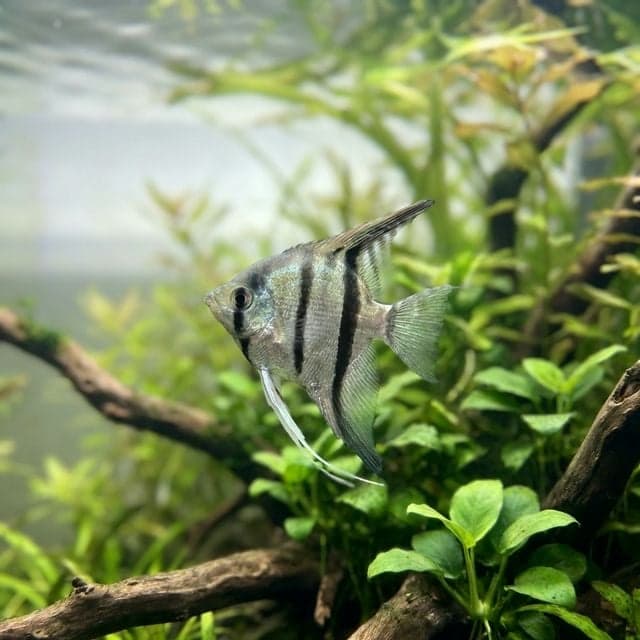
Angelfish come from slow, warm, soft, tannin-stained backwaters of the Amazon basin — flooded forest and vegetated margins rather than open river.
Two things follow that matter more than the numbers themselves: they want a warmer tank than a general community setup, and they are more sensitive to nitrate than their size suggests.
Temperature: warmer than the default
26–28°C (79–82°F).
Most community tanks run at 24–25°C, and angelfish kept there are not in trouble but are not at their best either — slower growth, less colour, and noticeably less inclined to breed.
| Temperature | Effect |
|---|---|
| Below 24°C | Sluggish, poor appetite, susceptible to infection. |
| 24–26°C | Acceptable. Common in mixed community tanks. |
| 26–28°C | Target. Best colour, growth and condition. |
| 29–30°C | Used deliberately to trigger spawning. Oxygen becomes a consideration. |
| Above 30°C | Stressful; increase aeration immediately. |
This is the parameter that decides tank mates more than temperament does. At 27°C, neon tetras — which want 21–24°C — are being slowly shortened, quite apart from being eaten. Cardinal tetras, which want 24–28°C, are the far better choice and are the standard companion for exactly this reason.
pH and hardness
pH 6.0–7.5. GH 3–10 dGH. KH 2–6 dKH.
Commercially bred angelfish — which is nearly all of them — are raised across a wide range of conditions and are genuinely adaptable. They will live and colour up well at pH 7.6 in moderately hard water.
Where it matters is breeding. Angelfish eggs fertilise poorly in hard, alkaline water, and a pair that spawns repeatedly with no viable fry is usually telling you the water is too hard. Softer, slightly acidic water — GH under 6, pH around 6.5 — makes the difference. See breeding and fry.
Do not chase pH with chemicals. The swing does more harm than the value ever did. If you want to move toward their natural water, use botanicals: Indian almond leaves, alder cones and driftwood release tannins that lower pH gently and tint the water. Angelfish come from tannin-stained water and look their best in it.
Wild-caught Pterophyllum — including altum angelfish — are a different proposition entirely, requiring genuinely soft, acidic blackwater. Those are a specialist fish and should not be bought on the assumption that domestic angelfish advice applies.
Nitrate matters more than usual
Ammonia and nitrite zero. Nitrate under 20 ppm.
Angelfish are more sensitive to chronic nitrate than most community fish, and it shows up in a specific and often-missed way: poor fin development in growing fish. A juvenile angelfish raised in a tank sitting at 60 ppm nitrate does not develop the long dorsal and anal fins the species is kept for, and that is not recoverable once the fish is mature.
If you are growing out young angelfish, the water change schedule is a cosmetic decision as much as a health one. 25–30% weekly, and more when growing fish hard.
They are also sensitive to dissolved organics generally — the tank looks fine, the tests read acceptably, and the fish do better after a water change anyway. Consistency beats heroics.
Flow and oxygen
Gentle flow. An angelfish is a tall sail on a slow body, and strong current pushes it around, exhausts it and stops it feeding. This is one of the most common unrecognised stressors: a fish holding station behind hardscape is often sheltering from the filter rather than hiding from tank mates.
Baffle the outflow, use a spray bar directed at the glass, or angle the return along the back wall.
At the same time, warm water holds less oxygen, so a tank at 28°C needs surface agitation even while the flow through the tank stays gentle. Those two are not in conflict — you want surface movement without a current through the swimming space.
Acclimatisation and change
Angelfish dislike sudden change more than they dislike any particular value. Drip acclimatise new fish over 30–45 minutes, match water change temperature by hand, and avoid large infrequent changes in favour of smaller regular ones.
A common failure: a tank neglected for a month, then a 70% change with cold tap water. The parameter shock does more damage than the neglect did.
Before you buy
- Set the heater to 27°C — warmer than a general community tank.
- Choose tank mates that suit that temperature; cardinals over neons.
- Keep nitrate under 20 ppm, especially while fish are growing.
- Baffle the filter; gentle flow, agitated surface.
- Use botanicals rather than pH chemicals if you want softer water.
- Soften the water properly only if you intend to breed.