How Long Do Angelfish Live?
Eight to twelve years, which is longer than most people expect and longer than most angelfish get. Why tank height and nitrate decide the outcome.
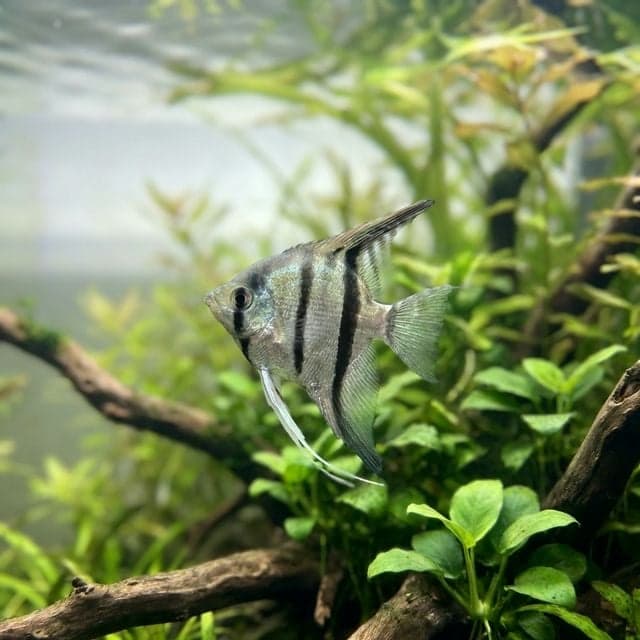
Eight to twelve years, and occasionally more. Angelfish are a long-term commitment on the scale of a small pet rather than a typical community fish — comparable to a bristlenose pleco and far beyond a guppy.
Most do not get close, and the reasons are almost all decided in the first year.
Stunting is the main cause of a short life
An angelfish grows to roughly full size in 12 to 18 months, and everything about that growth is determined by the tank it happens in.
In a tank that is too small — and especially too short — the fish's body continues growing while the skeleton and fins are constrained. The result is not a neat miniature angelfish. It is a fish with compressed proportions, underdeveloped fins, and internal organs that continue to grow against a body that has stopped.
Stunted fish die years early from organ failure, and the damage is not reversible by moving them to a bigger tank later.
The specification that prevents it is 45cm of tank height minimum, 50–60cm for veiltails, as set out in tank size and height. This is the single highest-leverage decision in angelfish keeping and it is made before you buy the fish.
Nitrate, quietly
Angelfish are more sensitive to chronic nitrate than most community fish. A tank sitting at 60–80 ppm indefinitely does not produce a crisis — it produces a fish that grows poorly, never develops proper fins, and dies at five instead of ten.
This is the second decision made during the growth year. Keep nitrate under 20 ppm with 25–30% weekly changes, and more while fish are growing hard.
What else shortens it
Running too cool. Angelfish want 26–28°C. A community tank at 24°C is survivable and suboptimal, and long-term it costs years. See water and temperature.
Chronic aggression. A fish permanently cornered by a bonded pair stops feeding, loses condition, and becomes vulnerable to everything else. This is one of the more common causes of an angelfish dying at two or three, and it is entirely a stocking decision — aggression and pairing.
Constant flow. A tall sail-shaped fish held against a current all day is being exercised to exhaustion. Baffle the filter.
Repeated spawning. A female spawning every two to three weeks for years is under real metabolic load. Breeding pairs are productive but not usually the longest-lived fish in a collection.
Fin damage and infection. Nipping tank mates cause tears; tears in marginal water become fin rot; repeated infection shortens lives.
Sudden change. Angelfish tolerate a wide range of parameters and dislike moving between them quickly. Large infrequent water changes cause more harm than small regular ones.
What extends it
- Tank height of 45cm+, from the start. Nothing later compensates.
- Keep nitrate under 20 ppm, especially through the first 18 months.
- Run at 26–28°C.
- Feed well and variedly while growing — quality pellets, frozen bloodworm, brine shrimp, daphnia.
- Sort out the social situation. A pair, a single fish, or 300L+.
- Gentle flow, smooth decor.
Growth and ageing
Angelfish reach sexual maturity at 6–12 months and full size at 12–18 months. A pair may spawn for many years — six- and seven-year-old fish breeding successfully is unremarkable.
An ageing angelfish loses colour intensity, and on silvers and zebras the vertical bars become permanently faint rather than shifting with mood. The fins thin and may curl at the extremities without the receding, discoloured margin of an infection. The fish becomes less active, holds position more, and feeds with less urgency. Some spinal curvature appears in genuinely old fish.
Because angelfish are so expressive when healthy — they recognise their keeper and come to the front of the tank — a fish that stops doing that is worth looking at properly. But the usual distinction applies: illness develops over days, age over months, and an old angelfish that still eats does not need medicating.
Before you buy
- Buy the tank height first. This decides the next decade.
- Budget for a fish you will still have in ten years.
- Keep nitrate low through the growth year above all else.
- Set the heater to 27°C.
- Resolve the pairing question rather than letting it resolve itself.
- Expect eight to ten years, and treat twelve as an excellent result.