How Long Do Bristlenose Plecos Live?
Five to twelve years, and the commonest cause of a short one is slow starvation in a clean tank. What actually shortens it and what an old bristlenose looks like.
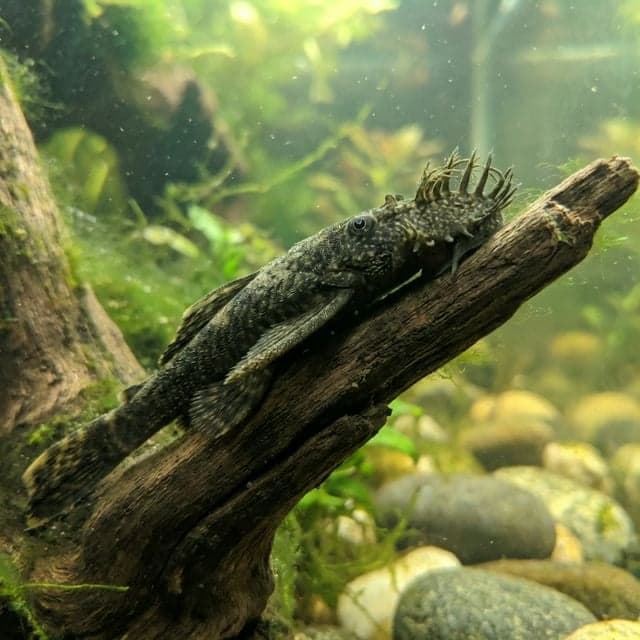
Five to twelve years, with seven to eight being a fair expectation for a well-kept fish. That is a long-lived animal by community aquarium standards — considerably longer than most tetras, danios or livebearers.
The gap between five and twelve is mostly food, and the failure mode is distinctive: bristlenoses do not usually die suddenly. They fade over months, unnoticed, because they are nocturnal and hide all day.
Starvation is the main killer
The chain is well worn. A bristlenose is bought as an algae eater. It clears the algae within a few weeks. The tank is now clean, there is nothing left to graze, and nobody is feeding it deliberately because it was sold as the fish that feeds itself.
It then declines over six to eighteen months. Because it is nocturnal and spends the day wedged in a cave or behind the filter, nobody looks closely. When it is eventually found dead, the conclusion is that plecos are short-lived.
Check the belly. A healthy bristlenose viewed from below or through the glass has a gently convex, rounded abdomen. A flat or concave belly means the fish is starving, and it is visible long before anything else goes wrong. This single check, done monthly, prevents the most common cause of early death.
Feeding properly — vegetables, quality algae wafers, occasional protein, always after lights out — is covered in diet and driftwood.
No driftwood is a slow version of the same thing
Ancistrus are wood eaters, and a tank without driftwood denies them both a food source and the gut function that depends on it. Fish kept without wood grow poorly, colour badly and have a shorter run of it, even when otherwise fed.
Driftwood is a lifespan intervention, not decoration.
What else shortens it
Chronic poor water quality. Bristlenoses produce a lot of waste and are often added to tanks already at capacity. Nitrate that sits at 60–80 ppm indefinitely shortens lives quietly without ever causing an obvious crisis.
No cave. A nocturnal fish with nowhere dark to spend the day lives under constant low-level stress. Cheap to fix.
Male-on-male aggression. Two males in a tank under about 200L means one is harassed away from shelter and food continuously. Keep one male.
Copper exposure. Bristlenoses are sensitive to copper-based medications and some plant fertilisers. Check the label before dosing a tank containing one.
Warm water. They tolerate 27°C but do better at 23–25°C, and cooler water means slower metabolism and a longer life — the same trade-off as zebra danios.
Sharp substrate. Coarse gravel abrades bellies and barbels on a fish that spends its life on the bottom, and the resulting infections are avoidable.
What extends it
- Feed deliberately, daily or near-daily, after lights out.
- Provide driftwood, always.
- Provide a proper cave.
- Over-filter and vacuum weekly. Keep nitrate under 40 ppm.
- One male per tank.
- Sand or smooth gravel.
- Run at 23–25°C rather than the top of the range.
None of this is difficult or expensive, which is why the species genuinely does reach ten years in the hands of people who take it seriously.
Growth and ageing
Growth is steady and slow: about 5cm at four to five months, near-adult size at around 18 months, and full size by two years. Bristles do not develop until roughly 12 months, which is why sexing juveniles is unreliable — see breeding.
Breeding males remain productive for many years, and a settled male can be spawning at six or seven years old.
An old bristlenose slows down, becomes less inclined to rasp glass, and spends more time in the cave. Colour and pattern flatten, and the bristles on old males may look sparser or more ragged. Some fin edge erosion without the receding margin of fin rot is normal.
Because they are cryptic by nature, the distinction between an old bristlenose and a sick one is best made on body condition rather than behaviour. A fish with a full, rounded belly that is simply less active is old. A fish with a sunken belly has a problem, whatever its age.
Before you buy
- Commit to feeding it for the next decade — this is not a low-maintenance fish.
- Buy driftwood and a cave with it.
- Check the belly profile monthly; it is your early warning.
- Keep nitrate down and run at the cooler end.
- One male only.
- Expect seven or eight years, and treat twelve as an excellent result.