Breeding Bristlenose Plecos: Caves, Eggs and Fry
Bristlenoses are the easiest catfish to breed and often do it without being asked. Sexing by bristles, cave requirements, and why the male does all the work.
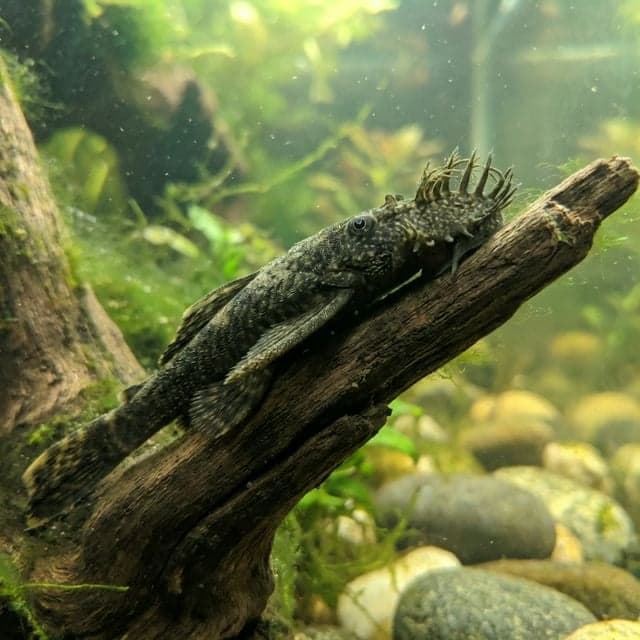
Bristlenoses are among the easiest egg-laying fish in the hobby to breed, and plenty of keepers discover this by finding fry in a tank they were not breeding. Give them a cave, good food and a mature tank, and they generally get on with it.
The male does everything after spawning, which makes this an unusually low-effort project with an unusually interesting thing to watch.
Sexing: the bristles
The easiest sexing in the hobby, once mature at around 12 months.
Males grow long, branching, fleshy tentacles (odontodes) across the whole snout and forehead. On a mature male these are unmistakable — a thicket of them covering the front of the head.
Females have either none or a sparse row of much shorter bristles along the edge of the snout only, never across the face.
Males are also slightly larger, flatter-headed and broader across the head. Females are rounder in the body when conditioned.
Below about 8cm this is unreliable — juveniles of both sexes show small snout bumps and males have not developed yet. Buying six juveniles and letting them sort themselves out is the standard route to a pair.
The cave is the whole setup
Bristlenoses are cave spawners and will not breed without a suitable one.
The specification matters more than people expect:
- One entrance only, closed at the far end.
- Just wide enough for the male to enter and turn around — snug, not roomy. Around 4–5cm internal diameter for an adult.
- Dark, and positioned in a shaded part of the tank.
- Horizontal, resting on the substrate.
Purpose-made ceramic pleco caves are ideal. A short length of PVC pipe capped at one end works just as well. A terracotta pot on its side is adequate but the open end makes males less secure.
Provide more caves than males — two or three per male — so he can choose, and so a second male has somewhere that is not contested.
Triggering a spawn
Often nothing is required beyond good conditions. Where a nudge is needed, the standard trigger is a cool water change: a 30–50% change with water two or three degrees below the tank, mimicking the rainy season. Do this in the evening.
Condition both fish beforehand for two to three weeks on a richer diet than usual — plenty of vegetables plus more protein than the maintenance ration described in diet and driftwood. Females need the food to produce eggs.
A slightly lower temperature overall, around 23–24°C, tends to help.
The male claims and cleans a cave, then displays at the entrance to attract a female. She enters, lays, and leaves. That is the extent of her involvement.
Eggs and the male's job
The female lays a tight orange cluster of 20–200 bright orange eggs on the cave ceiling, and then departs.
Everything after that is the male:
- He guards the cave, driving off anything that approaches.
- He fans the eggs constantly with his fins to keep them oxygenated and free of fungus.
- He stops eating, sometimes for the whole period, and loses noticeable condition.
Do not disturb him. Do not move the cave, do not shine a torch in repeatedly, and do not remove the eggs. A stressed male will eat the clutch, and that is by far the most common cause of a failed first spawn.
Eggs hatch in 4–10 days depending on temperature. The fry stay in the cave with the yolk sacs attached for a further 3–5 days, and the male continues guarding throughout. He goes back to eating once they disperse.
Raising the fry
Genuinely easy — no infusoria, no live food cultures.
Bristlenose fry begin rasping surfaces almost immediately and can eat what the adults eat, scaled down:
- Blanched courgette from the moment they leave the cave. This is the single best fry food for the species.
- Crushed algae wafers and powdered spirulina.
- Driftwood, which they start rasping straight away.
- Occasional protein once they are a couple of weeks old.
Feed daily and keep the water clean — small frequent changes. Fry are more sensitive to nitrate than adults.
They can be left in the parents' tank if it is peaceful and well planted; adults do not predate them, and the main risk is other tank mates. In a community tank, moving the cave and fry to a grow-out tank after hatching improves survival substantially.
Growth is steady rather than fast: around 2.5cm at two months, 5cm at four to five, sexable at eight to twelve months.
What to do with them
A single spawn can be 100+ fry, and a settled pair will spawn every four to eight weeks. This adds up quickly.
Arrange the outlet before you encourage a second spawn. Bristlenoses are one of the few fish a local shop will usually take, and they are always in demand among hobbyists — particularly the longfin and colour varieties, which are worth considerably more than standard browns.
If you do not want more, remove the caves. Without one, they will not spawn.
Before you start
- Buy six juveniles rather than trying to sex small fish.
- Wait for mature bristles — around 12 months — before expecting anything.
- Provide two or three proper caves per male.
- Condition both fish for two to three weeks first.
- Trigger with a cool water change in the evening.
- Leave the male alone once eggs are laid.
- Have somewhere for 100 fry to go.