Bristlenose Pleco Tank Size and Setup
100 litres, a cave, driftwood and more filtration than the fish's size suggests. What a bristlenose actually needs, and the bioload nobody warns you about.
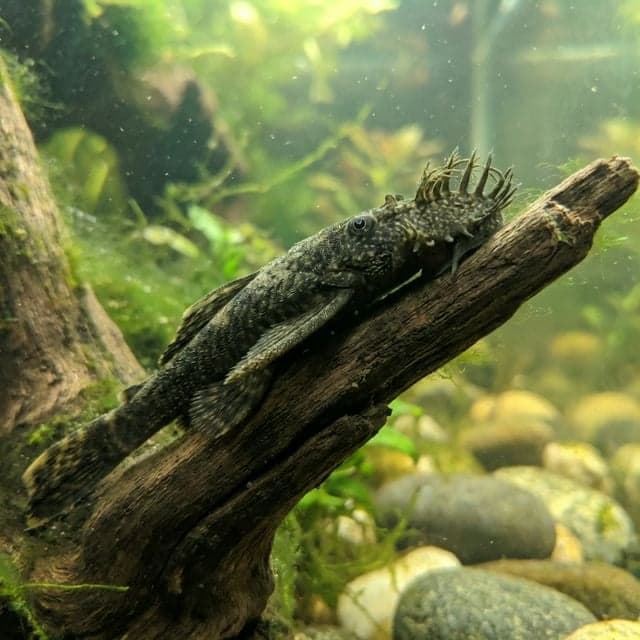
Bristlenoses are the sensible pleco — 10–15cm rather than the 45cm of a common pleco — but they are still a chunky, heavy-bodied catfish that eats constantly and produces waste to match.
The tank requirement is driven by bioload and floor space, not by the length of the fish.
Tank size
| Tank | Bristlenoses | Notes |
|---|---|---|
| 60L / 15 gal | Not recommended | Sold as adequate. Too little floor space and too much waste for the volume. |
| 100L / 25 gal | 1 | The realistic minimum for one adult. |
| 150L / 40 gal | 1 male + 1–2 females | The first size that supports a breeding group. |
| 200L+ / 50 gal+ | 2–3, one male only | Comfortable. |
Floor area matters more than height. These are bottom-dwelling fish that occupy the substrate, hardscape and glass. A long, wide tank gives more usable space than a tall one of the same volume.
One male per tank unless it is large and broken up. Males are territorial with each other, particularly around caves, and two males in a 100L tank will fight — usually one cornering the other away from shelter and food. Females coexist without difficulty.
Bioload: the thing people underestimate
A bristlenose eats heavily and constantly and produces a genuinely large amount of waste for a 12cm fish. Adding one to a fully stocked tank is not a neutral act.
- Over-filter. Target 5–6× tank volume per hour.
- Vacuum the substrate weekly. Waste collects under wood and hardscape.
- Watch nitrate. Bristlenose tanks climb faster than expected.
The irony is worth stating plainly: a fish widely sold to keep tanks clean makes more mess than most of its tank mates.
They do like some flow, coming from moving water, and good oxygenation matters — a filter return breaking the surface or a spray bar suits them well.
What the tank must contain
Driftwood. Not decoration — a dietary requirement, for the reasons in diet and driftwood. At least one substantial piece per fish.
A cave. Bristlenoses are nocturnal and need somewhere dark to spend the day. A terracotta pot on its side, a purpose-made pleco cave, a length of pipe, or a gap under rockwork. Caves are also where they spawn, so a proper cave — enclosed, one entrance, only just wider than the fish — is what you want if breeding interests you.
Without a cave, a bristlenose spends its days pressed against the glass behind the filter and is visibly more stressed.
Smooth substrate. Sand or smooth gravel. They forage along the bottom and sharp gravel damages barbels and bellies.
Subdued lighting, or shade. Bright open tanks suit them poorly. Floating plants or an area shaded by hardscape helps.
Water parameters
Refreshingly undemanding, which is one of the reasons the species is so widely kept.
- Temperature 23–27°C. They tolerate cooler than most tropicals, and the lower end is fine.
- pH 6.0–7.5, though they cope well outside it.
- GH 3–15 dGH — soft to moderately hard, all workable.
- Ammonia and nitrite zero, nitrate under 40 ppm.
This tolerance makes them compatible with almost any community tank on chemistry alone. They fit equally well in a soft-water neon tetra tank and a harder livebearer tank, which is unusual and useful.
They are, however, sensitive to copper — relevant if you medicate for snails or parasites — and to poor oxygenation in warm water.
Tank mates
Peaceful with essentially everything. They ignore other fish entirely, are too armoured to be bullied by most community species, and are safe with shrimp and fry.
Good company: tetras, rasboras, danios, livebearers, corydoras, peaceful gouramis, bettas.
Watch out for: large aggressive cichlids that harass them, other male bristlenoses, and very large flat-bodied fish in small tanks. Verdicts by species are in the bristlenose tank mate guide.
They occupy the bottom, so they compete with corydoras for floor space and sinking food rather than for territory — feed enough of both, at both ends.
Before you buy
- 100L minimum for one; do not believe the 60L label.
- Driftwood and a cave, bought at the same time as the fish.
- One male only, unless the tank is large.
- Filter as though for a much bigger fish.
- Sand or smooth gravel, not sharp gravel.
- Feed deliberately after lights out — they will not live on algae.