Bristlenose Pleco vs Common Pleco: Buy the Right One
A bristlenose reaches 12cm. A common pleco reaches 45cm and outgrows almost every home aquarium. They are sold side by side at the same size and price, and the mistake is expensive.
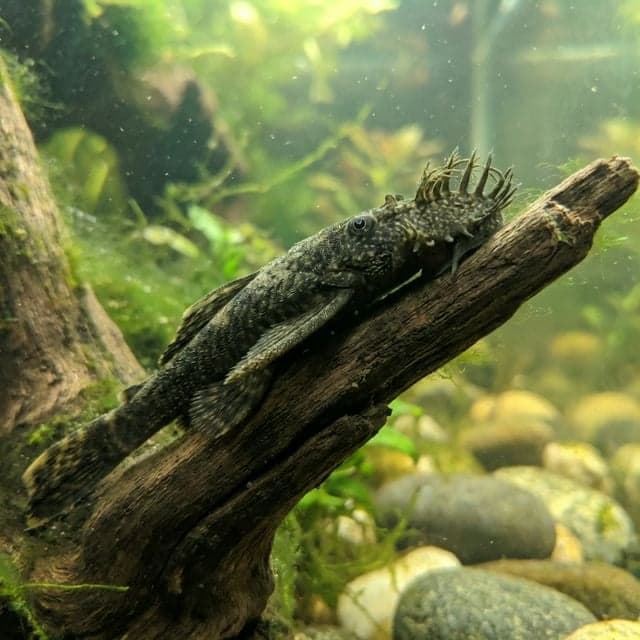
This is the most consequential identification question in the freshwater hobby, because both fish are sold at 5cm, in the same tank, at a similar price, labelled "pleco".
One stays at 12cm and suits a 100-litre tank for life. The other reaches 45cm or more and needs a tank most people will never own.
Telling them apart in the shop
At the size they are sold, the differences are subtle but reliable.
Body shape. A bristlenose (Ancistrus sp.) is short, broad and flattened — stocky, with a body roughly as wide as it is long behind the head. A common pleco (Pterygoplichthys pardalis and relatives) is longer and more torpedo shaped, tapering to the tail.
The snout. A bristlenose has a blunt, rounded, almost squared-off head. A common pleco's head tapers to a more pointed snout.
Bristles. Adult male bristlenoses grow the fleshy tentacles that name them. Juveniles of both sexes show small bumps along the snout edge. Common plecos never do. If you can see bristles, it is a bristlenose — but their absence proves nothing on a young fish.
Dorsal fin. Common plecos have a notably tall, sail-like dorsal with more rays. A bristlenose dorsal is shorter.
Pattern is useless. Both are brown with darker mottling at this size. Do not identify on colour.
If a shop labels a tank simply "plec" or "pleco", ask which species, and if nobody knows, do not buy it.
The comparison
| Bristlenose | Common pleco | |
|---|---|---|
| Adult size | 10–15cm | 45–60cm |
| Minimum tank | 100L / 25 gal | 1,500L+ / 400 gal+ — realistically a pond |
| Lifespan | 5–12 years | 10–20 years |
| Bioload | Moderate | Enormous |
| Algae eating | Genuinely good, lifelong | Good as juvenile, minimal as adult |
| Diet as adult | Wood, algae, vegetables | Largely carnivorous; may rasp fish slime |
| Breeds at home | Readily | Effectively never |
| Suitable for a home tank | Yes | No |
Why common plecos are a problem
They are sold as algae cleaners, and the trait fades. A juvenile common pleco does eat algae. An adult largely stops, shifting to a more carnivorous diet, and by then it is a 45cm fish producing an extraordinary quantity of waste.
Large adults have also been documented rasping at the slime coat of slow-moving, flat-bodied fish — discus and angelfish especially — causing injury and secondary infection.
The end of the story is usually one of three things: the fish is stunted in a tank far too small and dies early with organ damage; it is dumped on a shop that cannot rehome it; or it is released into local waterways. Pterygoplichthys is now an established invasive species across Florida, Texas, Mexico, southeast Asia and elsewhere, entirely through aquarium releases. Never release one.
If you already have one and cannot house it, contact local aquarium societies and specialist shops — rehoming is difficult but possible, and it is the right call.
Why the bristlenose is the right fish
Everything the common pleco was sold to do, the bristlenose actually does, at a tenth the size:
- Eats algae throughout its life, not just as a juvenile.
- Fits a real tank. 100L is comfortable for one.
- Peaceful with everything, including small fish and shrimp.
- Breeds readily, which is genuinely rewarding — see breeding.
- Widely available and cheap, in several attractive varieties.
The one requirement people miss is driftwood, which is not optional for this species and is covered in diet and driftwood.
Other plecos worth knowing
The family is enormous and "pleco" covers hundreds of species.
Clown pleco (Panaqolus maccus) — 9cm, another good small option, also a committed wood eater.
Rubber lip pleco (Chaetostoma) — 10–12cm, prefers cooler well-oxygenated water, a genuinely good algae eater.
Zebra pleco (Hypancistrus zebra, L046) — 8cm, spectacular, expensive, and not an algae eater at all — it is carnivorous. A specialist fish.
Sailfin pleco (Pterygoplichthys gibbiceps) — the other giant, to 50cm. Same problem as the common pleco.
The L-number system catalogues undescribed loricariids and is worth learning if you go further into the group.
Before you buy
- Ask for the species name, not "pleco". Walk away if nobody knows it.
- Check the snout — blunt and squared means bristlenose.
- Assume anything unlabelled at 5cm could be a 45cm fish.
- For any tank under 1,000L, the answer is bristlenose or another small species.
- Never release an outgrown fish. Rehome it.