Molly Tank Size and Stocking
Mollies are much bigger and messier than the tank they get sold for. Real sizes for common and sailfin mollies, the female-heavy ratio, and planning for constant fry.
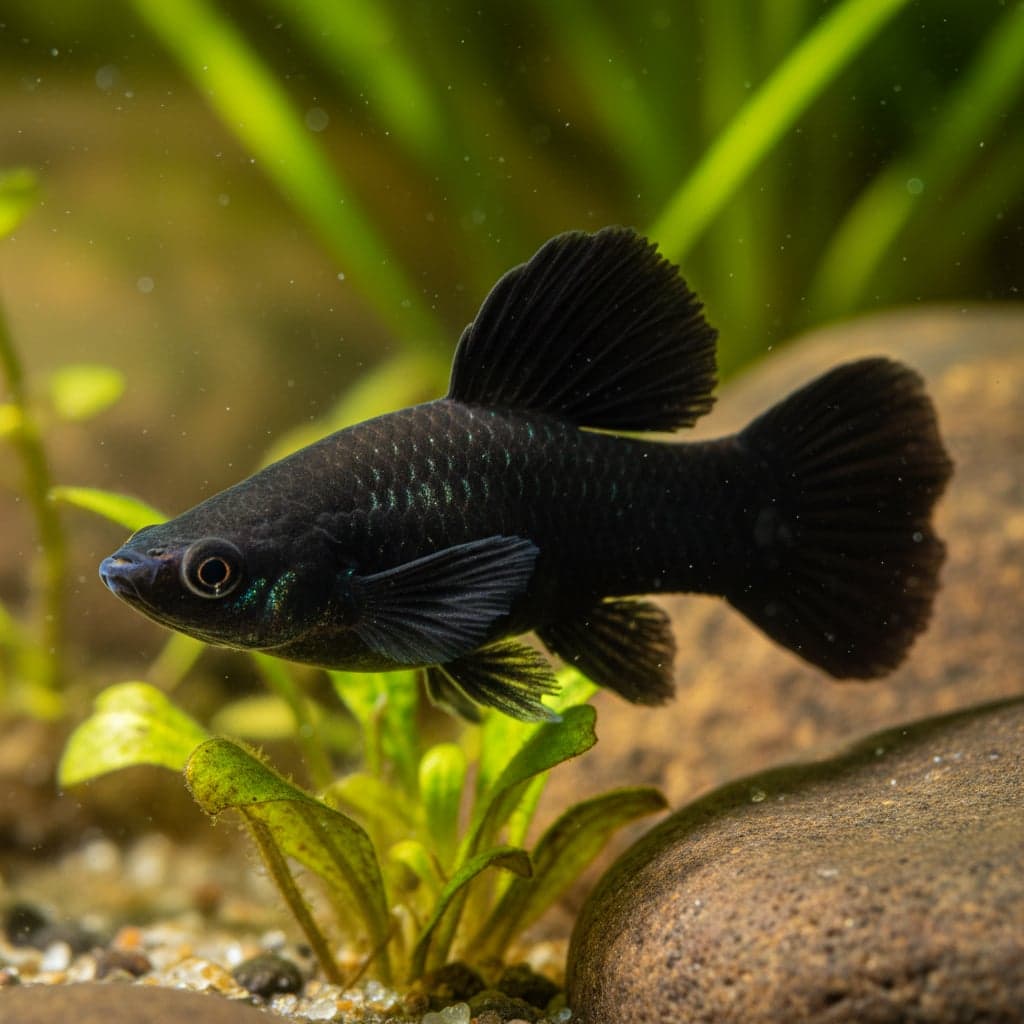
Mollies are sold next to guppies at a similar price and size, and they are not a similar fish. A common molly reaches 8–10cm, a sailfin reaches 12–15cm, and both eat and excrete accordingly.
The single most common molly mistake is stocking them like a large guppy. They need roughly double the tank.
Tank sizes
| Tank | Common molly | Sailfin molly |
|---|---|---|
| 40L / 10 gal | No | No |
| 75L / 20 gal | 1 male, 3 females | No |
| 100L / 25 gal | 2 males, 5 females | 1 male, 2–3 females |
| 150L+ / 40 gal+ | Comfortable colony | 2 males, 5 females |
75 litres is the honest minimum for common mollies and it is frequently described as 40. Sailfins need 100L and really want more — the dorsal display that makes a male sailfin worth keeping only develops properly in a fish with room to grow, and stunted sailfins never show it.
Length matters. Mollies are active mid-water swimmers that patrol, and a long tank suits them far better than a tall one of the same volume.
Bioload is the real constraint
This is where molly stocking differs from guppy stocking. Mollies are substantially heavier waste producers than their length suggests, because they are bulky grazers that eat more or less continuously.
Practical consequences:
- Over-filter rather than under-filter. Aim for 5–6× tank volume per hour.
- Weekly water changes of 30%, not fortnightly 20%.
- Watch nitrate. Molly tanks climb faster than most.
An under-filtered molly tank produces exactly the water quality problems that show up as shimmying.
The sex ratio
Two to three females per male, and never a single pair.
Male mollies court persistently and, like other livebearers, a lone female absorbs all of it — she stops feeding, hides, loses condition and often dies. Extra females divide the attention rather than reducing it.
Male mollies are also more aggressive toward each other than male guppies are. In a tank with two males, one will be harassed continuously. Keep either one male, or four or more so the aggression spreads.
An all-male or all-female group is a legitimate option and it solves the fry problem entirely. All-female is the calmest molly tank available, though note that shop females are almost always already pregnant.
Fry: constant and substantial
Mollies produce 20–100 fry per brood, roughly monthly, and molly fry are large — noticeably bigger than guppy fry and immediately able to eat crushed flake. That size means far more of them survive in a community tank.
This is the practical difference from guppies. A guppy colony self-limits because the adults eat most of the fry. Molly fry are often too big to be eaten from birth, so a mixed-sex molly tank fills up genuinely fast.
Plan for it before you buy:
- Keep one sex, the simplest solution by far.
- Have grow-out space, or an outlet — a shop that takes stock, or other keepers.
- Keep tank mates that predate fry if you want a mixed group without an explosion. Angelfish and larger tetras help substantially.
Detail is in molly breeding and fry.
Water and temperature, briefly
Mollies want hard, alkaline water at GH 12–25 and pH 7.5–8.5, and 24–28°C — warmer and harder than most community fish. This is the constraint that decides tank mates more than temperament does, and it is covered in salt and brackish water.
The mismatch worth knowing: neon tetras want soft, acidic, cooler water — the exact opposite. The two are sold together constantly and one of them is always wrong.
Tank mates
Good: other hard-water livebearers — platies, swordtails, guppies — plus robust community fish that tolerate hard alkaline water.
Poor: soft-water species, long-finned slow fish that male mollies will harass, and anything small enough to be bullied. Male mollies are pushier than their reputation suggests.
Full verdicts in the molly tank mate guide.
Before you buy
- Check which molly it is — sailfins need a much bigger tank than commons.
- 75L minimum for commons, 100L+ for sailfins.
- One male, or four-plus; never two or three males together.
- Two to three females per male, or keep a single sex.
- Over-filter and change water weekly.
- Test GH before you buy; soft water is the deciding factor.