Molly Shimmies: Why Mollies Rock in Place and How to Fix It
The shimmy is not a disease. It is a symptom with a short list of causes, almost always water chemistry — and it is reversible if you read it right.
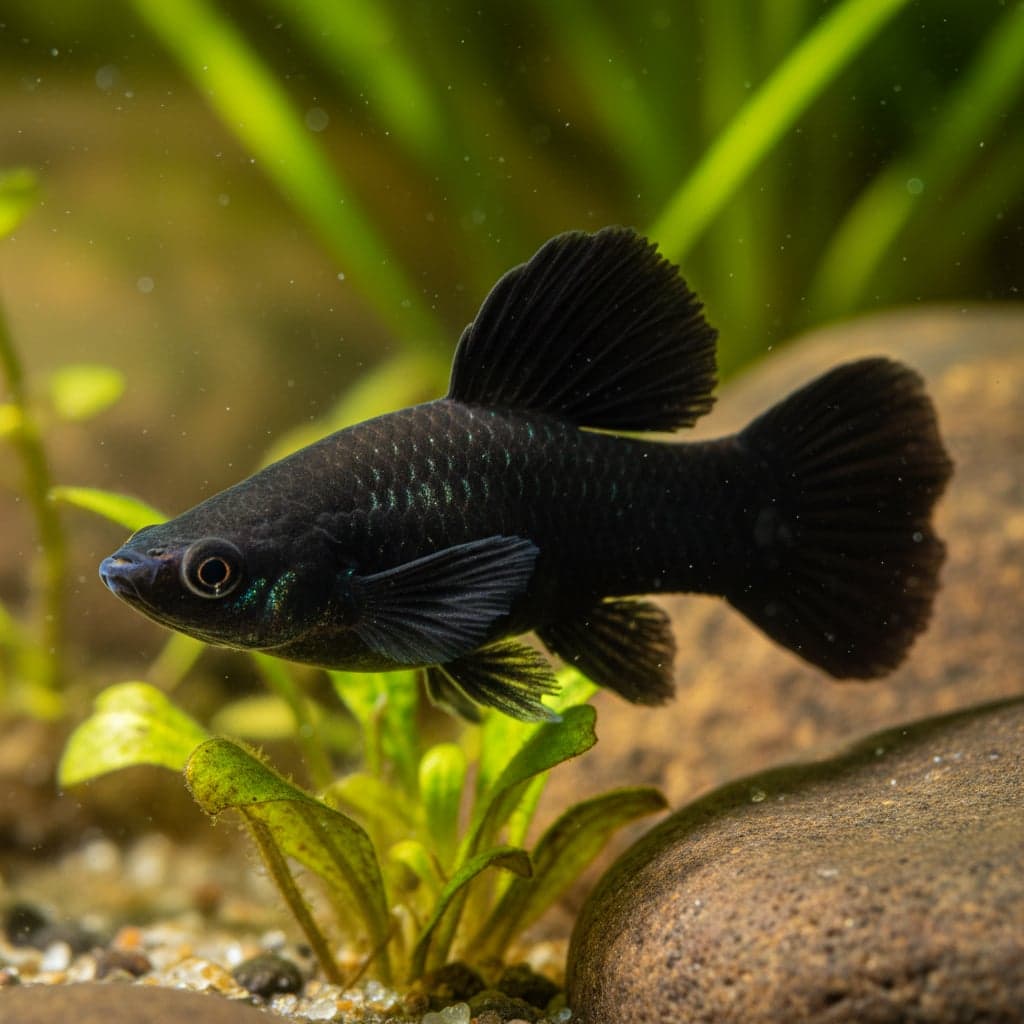
A shimmying molly rocks its body side to side, S-bending in place, swimming hard without going anywhere. It looks neurological and alarming, and keepers reach for medication.
The shimmy is not a disease and there is nothing to medicate. It is a stress response with a short list of causes, and it is reversible — often within a day — once you find which one applies.
What the shimmy actually is
Mollies are among the most osmotically demanding freshwater fish in the hobby. They evolved in hard, high-mineral water, and their osmoregulation — the work of holding internal salt balance against the surrounding water — is calibrated for it.
In soft water, that system runs at a deficit. The fish is expending energy continuously to hold ions it cannot easily get, and the shimmy is what neuromuscular stress under that load looks like. The same presentation appears under cold and under ammonia exposure, because those also disrupt the system.
So the shimmy is a general "my internal chemistry is failing" signal, and the job is working out which input is wrong.
The causes, in order of likelihood
1. Soft water. By a wide margin the most common. Mollies want GH 12–25 dGH, KH 10–20, pH 7.5–8.5 — harder than almost anything else in a community tank. In soft water they shimmy, fade, and eventually die. Full detail in salt and brackish water.
2. Temperature too low. Mollies want 24–28°C, warmer than many community tanks run. Below about 22°C the shimmy appears reliably, and it is one of the first signs of a failed heater.
3. Ammonia or nitrite. Any reading above zero. Common in new tanks, and mollies are heavy waste producers so they push an immature filter hard.
4. pH crash or swing. Low KH means no buffering, and an overnight pH drop will produce shimmying by morning.
5. Chronic stress. Harassment, a group that is too small, or a tank with nowhere to retreat.
Notice that four of the five are water chemistry. The shimmy is essentially a water test with fins.
How to diagnose it
Work in this order — it is fastest, cheapest first.
- Check the thermometer. Is it 24–28°C? A failed heater is a five-second diagnosis.
- Test ammonia and nitrite. Must be zero.
- Test GH, KH and pH. This is the one most people skip and it is the most likely answer. GH under 10 in a shimmying molly tank is your result.
- Look at the other fish. If only the mollies are affected, suspect hardness — they are the most demanding fish in the tank. If everything is affected, suspect ammonia or temperature.
- Watch for harassment, particularly males pursuing a lone female.
Fixing it
If the water is soft — the usual case — add crushed coral to the filter or as substrate and bring GH up over one to two weeks. Do not swing it in a day; a fast chemistry change is its own stressor.
As short-term support while hardness comes up, aquarium salt at 1–2 g/L genuinely helps. It raises osmotic pressure and reduces the load the fish is carrying. This is the legitimate use of salt for mollies — as a temporary treatment, not a permanent policy, and not in a tank containing scaleless fish or plants you care about.
If it is temperature, raise slowly to 26°C — no more than a degree an hour.
If it is ammonia, water changes now, and address the cycle.
Recovery is often dramatic. A molly shimmying from soft water can be swimming normally within 24 hours of a salt dose, which is exactly why the salt myth persists — people see the fix and mistake it for the requirement.
Other things mollies get
Ich / white spot — salt-grain white spots. Mollies are prone to it after a chill. Raise temperature to 28°C with aeration; see white spot.
Fin rot — ragged receding fins, secondary to water quality. Clean water first.
Columnaris — greyish fuzzy patches, often around the mouth, fast moving. Do not raise temperature; it accelerates. Needs prompt antibacterial treatment. Mollies in warm soft water are a classic columnaris setup.
Constipation and bloat — mollies are grazers with a herbivorous lean and get constipated on a pure protein flake diet. Blanched courgette, deshelled peas and spirulina flake fix and prevent it.
Gill flukes and velvet — appear in stressed, poorly kept stock. Quarantine new fish, as farmed mollies come from dense operations.
The sourcing problem
Mollies are mass-produced at very high density, often in hard outdoor ponds, and frequently on prophylactic antibiotics. Shop stock therefore arrives with an untested immune system, straight into water that is likely softer than the farm's.
That combination — soft water plus depleted fish — is why mollies have a reputation for dying in the first month despite being described as hardy. They are hardy in the right water. Quarantine for two to four weeks, and test your hardness before you buy, not after.
Before you buy
- Test GH and KH first. Under 10 dGH, choose a different fish or plan crushed coral.
- Set the heater to 26°C.
- Treat a shimmy as a water test result, not an illness.
- Keep salt for treatment, not as a permanent additive.
- Quarantine new mollies without exception.