Molly Breeding and Fry: What to Expect
Mollies breed whether you plan to or not, and their fry are large enough to survive. Gestation, sperm storage, and why a molly tank fills up faster than a guppy tank.
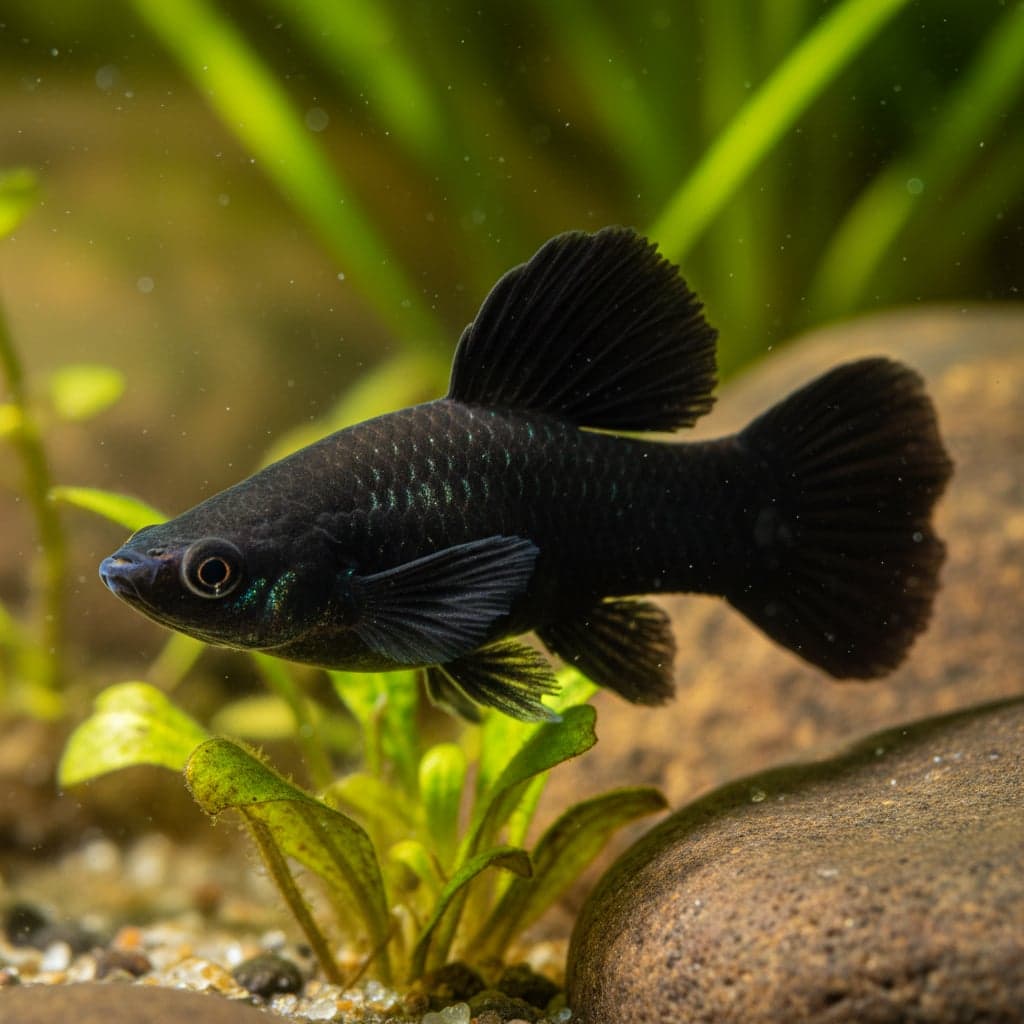
Mollies are livebearers and they breed readily, which means the interesting question is rarely how to make it happen. It is what to do about it.
The thing that separates mollies from other livebearers is fry size. Molly fry are born large — big enough to eat crushed flake immediately and often too big for the adults to swallow. In a guppy tank the adults eat most of the fry and the population self-limits. In a molly tank they do not, and it does not.
Gestation is longer than you expect
50 to 70 days, considerably longer than the 21–30 days of a guppy. Warmer water shortens it; at 28°C expect the lower end, at 24°C the upper.
That longer gestation is why molly fry emerge so well developed, and it is also why a newly bought female may not drop for weeks — leading people to conclude she is not pregnant when she is.
Sperm storage, and why an all-female tank still produces fry
Female mollies store sperm and can produce several broods from a single mating, over four to six months.
The practical consequences are worth stating plainly:
- Any female you buy is very likely already pregnant. Farms keep mixed populations at density.
- An all-female group will still produce fry, for months, and this is not a sexing error.
- Removing the male does not stop reproduction for a good half year.
If you want no fry at all, the only reliable option is an all-male group — which is also the more colourful choice, since males carry the sailfin display.
Reading a pregnant female
The gravid spot — a dark patch near the vent — darkens and enlarges as the brood develops. It is easy to see on pale mollies and genuinely hard on black mollies, which is inconvenient given how common they are.
Body shape squares off. A pregnant molly goes from rounded to noticeably boxy when viewed from above, and this is often the more reliable signal on dark fish.
Behaviour before birth: she seeks cover, becomes less interested in food, and may hang near the heater or in a corner. Birth usually happens in the early morning.
Do not use a breeder trap unless you are watching closely. The cramped mesh boxes sold for this cause real stress and can trigger premature delivery or stillbirth. A heavily planted tank is better for the female and nearly as good for the fry.
Raising the fry
Molly fry make this easy. They are born 8–10mm, free-swimming immediately, and able to eat crushed flake from day one — no infusoria stage, no microworm cultures, none of the difficulty that egg-laying species involve.
- Feed three to four times daily, small amounts. Crushed flake, powdered fry food, baby brine shrimp, finely crushed spirulina.
- Include vegetable matter early. Mollies are grazers and fry raised on pure protein grow poorly and develop digestive problems.
- Keep the water hard and warm — same parameters as adults, GH 12–25 and 26°C. Fry are less tolerant of soft water than adults, not more.
- Small frequent water changes. Growth rate is limited by water quality more than by food.
They reach 2.5cm in about six weeks, are sexable at two to three months, and sexually mature at three to four. Separate the sexes by three months or the second generation starts breeding in your grow-out tank.
Sexing
Straightforward in mature fish. Males have a gonopodium — the anal fin modified into a narrow rod — and are usually slimmer and more colourful, with the sailfin dorsal in sailfin strains. Females have a normal fan-shaped anal fin, are larger and deeper bodied, and show a gravid spot.
The gonopodium develops from around eight to ten weeks. Before that, sexing is unreliable.
Limiting the population
You will need one of these, and it is better chosen than discovered.
Keep one sex. All-male is the standard answer and the most attractive tank.
Keep fry predators. Unlike guppy fry, molly fry are too large for many community fish, so this works less well than people expect. Larger tank mates — angelfish, larger cichlids, bigger tetras — do reduce recruitment meaningfully.
Plant lightly rather than heavily, if you have a mixed group and want fewer survivors. Dense cover is what allows a molly population to run away.
Have an outlet arranged. A local shop or other keepers, agreed before you have sixty juveniles.
Hybrids
Mollies interbreed readily with other Poecilia, and molly × guppy crosses are occasionally reported though rarely viable. Molly species and varieties — sailfin, common, black — cross freely with each other, and offspring of mixed strains revert toward plain wild-type colouring within a couple of generations. Keep one strain per tank if you want to maintain it, as with guppy strains.
Before you start
- Assume every female you buy is pregnant.
- Decide on one sex or both before purchase — this is the whole decision.
- Have grow-out space or an outlet arranged in advance.
- Skip the breeder trap; plant the tank instead.
- Feed fry vegetable matter, not just protein.
- Separate the sexes by three months.