Molly vs Guppy: Which Livebearer Should You Keep?
Both are hard-water livebearers that breed constantly, and they are not interchangeable. Size, bioload, tank requirement and fry behaviour all differ more than the shelf suggests.
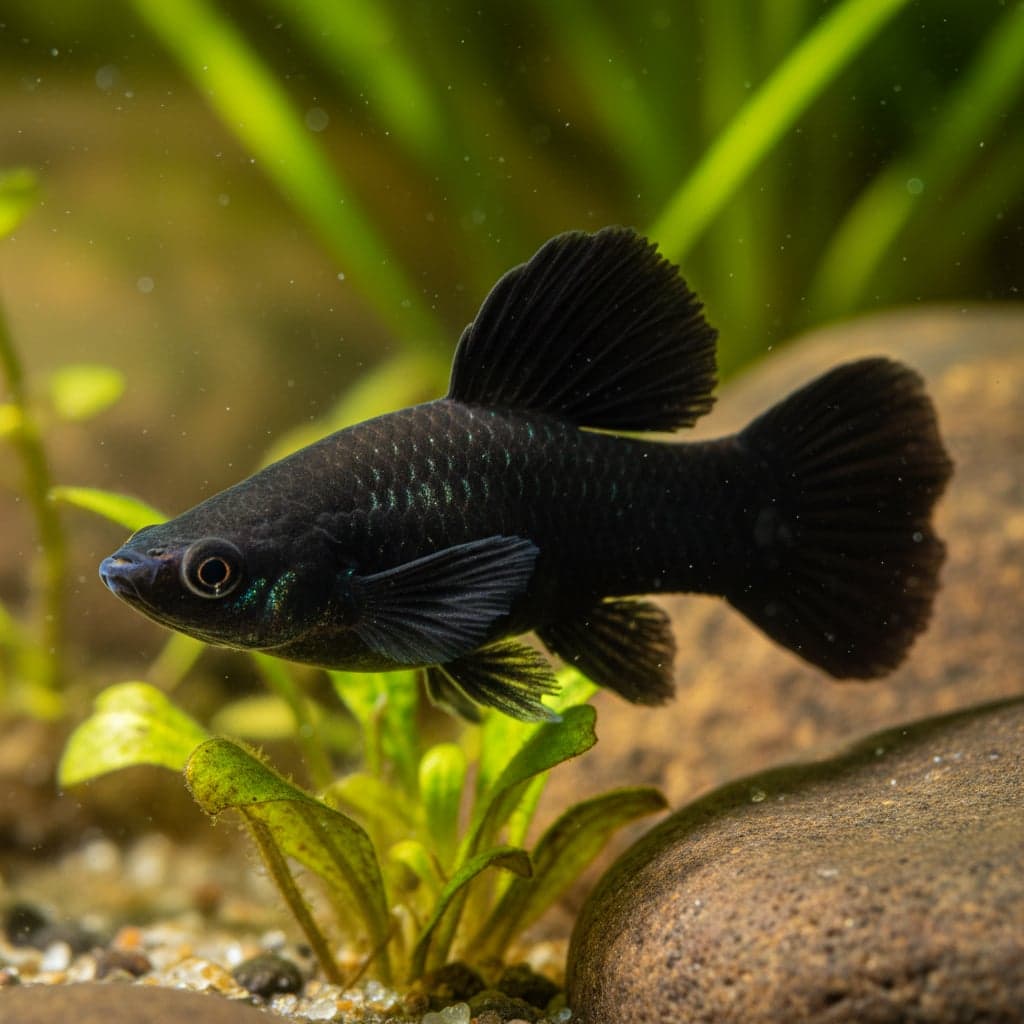
They sit next to each other in the shop, cost about the same, and both get described as hardy beginner livebearers. Then one of them turns out to be three times the fish.
The differences that matter are size, waste output and what happens to the fry. Everything else is detail.
The comparison
| Molly | Guppy | |
|---|---|---|
| Adult size | 8–10cm common, 12–15cm sailfin | Male 3–3.5cm, female up to 6cm |
| Minimum tank | 75L / 20 gal | 40L / 10 gal |
| Bioload | Heavy | Light |
| Temperature | 24–28°C | 22–26°C |
| Hardness | GH 12–25 — the harder of the two | GH 8–20 |
| Gestation | 50–70 days | 21–30 days |
| Fry per brood | 20–100, large | 20–60, tiny |
| Fry survival | High — too big to be eaten | Low — adults eat most |
| Colour | Solid blocks; sailfin display | Extreme tail and pattern variety |
| Temperament | Pushier; males harass | Peaceful; males pester females |
| Lifespan | 3–5 years | 1–3 years |
Size is the decision
A common molly is three times the length of a male guppy and many times the mass. A sailfin is larger still.
This drives everything downstream. Mollies need 75 litres minimum where guppies manage in 40. They produce far more waste, so they need heavier filtration and weekly rather than fortnightly water changes. And they need a longer tank to patrol.
If your tank is 40 litres, the decision is already made: keep guppies. Putting mollies in it produces the water quality problems that show up as shimmying.
The fry difference is bigger than it sounds
Both breed constantly. Both store sperm and deliver broods for months from one mating. The difference is what survives.
Guppy fry are tiny and the adults eat most of them. A planted guppy tank self-limits at a stable population without intervention — the mechanism described in guppy tank size and stocking.
Molly fry are large — 8–10mm, free-swimming, eating crushed flake on day one, and frequently too big for the adults to swallow. A molly tank does not self-limit. It fills.
So a mixed-sex guppy tank finds an equilibrium and a mixed-sex molly tank becomes a management problem. If you want livebearers without a population plan, guppies are more forgiving. If you actively want fry to raise, mollies are far easier — no infusoria, no micro-food, just crushed flake.
Water: similar, but mollies are stricter
Both want hard, alkaline, mineral-rich water, which is why they are often kept together successfully — see guppy and molly.
Mollies want it harder (GH 12–25 against 8–20) and warmer (24–28°C against 22–26°C). In a shared tank, meet at GH 15+ and around 25°C and both are fine.
Neither belongs in soft water. If your tap water is soft, both species need crushed coral, and the mollies will complain first.
Temperament
Guppies are peaceful. The only social problem is males pestering females, solved by a 2:1 female ratio.
Mollies are pushier than their reputation. Males harass females and each other, and a male molly will nip the trailing fins of a fancy guppy. Keep one male molly or four-plus, never two or three.
In a shared tank the size difference tells: mollies reach food first and out- compete guppies at feeding time. It works, but feed at two points.
Which should you buy?
Choose guppies if your tank is under 75L, you want maximum colour variety, you want the population to self-limit, or it is your first tank.
Choose mollies if you have 75L or more, want a larger and more substantial fish, have genuinely hard water, want a sailfin display, or intend to raise fry easily.
Choose both if you have 75L+ and hard water — they are genuinely compatible, with the caveats above.
If longevity is the priority, mollies win clearly: three to five years against one to three, for reasons covered in guppy lifespan.
Before you buy
- Measure the tank first; under 75L this is not a choice.
- Test GH — soft water rules out both without crushed coral.
- Decide whether you want fry to survive. That single question separates them.
- One sex only if you want no population management at all.
- Remember sailfin mollies need 100L, not 75L.