Do Mollies Need Salt? Brackish Water Explained
The most argued-about question in livebearer keeping. Mollies do not require salt, but they do require hard mineral-rich water — and the two get confused constantly.
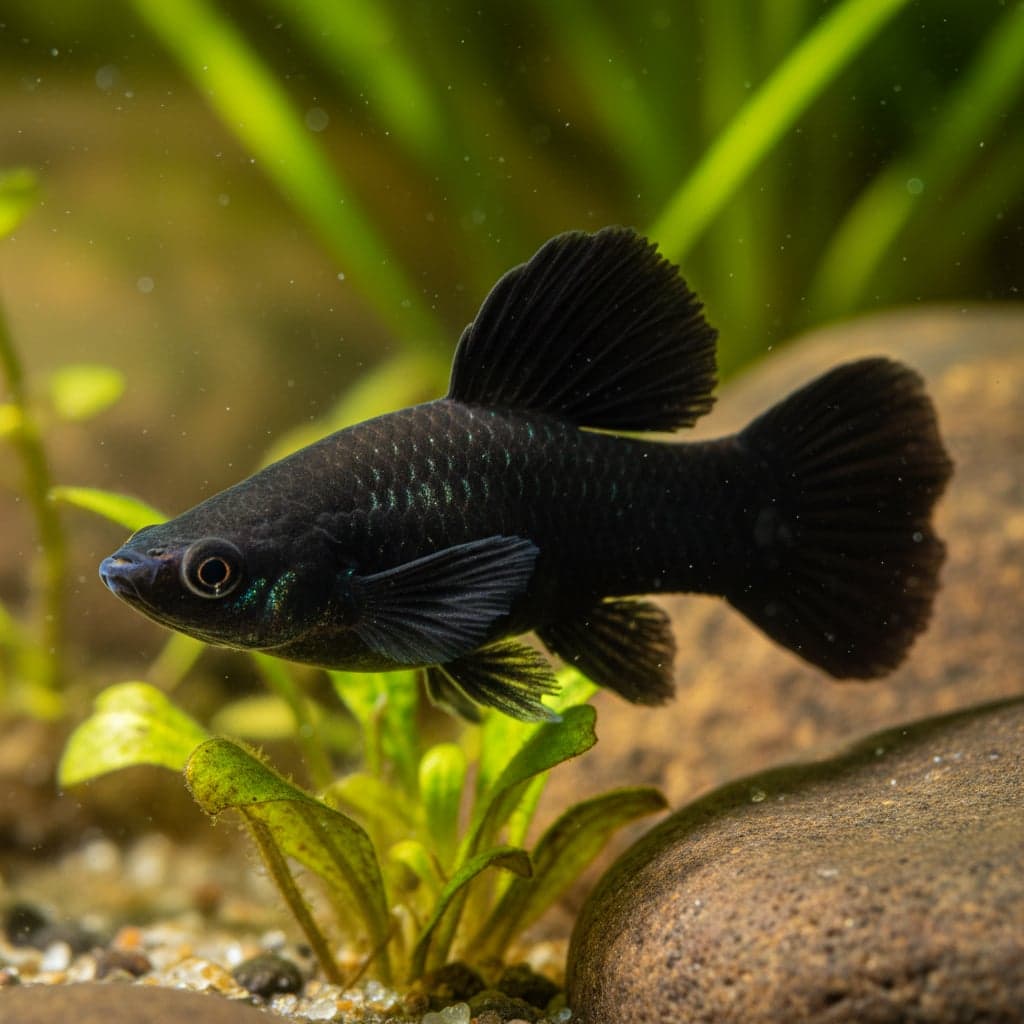
No — but the advice is not as wrong as the correction usually claims.
This question generates more bad advice than anything else in livebearer keeping, in both directions. One camp insists mollies are brackish fish that need salt to survive. The other insists salt is unnecessary and harmful to plants and tank mates. Both are working from a partial picture.
The resolution: mollies need hard, mineral-rich, alkaline water. Salt is one crude way of making water feel more like that, and it treats the symptom of soft water rather than the cause.
Where the myth comes from
It comes from a true fact. Poecilia mollies are genuinely euryhaline — they tolerate an exceptionally wide salinity range, and wild populations occur in fresh water, brackish estuaries and even full marine conditions. Sailfin mollies in particular are found in coastal salt marshes.
So mollies can live in brackish water. That is not the same as needing it, and the leap from one to the other is where the advice goes wrong.
What is actually going on is this. Mollies come from hard, alkaline, mineral-rich water with high dissolved solids. When a keeper puts them in soft tap water they do badly — faded colour, clamped fins, shimmying, disease. Adding salt raises dissolved solids and osmotic pressure, the fish improve, and the keeper concludes mollies need salt.
They did not need salt. They needed minerals, and salt was a blunt instrument that partially delivered them.
What they actually need
GH 12–25 dGH. KH 10–20 dKH. pH 7.5–8.5.
That is harder and more alkaline than almost any other common community fish wants, and harder even than guppies require — mollies are the most demanding of the common livebearers on this axis.
If your tap water delivers that, you need nothing. No salt, no additives.
If your water is soft, fix the hardness properly:
- Crushed coral or aragonite in the filter or as substrate. Dissolves slowly, raises GH and KH, and self-limits. The standard answer.
- A GH/KH remineraliser if you run RO water.
- Limestone or texas holey rock as hardscape.
All of these raise the minerals the fish are short of, without the side effects of salt.
When salt genuinely helps
Salt is a legitimate tool for mollies in specific circumstances — this is why the old advice will not die.
As a disease treatment. Aquarium salt at 1–3 g/L is effective against some external parasites and helps with osmotic stress in a sick fish. Mollies tolerate this better than most fish, which makes salt a reasonable treatment option for them where it would be risky for others.
As a temporary support for a fish shimmying in soft water while you sort out the hardness properly. It buys time. It is not the fix.
In a dedicated brackish tank, where mollies are an excellent choice alongside other brackish species. This is a deliberate setup, not a default.
What salt does not do is provide general "tonic" benefit. Permanent low-dose salt in a freshwater community tank is not maintenance — it is a constant mild osmotic load on every fish that is not a molly.
Why permanent salt is a bad default
It harms most tank mates. Corydoras, kuhli loaches, most tetras and nearly all catfish are scaleless or salt-intolerant. A molly community dosed with salt is a bad tank for everything except the mollies.
It kills most plants. Salt at meaningful concentrations damages or kills common aquarium plants, which removes the cover and nitrate uptake a livebearer tank benefits from.
It does not evaporate. Salt stays when water leaves, so topping up evaporation with fresh water and salted water alternately produces a slowly drifting salinity nobody is tracking.
It masks the real problem. A tank that needs salt to keep mollies healthy is a tank with the wrong hardness, and that will keep causing problems.
The practical decision
- Test your GH and KH. This is the whole question, and one test kit answers it.
- GH 12+ and pH above 7.5? Keep mollies, add nothing.
- Softer than that? Add crushed coral and raise hardness over a few weeks. Do not add salt.
- Fish shimmying right now? Salt at 1–2 g/L as short-term support while the hardness comes up — see molly shimmies and health.
- Want a brackish tank? Mollies are one of the best candidates, at SG 1.005–1.015, with tank mates chosen to match.
Before you buy
- Test tap water GH, KH and pH before choosing mollies at all.
- Soft-water areas: plan for crushed coral from day one.
- Never dose salt permanently in a mixed community tank.
- Keep salt in the cupboard as a treatment, not in the tank as a policy.
- Remember mollies want harder water than guppies, not merely similar water.