Mayan Cichlid: Mayaheros urophthalmus
A large, bold Central American cichlid from the Yucatán's lagoons, mangroves and cenotes, with a striking eyespot on the tail and a tolerance for brackish water.
Also known as: Mexican mojarra · Mexican cichlid · Cichlasoma urophthalmus · Mayaheros urophthalmus

Mayan Cichlid
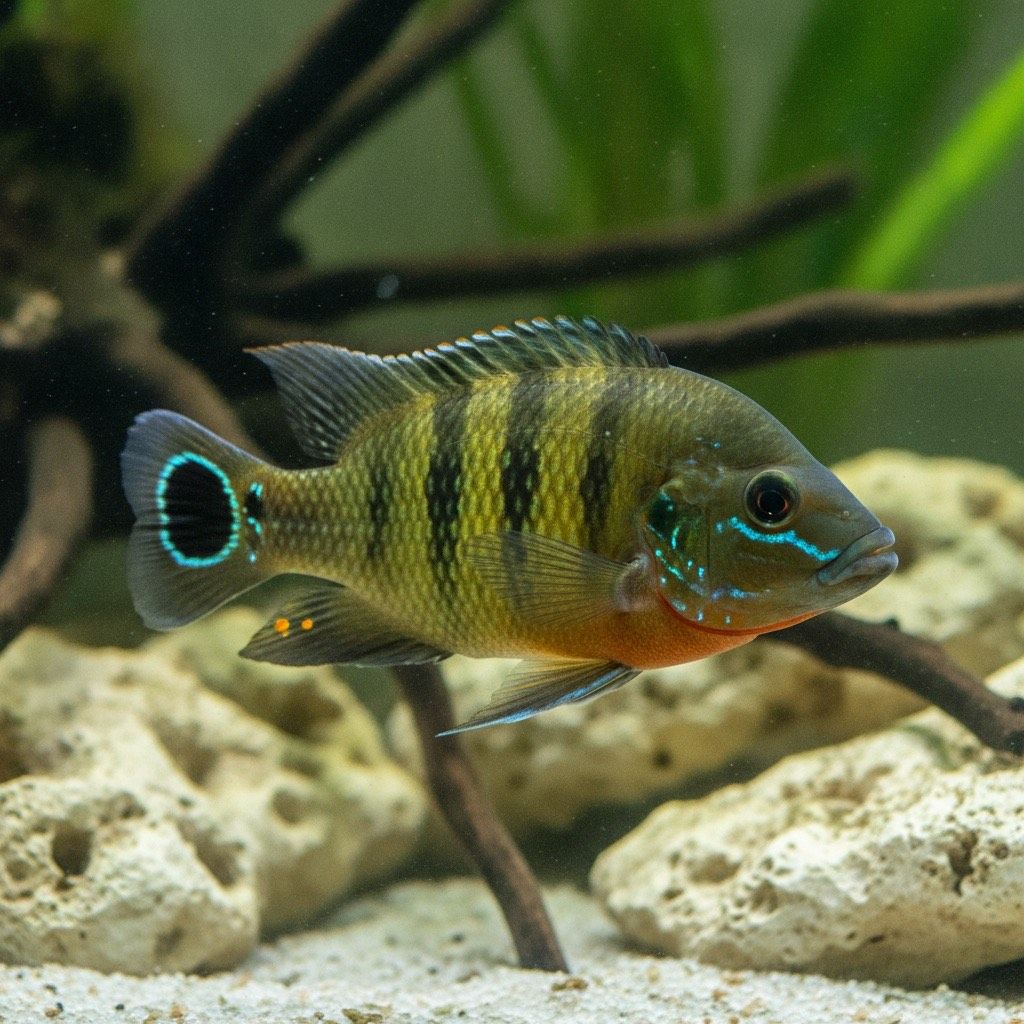
The Mayan Cichlid (Mayaheros urophthalmus, formerly Cichlasoma urophthalmus) is a robust, deep-bodied cichlid from the Atlantic side of Central America. Its species name means "tail eye", after the large black eyespot ringed in blue at the base of the tail. Adults show six or seven dark vertical bars over an olive to golden body, and breeding fish flush brick-red across the throat and belly.
This is a big fish. FishBase records a maximum of 39 cm, and aquarium adults commonly reach 25-30 cm. It is intelligent, responsive and full of character, but it needs space and an owner who plans for its temperament.
Natural Habitat & Origin
The species ranges along Atlantic drainages from southern Mexico to Nicaragua, and is especially common on the Yucatán Peninsula, where it lives in coastal lagoons, mangrove swamps, marshes and the freshwater sinkholes known as cenotes. It moves between fresh and brackish water without difficulty, and it has become established in southern Florida, where it is treated as an invasive species.
Its natural waters are warm and usually hard and alkaline, often clear, with rocky or muddy bottoms and plenty of submerged wood and roots.
Care Requirements
Plan for a tank of at least 450 litres for a single adult or a pair, at least 150 cm long. Filtration must be strong: this is a large, messy carnivore, and nitrate builds quickly. Keep the water at 24-30°C, with a pH of 7.0-8.5 and moderate to high hardness.
A small amount of marine salt is tolerated and is sometimes used to mimic its lagoon habitat, but it is not required; the species does well in hard fresh water.
Aquascape with large rocks and wood arranged to create sight lines and territories, and anchor everything firmly, as Mayan Cichlids dig and rearrange the tank, especially when breeding. Delicate plants will be uprooted; robust plants attached to wood, such as Anubias and Java Fern, have the best chance.
Diet & Feeding
In the wild it feeds on small fish and larger invertebrates. In the aquarium it takes quality cichlid pellets readily, and these should be supplemented with frozen foods such as krill, mysis, prawn and mussel. Feeding live feeder fish is unnecessary and risks introducing disease.
Behavior & Temperament
Mayan Cichlids are territorial and become aggressive, particularly when breeding. They can be kept with other large, robust Central American cichlids in a big enough tank, but not with small or peaceful fish, which will be eaten or harassed.
A mated pair forms a strong bond and defends its territory fiercely. Buying a group of juveniles and letting a pair form is the most reliable way to get a compatible pair; remove the others once it does.
Tank Mates
Only in a large tank, and only with fish of similar size and temperament:
- Jack Dempsey
- Large, robust catfish such as sailfin plecos
- Other large Central American cichlids, with care
Avoid small cichlids, community fish and anything slow or long-finned.
Breeding
Mayan Cichlids are open substrate spawners and attentive parents. The pair cleans a flat rock or a patch of the tank floor, and the female lays several hundred eggs; FishBase records up to about 600. Both parents guard the eggs and then the free-swimming fry, which can be fed newly hatched brine shrimp and crushed flake. Expect a sharp rise in aggression towards tank mates during this time.
Common Health Issues
The Mayan Cichlid is hardy. The most common problem in large cichlids is head and lateral line erosion, linked to poor water quality and high nitrate, so large, regular water changes matter. Quarantine new fish, avoid feeder fish, and give it the space it needs.