Vampire Shrimp: Atya gabonensis
A large filter feeder that fans the current with feathered forelimbs rather than grazing. Needs flow and suspended food, not algae wafers.
Also known as: Viper Shrimp · African Fan Shrimp · Atya gabonensis · Gabon Shrimp

Vampire Shrimp
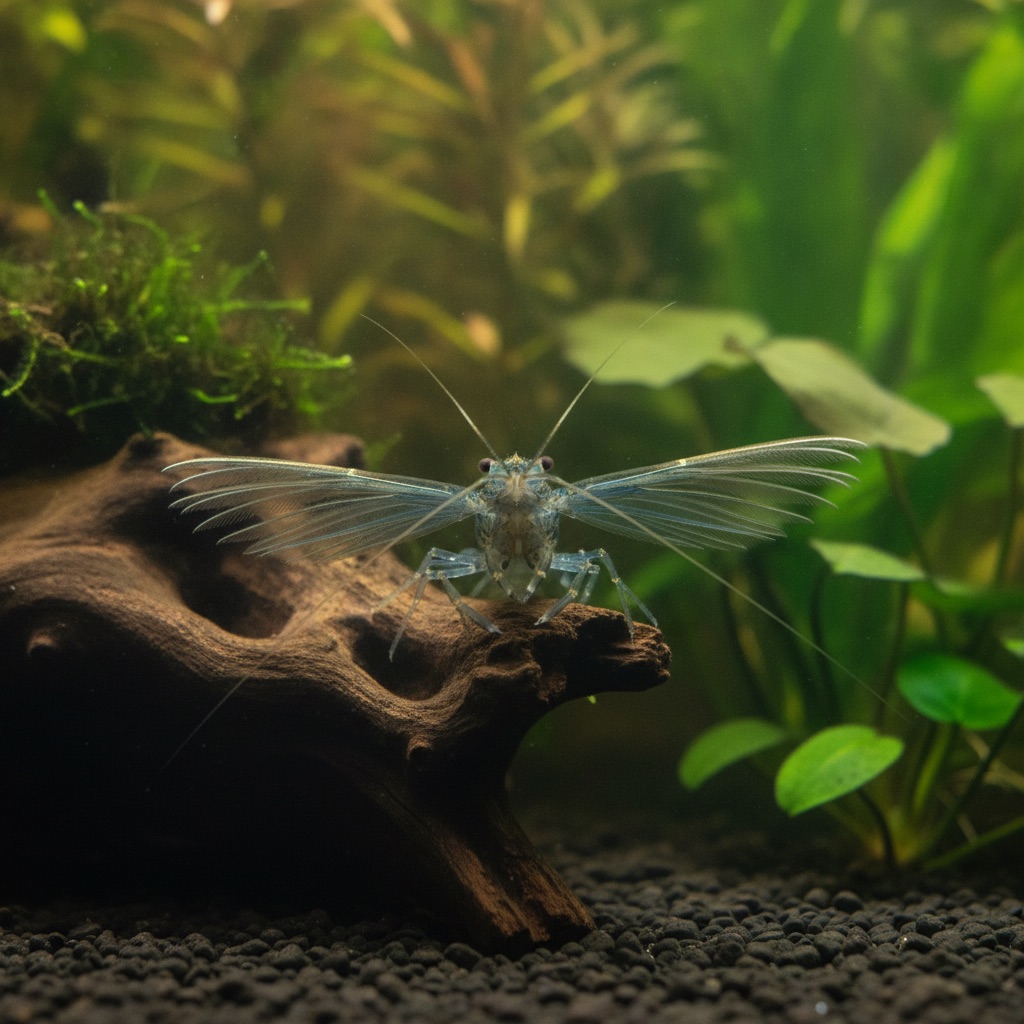
Atya gabonensis is the largest shrimp most people will keep in fresh water — 10 to 15 cm of heavy, ridged, blue-grey or rusty-brown animal that looks armoured and menacing and is one of the most harmless creatures in the hobby. It has no grasping claws at all. The first two pairs of legs end not in pincers but in dense brushes of fine setae, which it unfurls into the current like a pair of hand fans and combs shut every few seconds to eat whatever it has caught.
That anatomy is the entire care sheet. A Vampire Shrimp cannot compete for sinking pellets, cannot rasp algae off glass, and cannot chase anything. It eats what drifts past. The single most common way to kill one is to put it in a beautifully maintained, heavily filtered, spotlessly clean tank where nothing drifts past at all, and then not notice for four months.
Natural Habitat & Origin
The species is recorded from fast-flowing rivers in West Africa — Senegal, Gambia, Nigeria, Gabon and neighbouring countries — and from northern South America, an unusual disjunct distribution that some authors think may eventually prove to involve more than one species. Almost all trade stock is wild-collected from West Africa.
The habitat is the point. These are riffle animals, found wedged among rocks in strong current, facing upstream, where the water carries a continuous load of suspended algae, bacteria, detritus and small invertebrates. In that setting the fan-feeding strategy is highly efficient: the shrimp does not have to move, and the river delivers food indefinitely. A tank has to imitate the delivery, not just the water chemistry.
Care Requirements
Flow is the first requirement and the one people underestimate. You need a defined current — a wave maker or a canister return aimed across an open rock or piece of driftwood — and a perch positioned in it. A shrimp given a proper flow lane will settle on it and use it for months; a shrimp in a still tank wanders the substrate looking for one.
Size next: a 15 cm shrimp needs a tank of at least 100 litres, with a footprint long enough to accommodate flow at one end and quiet water at the other. It also needs a cave or overhang it can retreat into for the week after moulting.
Chemistry is easy by comparison — 23-28°C, pH 6.5-7.5. Moderate hardness (GH 6-12) supports the substantial exoskeleton it has to rebuild at each moult; very soft water gives soft shells and failed moults in an animal this size.
The counterintuitive part is filtration. Aggressive mechanical filtration, a UV steriliser and diatom-polished water all do exactly what they are designed to do — strip suspended particulate from the water column — and that particulate is this animal's food supply. A Vampire Shrimp does best in a mature, slightly "living" tank with plants, leaf litter and a filter sized for biological rather than polishing duty.
Use the Aquarium Tracker to log these parameters against your own readings — it flags a drift before it becomes a problem.
Diet & Feeding
It filters. Suitable food is anything fine enough to stay suspended: powdered invertebrate and fry foods, crushed flake, spirulina powder, powdered spinach, newly hatched brine shrimp, green water. Algae wafers and sinking pellets are close to useless — by the time they have broken down enough to be usable, other tank inhabitants have eaten them.
Target-feed rather than broadcast. Mix a small amount of powdered food into a little tank water, draw it into a pipette or turkey baster, and release it into the current a few centimetres upstream of the perched shrimp. Done properly you will see the fans open wider and comb faster within seconds. Two or three feedings a week in a mature tank, more in a sparse one.
The behavioural tell is unambiguous and every keeper should know it: a Vampire Shrimp that has abandoned the flow and is sweeping the substrate with its fans, or scraping surfaces with them, is not foraging normally. That is a hungry animal switching to a much less efficient last-resort mode, and it is the sign to feed the water column more heavily. See feeding invertebrates.
Behaviour & Temperament
Shy at first — new arrivals often disappear into the hardscape for a week or more — then increasingly bold, and eventually so settled that they feed in the open with the lights on. A well-kept individual spends hours in the same spot in the current, fans working steadily.
Colour is variable and shifts. The same animal can appear pale grey-blue, lavender, tan or rust-red at different times, and it usually changes noticeably after a moult. This is normal and not a health signal. Moulting itself is dramatic in an animal this size: the shrimp hides for several days, the shed shell is a complete and startlingly lifelike replica that people regularly mistake for a dead shrimp, and it should be left in the tank for the shrimp to eat and recover the calcium.
Despite the size and the name, it is defenceless. It has no claws, it does not compete, and it will not threaten anything in the tank including shrimplets and fry.
Tank Mates
Excellent with medium-sized peaceful community fish — it is too big to be eaten and equipped to eat nothing. Rasboras, tetras, barbs, rainbowfish, bristlenose plecos and corydoras all work well, and their feeding actually helps by putting fine particulate into the water.
Avoid two categories. First, anything that will harass a soft-shelled shrimp after a moult — large cichlids, and boisterous fish that pick at slow-moving tank mates. Second, and less obviously, anything that will monopolise fine suspended food before the shrimp can filter it; a heavy population of small surface feeders can quietly outcompete it. A single Vampire Shrimp is fine alone, but two or three in a large tank will each claim a flow lane and are worth keeping together for the display.
Breeding
Effectively impossible in a home aquarium, and the reason is larval biology. Atya gabonensis is amphidromous: females release very large numbers of tiny larvae that must reach brackish or marine water within days to develop. They feed as plankton for weeks before metamorphosing into juveniles that then migrate back upstream into fresh water.
A female will occasionally become berried in captivity, and the eggs will hatch, and the larvae will die — they need salinity, a continuous plankton food supply and a scale of water volume that a home setup cannot provide. Commercial captive breeding does not exist for this species, which is why every animal in the trade is wild-caught and why they arrive as adults rather than as juveniles.
Common Health Issues
Starvation, and it is by far the most common cause of death. It is also the hardest to spot, because it takes months and the animal looks structurally the same throughout. Watch for a body that has become noticeably translucent or sunken between the carapace ridges, for reduced fan activity, and for the substrate-sweeping behaviour described above. By the time a filter feeder looks obviously thin it is usually too late. Feed the water column deliberately rather than assuming a mature tank is enough.
Moulting failure is the second, and in an animal this large it is usually fatal. It follows insufficient calcium and magnesium in soft water, or a sudden change in temperature or mineral content. Keep GH in the 6-12 range, change water in small matched increments, and leave the old shells in the tank.
Copper is lethal, as with all invertebrates, and the contamination outlasts the treatment — dosed copper binds to substrate, rock and silicone and leaches back for months. Never treat a tank containing a Vampire Shrimp with a copper-based medication; move the fish to a hospital tank. See medications and heavy metals.
Finally, import condition. These are wild-caught animals that have been through collection, holding and long-haul freight, often without feeding, and they frequently arrive already depleted. Buy the fattest, most active individual in the shop tank, ask how long it has been in, and start deliberate target feeding immediately rather than waiting to see whether it settles. Given decent conditions they are long-lived — five years or more is normal.