Ghost Shrimp: Palaemonetes paludosus
A near-transparent scavenger sold cheaply as feeder stock. Larger and more predatory than Neocaridina — it will take fry and smaller shrimp.
Also known as: Glass Shrimp · Feeder Shrimp · Palaemonetes paludosus
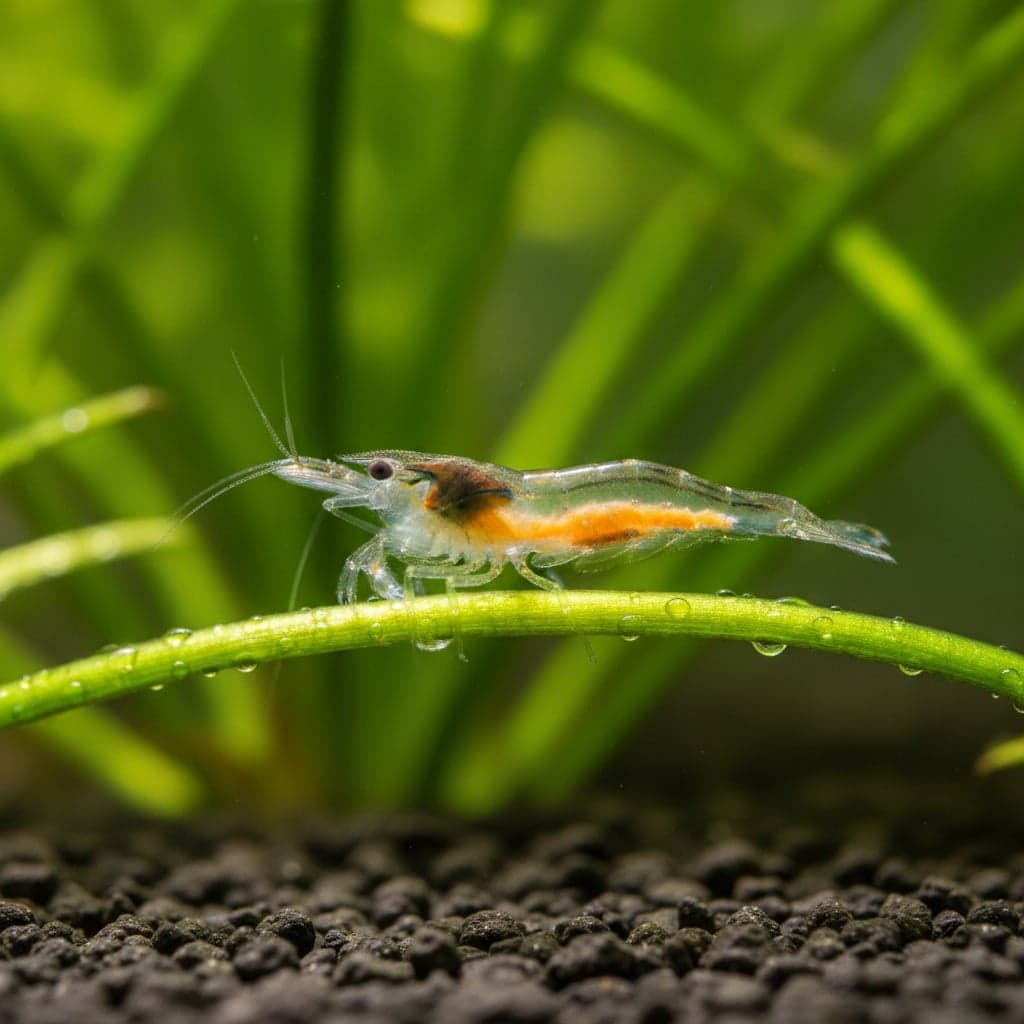
Ghost Shrimp
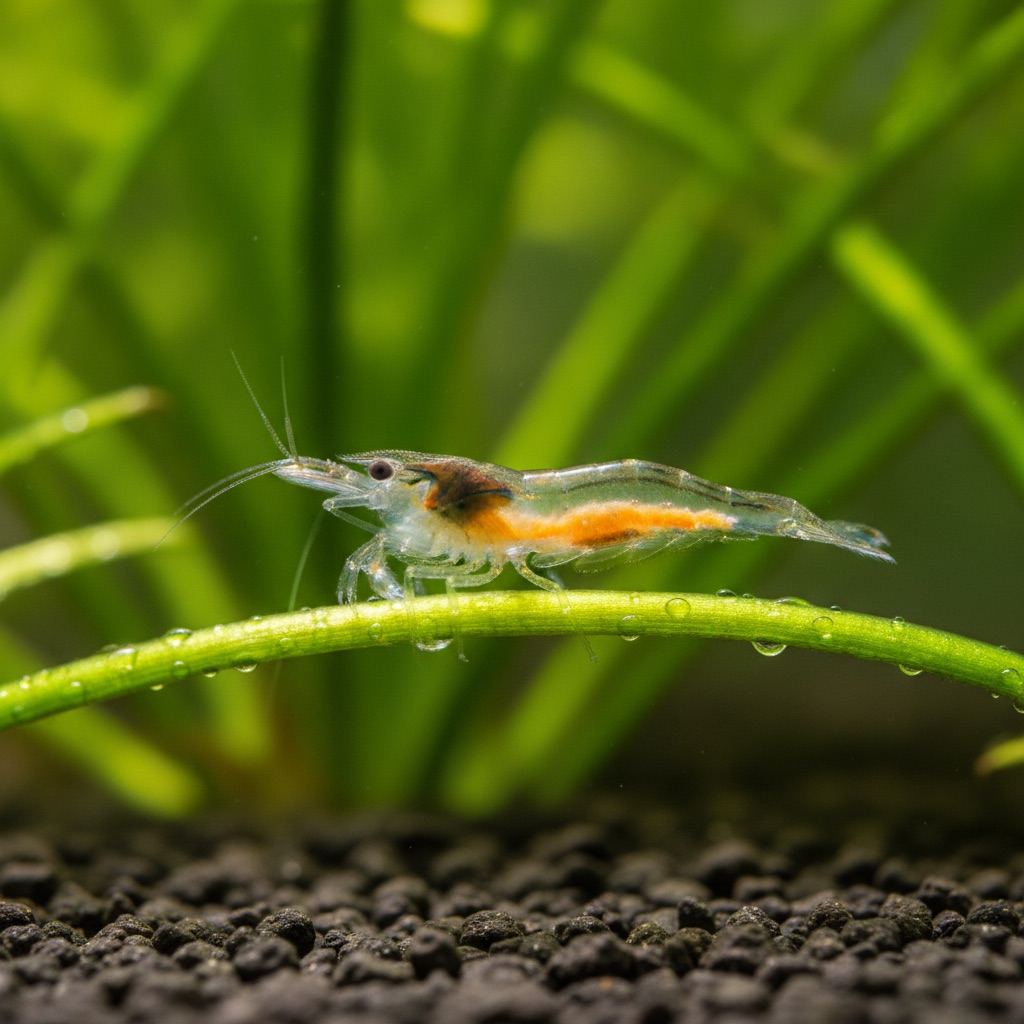
"Ghost shrimp" is a trade name, not a species. The animal most often meant is Palaemonetes paludosus, the American glass shrimp — a 3-4 cm, almost entirely transparent scavenger from the southeastern United States, through whose body you can watch the gut fill, the heart beat and a female's eggs develop. But the label gets applied to several Palaemonetes and Palaemon species, and in feeder tanks it routinely gets applied to juvenile Macrobrachium as well.
That last substitution is the one that costs people fish. Macrobrachium are long-armed river prawns, and they are predators — a "ghost shrimp" that grows past 5 cm and develops long, obviously clawed second legs held out in front of it is not a glass shrimp, and it will kill tank mates. Check the front limbs before you buy. A true glass shrimp has small, delicate pincers barely visible against the body; a Macrobrachium has arms you can see across the room.
Natural Habitat & Origin
Palaemonetes paludosus lives in the freshwater ponds, ditches, swamps and slow streams of the southeastern United States, from Florida through the Gulf states and up the Atlantic coastal plain. It is a vegetation animal rather than a rock animal — it lives among submerged and emergent plants, where transparency against a background of stems and detritus is an effective defence against sight hunters.
The water there is warm, generally neutral to slightly alkaline, and often tannin-stained. It is an entirely freshwater species: unlike the estuarine Palaemonetes of the same coast, it completes its whole life cycle without ever reaching salt water. That distinction matters a great deal when it comes to breeding, and it is the point most care sheets get wrong.
Care Requirements
Genuinely hardy, which is precisely why the pet trade uses it as cheap feeder stock. Anywhere in 20-28°C and pH 7.0-8.0 is fine, and it will tolerate more than that provided ammonia and nitrite are zero. It is not, however, tolerant of copper — see the health section — and it is no more tolerant of a cycled-tank shortcut than any other animal. Using ghost shrimp to "cycle" a tank is animal disposal dressed up as husbandry; use ammonia, and see the nitrogen cycle.
Give them 40 litres or more for a small group. They are bigger and much more active than dwarf shrimp, and a group in a nano tank will harass each other over food. Provide planting, driftwood and leaf litter: they need cover for the day or two after each moult, when the new shell is soft and other shrimp will attack them.
Moderate hardness supports moulting — GH 6-12 is a reasonable target, since like all crustaceans they draw calcium from the water to build the new exoskeleton. Very soft water gives soft shells and failed moults.
Use the Aquarium Tracker to log these parameters against your own readings — it flags a drift before it becomes a problem.
Diet & Feeding
Opportunistic omnivores with a broad appetite: leftover food, detritus, soft algae, biofilm, dead plant matter, dead fish and — given the opportunity — anything small and slow enough to catch. They are noticeably more carnivorous than Neocaridina and will actively pick at fish fry, newly hatched shrimplets and sleeping or ailing small fish.
In practice they need almost no dedicated feeding in a stocked community tank, which is their main appeal: a group of six will keep the substrate of a 60-litre tank clear of uneaten food. In a sparsely stocked or species tank, feed sinking pellets, algae wafers, blanched vegetables and the occasional protein food. The transparency makes portioning easy — the gut runs as a dark line down the back, so you can literally see whether they have eaten.
Behaviour & Temperament
Individually peaceful towards anything they cannot catch, but far more assertive than their reputation suggests. They squabble over food, chase each other, and larger individuals will pull the legs off a shrimp that has just moulted. Housed in a group with enough cover and enough food this is unremarkable; housed crowded and underfed it becomes serious.
They are active by day, unusually so for a scavenger, and they spend most of it picking through the substrate and swimming between plant stems. The transparency also means you get a free view of shrimp anatomy — the beating heart behind the carapace and the moving gut are visible without magnification, which makes them the best animal in the hobby for teaching someone what a shrimp actually is.
Tank Mates
Good with community fish too large to be eaten and too peaceful to be a nuisance: harlequin rasboras, corydoras and their larger relatives, bristlenose plecos, most tetras and barbs. Nerite snails are safe.
They are bad company for dwarf shrimp. Do not put them in with cherry shrimp or any Neocaridina colour line, and do not put them in a fry-rearing tank. They will also be eaten themselves by anything big enough — larger cichlids, angelfish and goldfish all take them, which is exactly why they are sold as feeders in the first place.
Breeding
This is where most sources go wrong. Palaemonetes paludosus does not need brackish water: it is a wholly freshwater species and will complete its life cycle in fresh water. What it does not have is direct development. A berried female carries a clutch of small green eggs on her swimmerets for around three weeks, and what hatches is not a miniature shrimp but a free-swimming planktonic larva, a few millimetres long, that spends one to three weeks drifting and feeding before metamorphosing.
That larval stage is why almost nobody rears them. The larvae are too small for prepared foods, need dense microscopic food such as green water, infusoria or newly hatched brine shrimp, and are drawn straight into any standard filter. In a normal community tank they are simply plankton, and they are eaten within a day. To rear them you need to move a berried female to a bare tank with an air-driven sponge filter, remove her once the larvae hatch, and feed the water column continuously.
The confusion is worth untangling because it is genuine: several of the estuarine Palaemonetes species sold under the same "ghost shrimp" label — grass shrimp from Atlantic and Gulf salt marshes — really do require brackish water for larval development. If your shrimp came from a feeder tank, you do not know which species you have, and that alone explains most of the contradictory breeding reports.
Common Health Issues
Condition on arrival is the biggest single problem. Feeder-grade shrimp are wild-collected or bulk-farmed, shipped at very high density, held in unfiltered vats and often exposed to copper or formalin as a blanket prophylactic. A proportion of any batch is already dying when you buy it, and losses over the first two weeks routinely reach a third or more with no fault of yours. Buy from the ornamental tank rather than the feeder tank if the shop separates them, and quarantine before adding them to a display.
Copper is lethal, as it is to every invertebrate. Copper-based ich and snail medications kill shrimp at doses that fish tolerate, and dosed copper then binds to substrate, rock and silicone and leaches back into the water for months afterwards. Treat fish in a hospital tank — medications and heavy metals go into it.
Failed moults are the third, and they come from soft water or from a sudden change in temperature or mineral content. A shrimp stuck part-way out of its old shell will not recover. Keep GH up, change water in small matched increments, and leave shed shells in the tank for the shrimp to eat and recycle the calcium.
Lifespan is short even when everything goes right — around one year, sometimes a little more. A ghost shrimp that dies after twelve months of normal behaviour has not been failed by anything; it has simply reached the end.