Horned Nerite Snail: Clithon corona
The smallest common nerite, carrying black horns on a yellow shell. Small enough for nano tanks where a full-size nerite would look out of scale.
Also known as: Horned Snail · Clithon corona · Clithon diadema
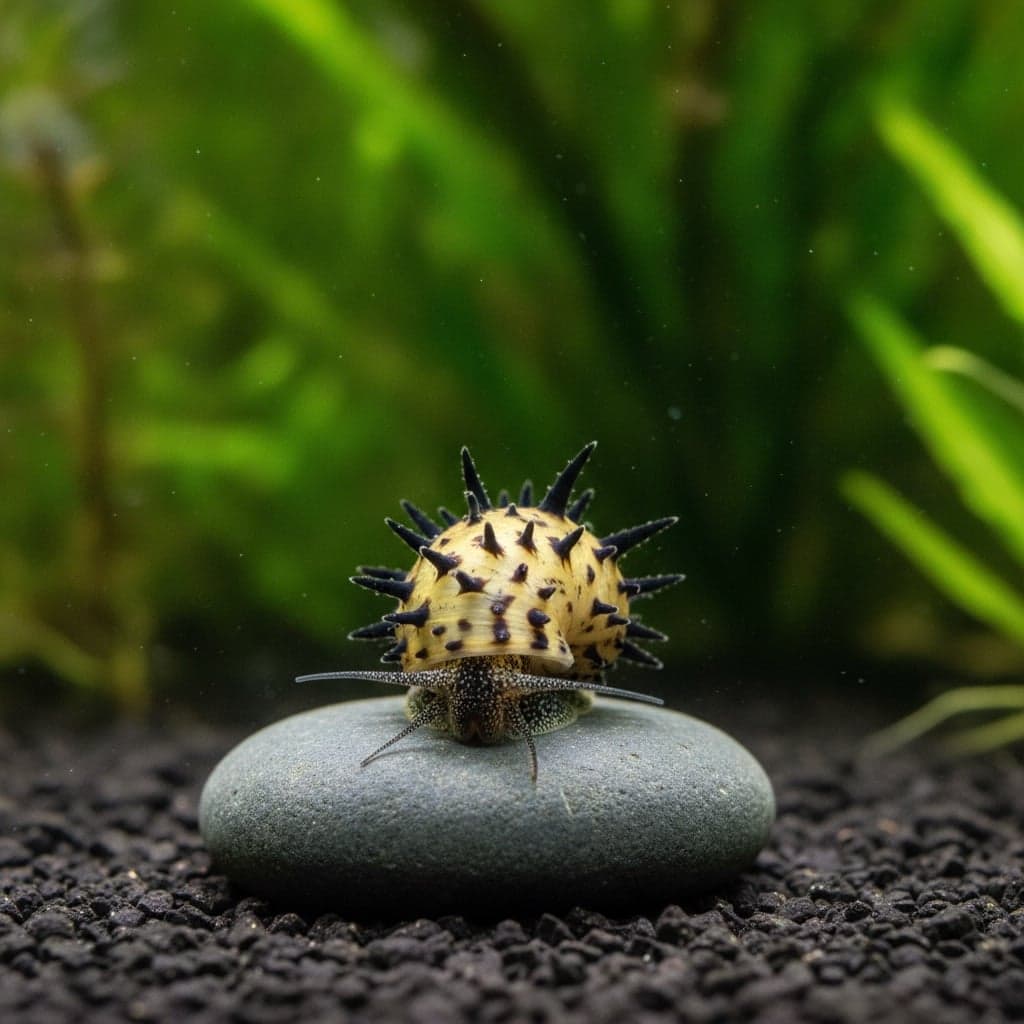
Horned Nerite Snail
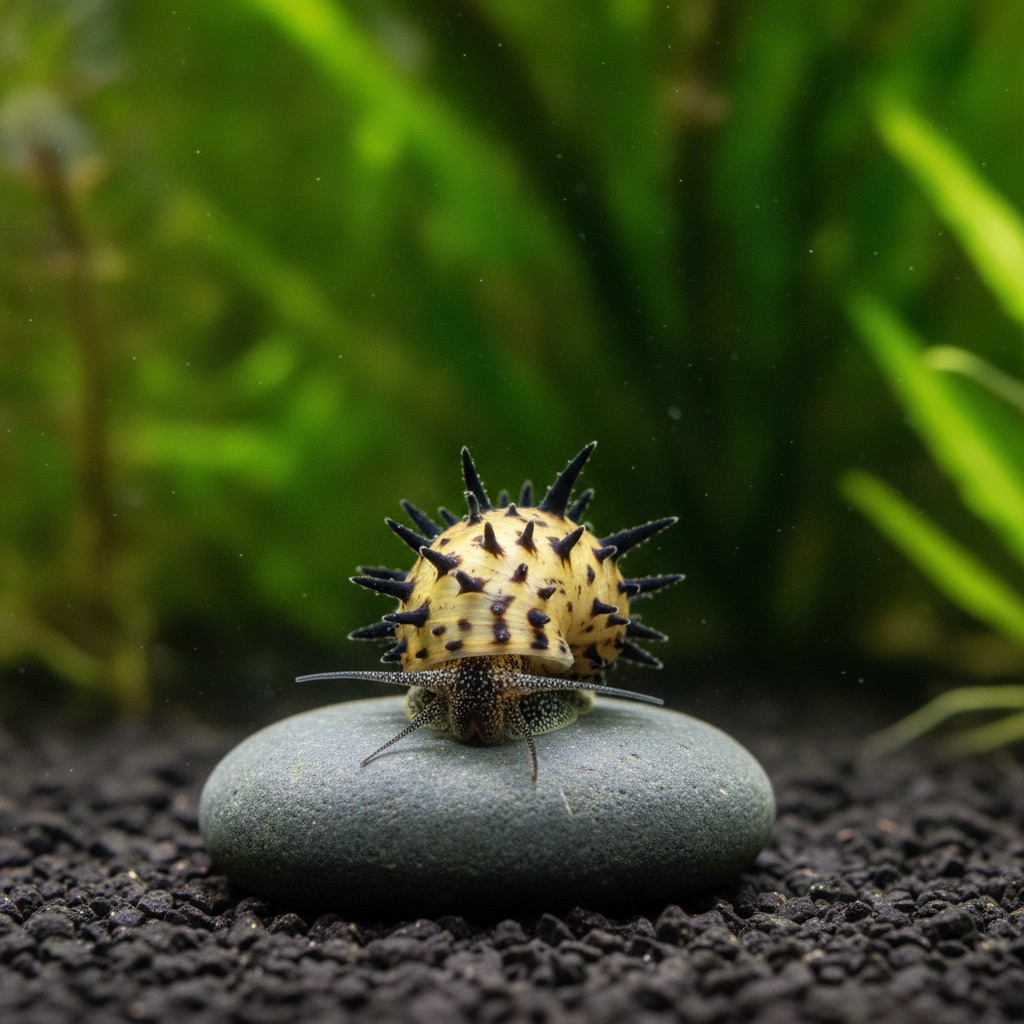
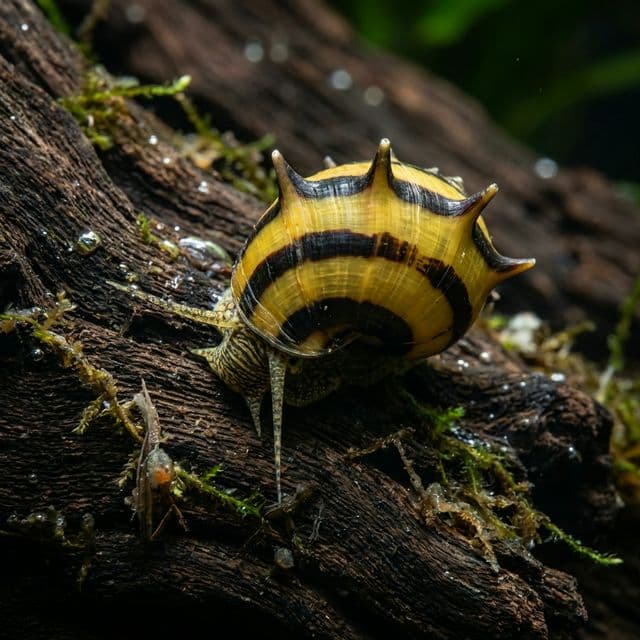
At 1 to 1.5 cm the Horned Nerite is the smallest nerite in general trade, and it is the only one that looks right in a 20-litre tank. A full-size zebra or helmet nerite in a nano scape reads as a boulder crawling over the hardscape; this one reads as a detail. The black spines that give it its name are hollow projections of the shell, arranged in a row along the outer whorl, on a background that runs from bright yellow through orange to olive with dark banding.
Those horns are more than decoration for the aquarist: they are a calcium gauge. They are the thinnest, most exposed structures on the shell, so they are the first thing the water dissolves when hardness drops. Blunted or missing horns tell you your GH is too low weeks before the shell body starts pitting, which makes this the easiest nerite to keep honest about water chemistry.
Natural Habitat & Origin
Clithon corona — sold interchangeably as Clithon diadema, and the two names have been applied so loosely in the trade that shop labels mean very little — comes from the coastal streams and estuaries of Southeast Asia, principally Indonesia, the Philippines and Thailand. Adults live in fresh water on rock and submerged wood, often in fast, shallow runs.
Like every nerite it is amphidromous. Eggs laid in the freshwater reach release larvae that drift downstream into brackish water, spend weeks feeding as plankton, then settle and migrate back up the river as juveniles. Stock is therefore wild-collected rather than farmed, which matters for two reasons: the animals arrive already stressed by a long supply chain, and collection pressure falls on wild populations of a species nobody breeds commercially.
Care Requirements
Hard, alkaline water and nothing exotic beyond that. GH 6-12, KH 4 or higher, pH comfortably above 7.0, and a temperature anywhere in the 22-28°C band. The mechanism behind the hardness requirement is simple chemistry: the shell is calcium carbonate, and soft acidic water is undersaturated with respect to it, so the water dissolves the shell faster than the snail can rebuild it. On this species the horns go first, then the spire whitens, then the pattern pits.
If your tap water is soft, put crushed coral in the filter or dose a remineraliser. Do not use a pH-up chemical: it moves pH without supplying the carbonate that holds it there, and the reading drifts back within days. The GH, KH and hardness guide covers the distinction.
Two practical points specific to this snail. Its small size means it can crawl into places larger nerites cannot — check filter intakes and any gap between hardscape and glass, because a wedged nerite dies where it sits. And the horns catch on fine mesh and on tight prefilter sponges; a coarse sponge filter intake is a better choice than a fine mesh guard. As with all nerites, keep a lid on the tank — they graze past the waterline and will keep going.
Use the Aquarium Tracker to log these parameters against your own readings — it flags a drift before it becomes a problem.
Diet & Feeding
Film algae, biofilm and diatoms, scraped off every hard surface with a radula. The small mouth and short radula handle soft films very well and struggle more than an olive nerite does with mature green spot algae, which is welded hard to the glass. If green spot is your problem, buy a larger nerite.
In a nano tank, stocking density is the thing people get wrong. Three Horned Nerites in 20 litres will clear the available film in a week or two and then have nothing. Because they are small, they starve faster than a big nerite with more stored reserve — a hungry one stops moving and sits with a thin, pale new growth band at the shell lip. Once the glass stays clean, feed them directly: algae wafers, blanched courgette, spinach, or a spare stone grown green on a windowsill and rotated into the tank. Feeding invertebrates goes into the routine.
Behaviour & Temperament
Slow, peaceful and easily overlooked, which in a small tank is a feature. They graze the glass, the hardscape and the leaves of slow-growing plants without damaging any of it — the radula cannot break an intact leaf cuticle, so a Horned Nerite working over an anubias leaf is cleaning it, not eating it.
Most activity is nocturnal or at dawn and dusk. In a bright nano tank they often spend the day tucked under wood and emerge after lights out, which regularly convinces new keepers that the snails have died or escaped.
Tank Mates
This is the nerite for a shrimp tank. It shares the mineral requirements of cherry shrimp and their colour lines, takes nothing they need, and is too small to disturb a carefully arranged nano scape. It also works with the small fish that suit those tanks: chili rasboras, ember tetras and celestial pearl danios.
Its size is the vulnerability. Anything that can swallow a 1 cm snail whole eventually will, so avoid larger cichlids, and avoid the dedicated snail eaters outright — pea puffers, clown and yoyo loaches, and assassin snails.
Choosing between nerite varieties
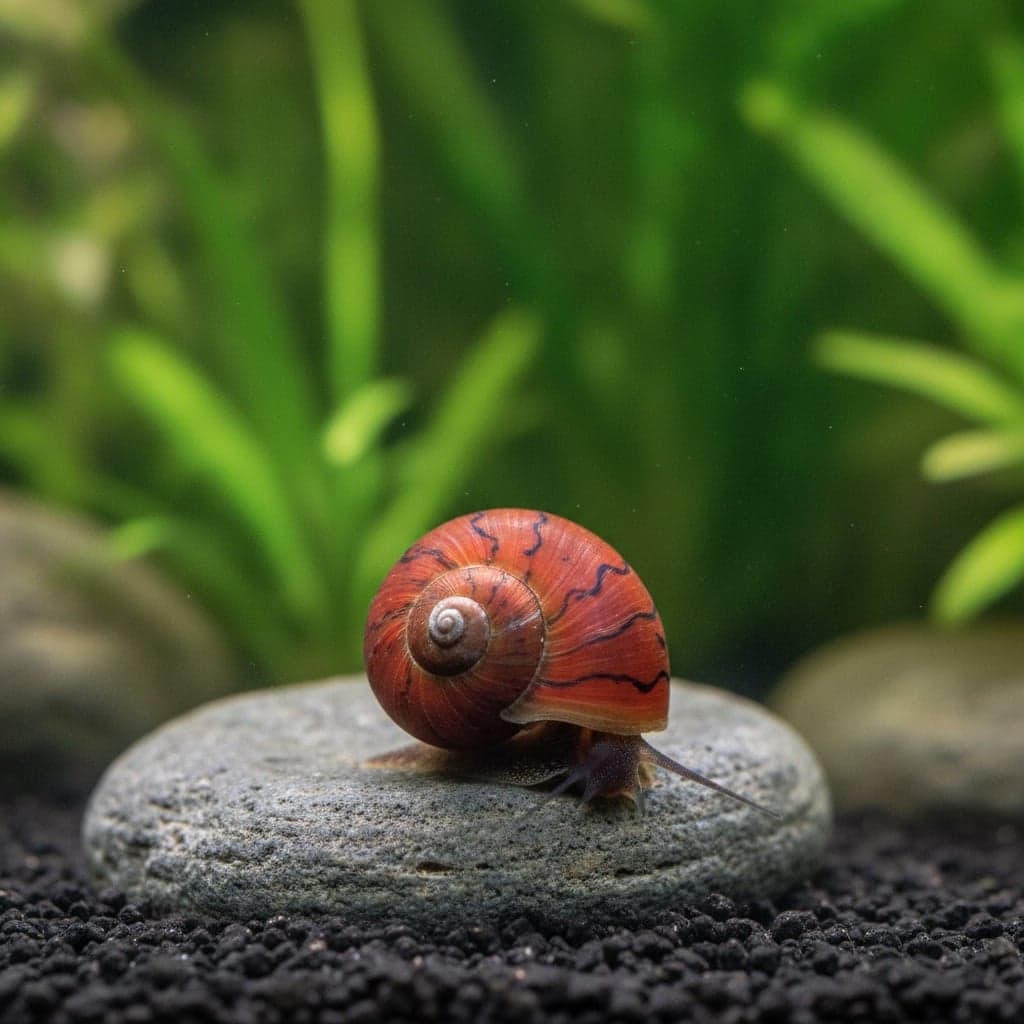
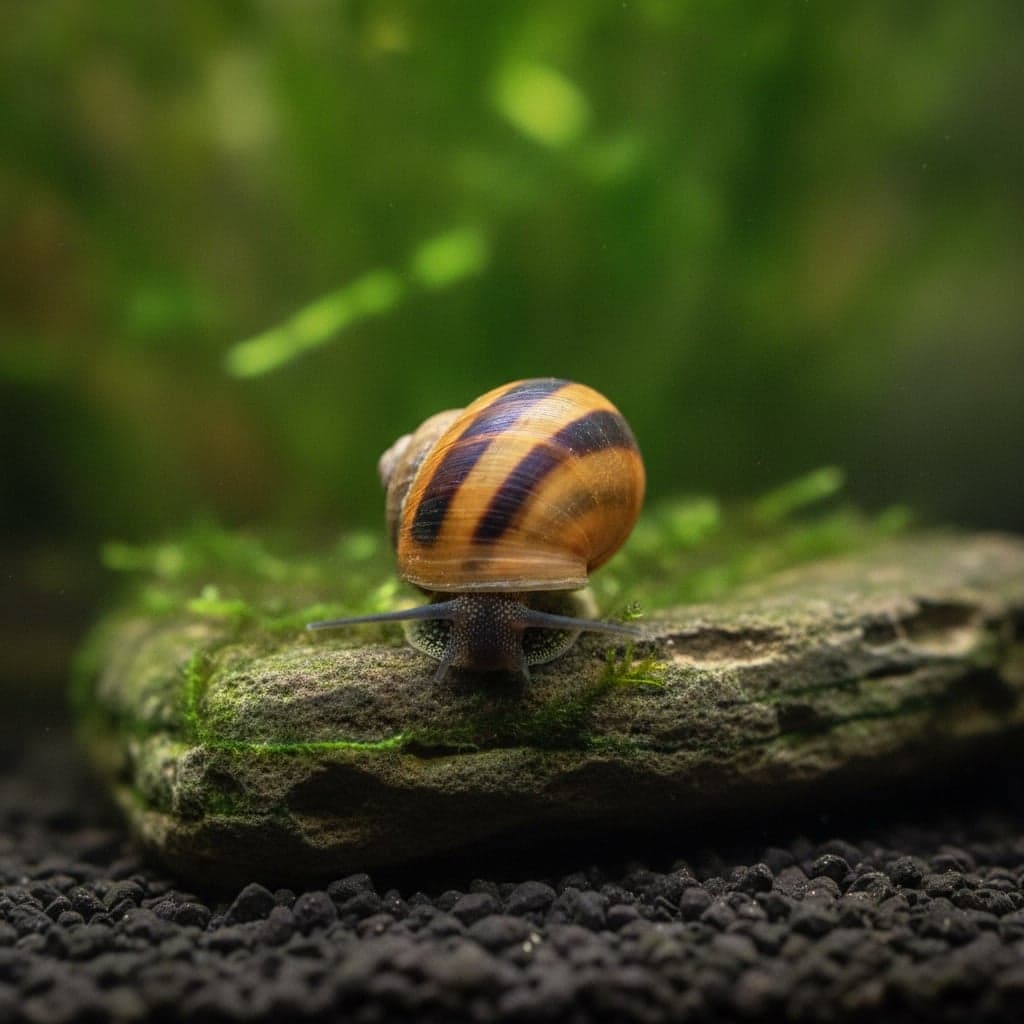
All nerites share the same care requirements, so the choice comes down to shell pattern and size. The Horned is the one to pick for tanks under about 40 litres; the olive is the better green spot algae eater and the black military helmet the fastest worker in a big tank. See the nerite snail comparison guide for the full range side by side.
Breeding
Not in fresh water. The larvae require brackish conditions to develop and there is no way to provide that inside a normal freshwater aquarium, so a group of Horned Nerites is a terminal generation however well you keep them.
They lay regardless. The eggs are hard white capsules roughly a millimetre across, cemented to glass, wood, rock and the shells of tank mates, each holding dozens of embryos beneath a calcified cap. They are visually conspicuous on dark hardscape and stubbornly permanent on anything porous — a blade lifts them off glass and nothing much lifts them off wood. Keeping a single snail avoids the problem completely, since nerites do not self-fertilise.
Common Health Issues
Horn wear is the early warning and shell erosion is the endpoint, both driven by insufficient calcium and low pH rather than by any pathogen. The damage is permanent — raising hardness stops the erosion but does not regrow what is gone, though new shell laid down at the lip will be sound.
Copper kills invertebrates at concentrations that do not trouble fish, and the contamination outlasts the treatment: dosed copper binds to substrate, rock and silicone and leaches back into the water for months. Never treat a snail tank with a copper-based ich or snail medication; move the fish to a hospital tank instead. See medications and heavy metals.
The last one is mechanical. A small nerite that falls onto flat sand on its back may not be able to right itself, and one that wedges into a crevice or an intake will die there. Both are avoidable with a glance at the tank every day or two, and a dead snail needs removing quickly — decomposition in a 20-litre tank produces an ammonia spike within hours.