Red Racer Nerite Snail: Vittina waikuku
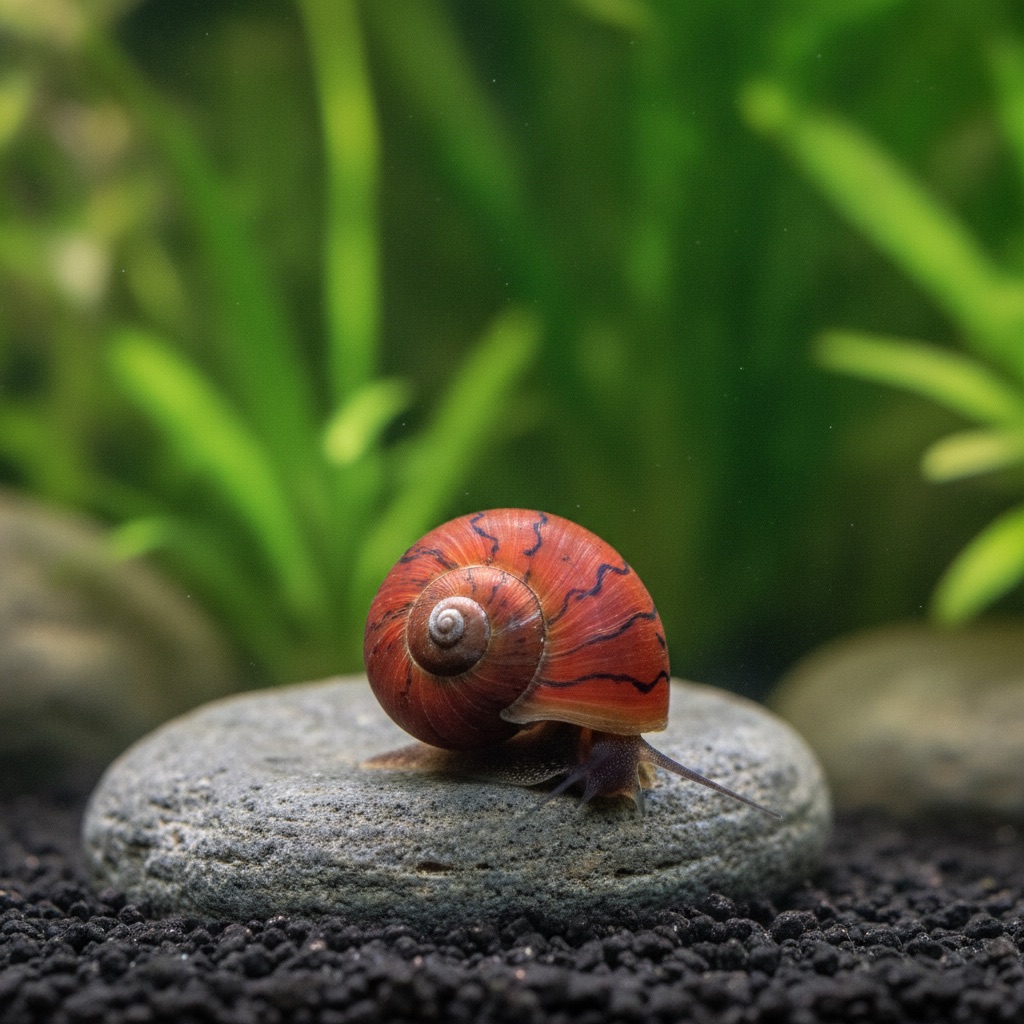
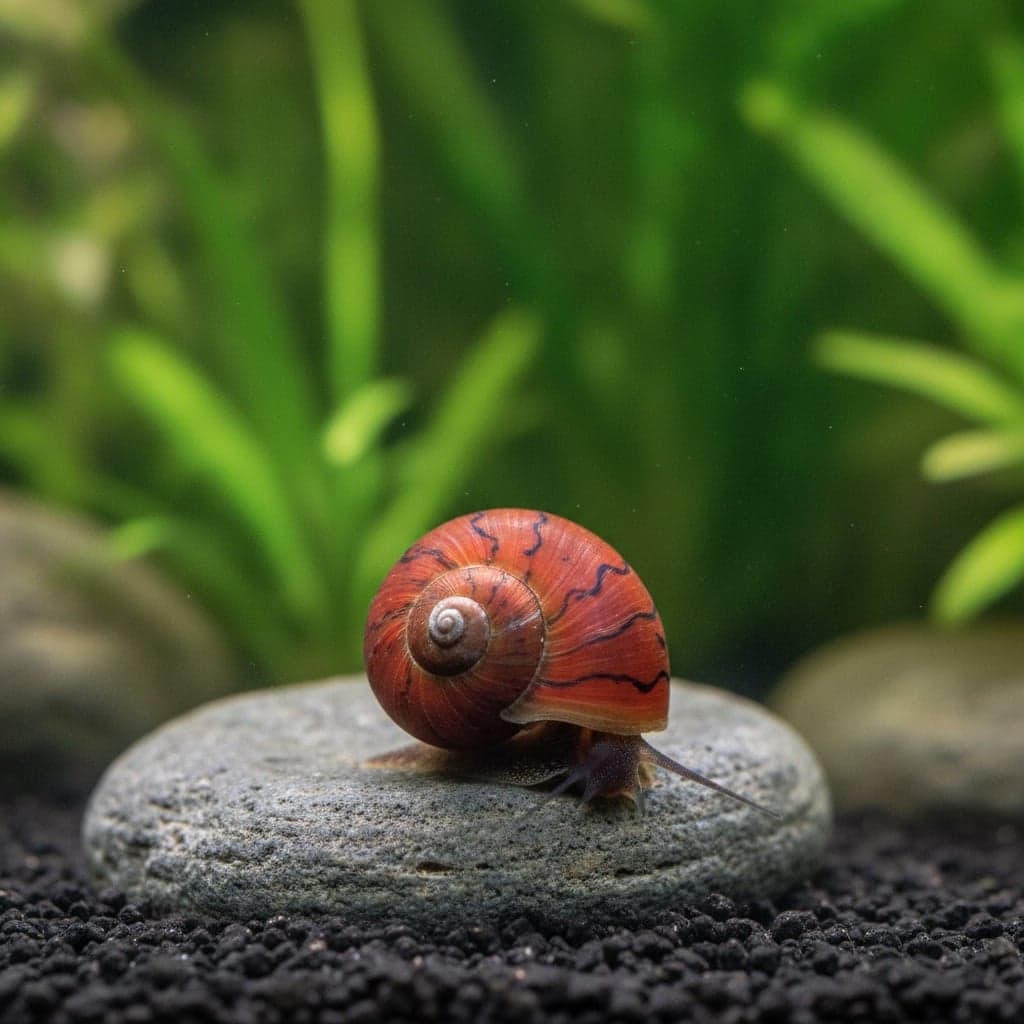
A rust-red shell with fine dark markings, and noticeably quicker across the glass than other nerites — hence the name.
Also known as: Red Racer Snail · Vittina waikuku
Red Racer Nerite Snail
"Racer" is a relative term — nothing in this family is fast — but put a Red Racer on the same pane of glass as a zebra nerite and the difference is obvious within a minute. It covers ground at a visibly higher rate, and it keeps moving in daylight when other nerites have parked in the shade. The shell is a warm rust to brick red, overlaid with fine dark hatching and often a paler band, and the colour holds better against a dark substrate than against pale sand.
The activity is a genuine practical difference and not just a sales line. A Red Racer covers more surface per day than a similarly sized nerite, which makes it the better choice in a tank with a persistent film algae problem — and the worse choice in a clean, mature tank, because it exhausts the available food sooner and starves sooner as a result.
Natural Habitat & Origin
Vittina waikuku is a Southeast Asian species, collected mainly in Indonesia from coastal streams and the freshwater reaches above river mouths. It lives on rock and wood in moving water, which is the habitat that shaped the broad muscular foot and the low, drag-resistant shell shared across the family.
Its life cycle is amphidromous, and this is the single fact that explains most nerite behaviour in captivity. Adults live and spawn in fresh water, but the larvae must reach brackish water to develop: they drift downstream, feed in the plankton for several weeks as veligers, settle out as microscopic snails and then climb back up the river. A closed aquarium supplies the spawning half of that cycle and none of the rest.
Because nobody has industrialised the brackish larval stage, essentially all stock is wild-collected adults. Expect some attrition in the first two weeks that has nothing to do with your husbandry and everything to do with the journey.
Care Requirements
Standard nerite chemistry, and it is not negotiable. The shell is calcium carbonate; soft, acidic water is chemically undersaturated with respect to it and dissolves it faster than the snail deposits new material. On a Red Racer the damage is especially visible because the erosion bleaches out the red — the spire whitens, then pits, then the fine dark hatching disappears into chalk.
Aim for GH 6-12, KH 4 or above and pH comfortably over 7.0. Soft tap water needs crushed coral in the filter or a proper remineraliser; a pH-up product raises the number without adding carbonate and the reading slides back within days. GH, KH and hardness sets out why those are different problems.
Keep a lid on the tank, and mean it with this species. Nerites graze the biofilm band at the waterline and carry on above it, and the most active nerite in the hobby is also the one most likely to be found dried out on the floor behind the cabinet. Keeping the water level a couple of centimetres below the rim helps.
Use the Aquarium Tracker to log these parameters against your own readings — it flags a drift before it becomes a problem.
Diet & Feeding
Film algae, diatoms, green dust and biofilm, rasped off glass, wood, rock and leaves. Like all nerites it will not deal with hair algae or black beard algae, and if that is what you have, a snail is the wrong tool entirely.
Stock lightly. The higher activity rate that makes this snail attractive is also what makes it easy to starve: it works through the standing algae in a 60-litre tank faster than an olive or zebra nerite would, and then it has nothing. One Red Racer per 30-40 litres is a reasonable ceiling in a tank with visible film algae, and fewer than that in a mature, well-lit planted tank where algae never gets a foothold.
Once the glass stays clean between water changes, you are the food supply. Algae wafers, blanched courgette, spinach and cucumber all work, two or three times a week. The tell for a hungry nerite is a thin, pale band of new shell at the lip and long periods of not moving — which on this species, being the active one, is easier to notice than on the rest. Feeding invertebrates covers it in more detail.
Behaviour & Temperament
Peaceful and busy. It is the nerite you actually see working, since it does not retreat under the hardscape during the photoperiod the way the darker-shelled species tend to. It ignores fish, ignores shrimp and does not damage plants — the radula cannot break an intact leaf cuticle, so a Red Racer on an anubias leaf is cleaning it.
Give it texture to work over. On bare glass and a plain substrate it patrols the same panes repeatedly; with driftwood and rock it distributes its grazing across the tank and gets more out of the same food supply.
Tank Mates
Any peaceful community. It coexists happily with dwarf shrimp — cherry shrimp and the colour lines want the same mineral content — and with small schooling fish such as harlequin rasboras and ember tetras.
Avoid the snail specialists. Pea puffers, clown and yoyo loaches, and assassin snails will kill nerites; larger cichlids chip at the shell aperture until the animal dies of the injury even when they cannot extract it.
Choosing between nerite varieties
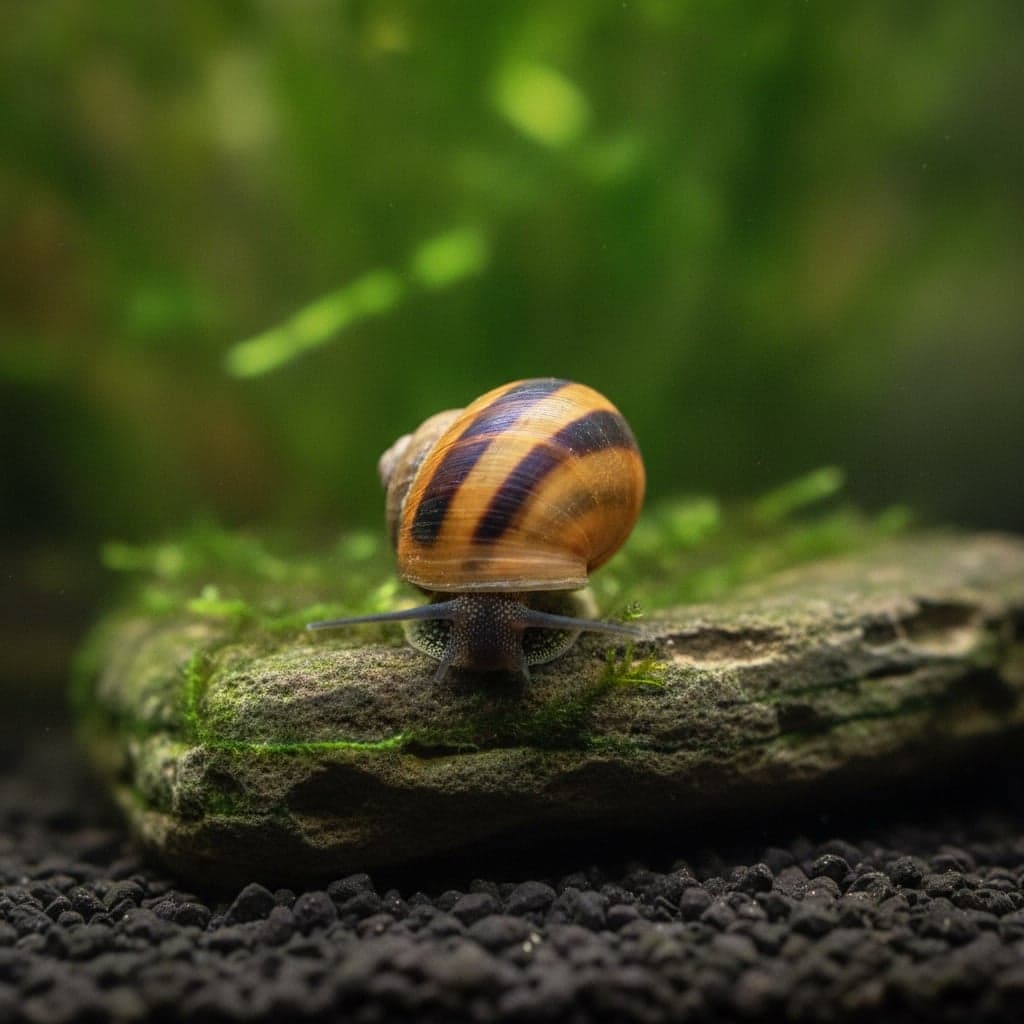
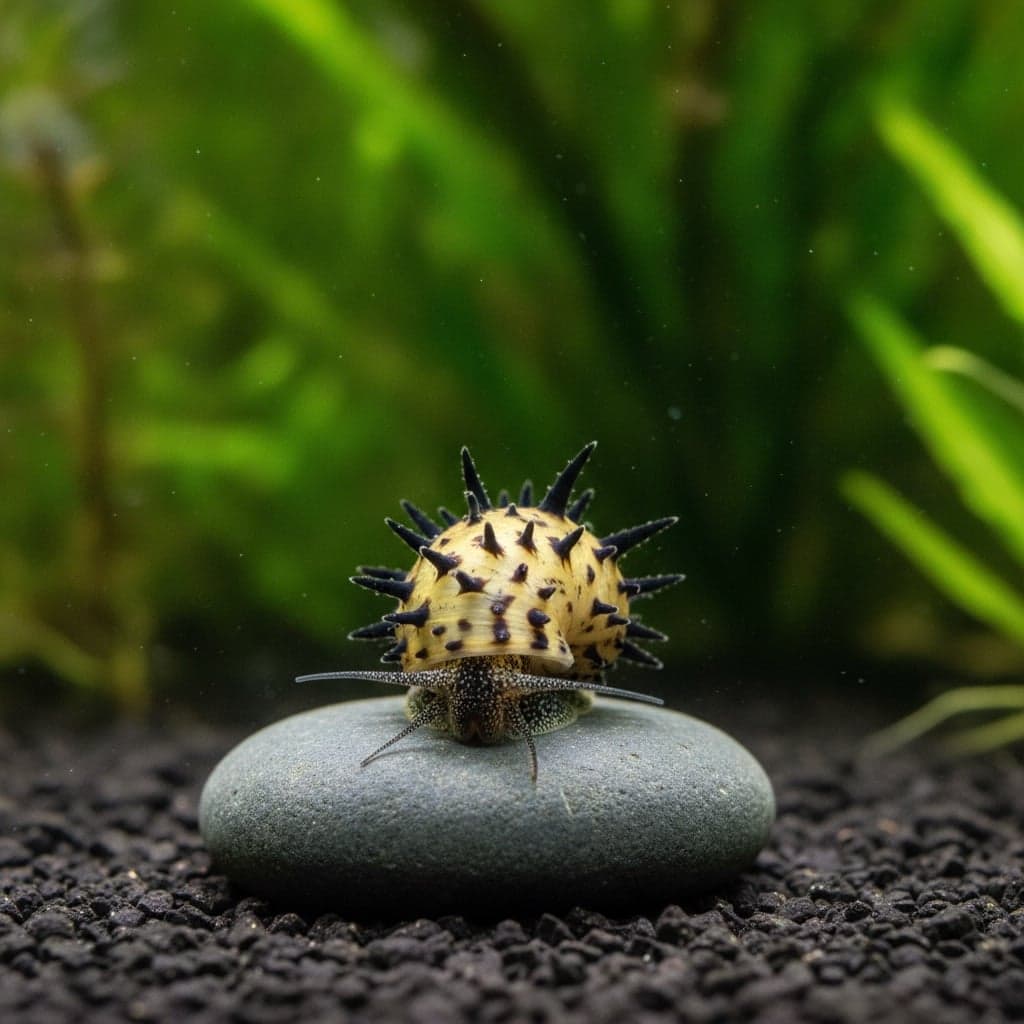
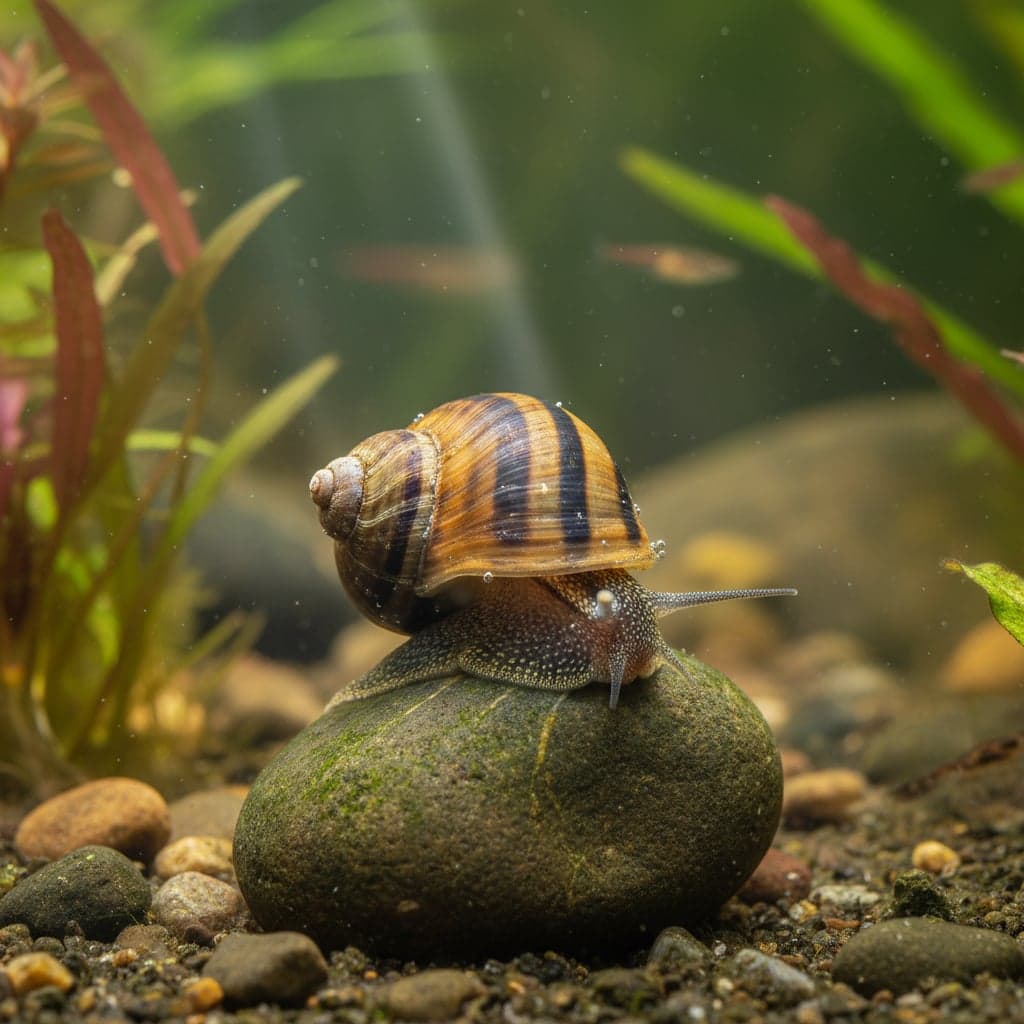
All nerites share the same care requirements, so the choice comes down to shell pattern, size and pace. The Red Racer is the one to pick when you want visible activity and have the algae to sustain it; the olive is the green spot specialist, the horned the nano option. See the nerite snail comparison guide for the full range side by side.
Breeding
It does not reproduce in fresh water. The larvae need brackish conditions and a home aquarium cannot provide the downstream half of the life cycle, so a group of Red Racers is the last generation you will have.
They lay eggs anyway, and being active animals they distribute them widely. The capsules are hard, white, roughly sesame-sized ovals cemented onto glass, wood, rock, plant leaves and other snails, each containing dozens of embryos beneath a calcified lid. They will not hatch and they will not wipe off — a blade removes them from glass, but on porous surfaces they are permanent. A single snail lays nothing at all, since nerites do not self-fertilise, so keeping one is the only reliable way to avoid the eggs.
Common Health Issues
Shell erosion in soft or acidic water, which on a red-shelled species shows as bleaching before it shows as pitting. Correcting hardness stops the progression but does not restore the lost shell; growth at the lip comes in sound.
Copper is lethal to invertebrates, and the problem outlasts the treatment. Copper-based ich and snail medications kill nerites at doses fish barely register, and the copper then binds to substrate, rock and silicone and leaches back for months. Treat fish elsewhere — medications and heavy metals go into it. Most planted-tank fertilisers are fine at label dose, but check the trace mix before overdosing anything.
Beyond that, the failure modes are mechanical and behavioural: escapes over the rim, animals stranded on their backs on smooth sand, and the slow starvation of an over-efficient grazer in a tank that has run out of algae. Any snail that stays sealed and detached from a surface for more than a day should be checked, and removed if it has died, before it spikes ammonia.